








We couldn’t find what you are looking for. Please try another way.
Life at Multiverse
Thank you! Your submission has been received!
Oops! Something went wrong while submitting the form.
Meet Multiverse’s new Chief Product Officer
Life at Multiverse
Team Multiverse
A native New Yorker with a career built at the intersection of culture and technology, Jay’s fingerprint is on some of the most foundational tech products of the last two decades. From the early days of Hulu to a decade-long tenure helping scale Spotify from a startup to a global powerhouse, and most recently leading AI-driven commerce systems at Amazon, Jay has a proven track record of finding the next before it becomes the now.
Now, he’s moved to London to lead the next phase of the Multiverse product journey. We sat down with him on his first day to talk about his bet on the future of AI, the cultural discipline of dogfooding, and the lessons in timing he’s carried from Spotify and Amazon to Multiverse.
As you start this new chapter at Multiverse, what’s one cultural ritual you’re excited to establish to ensure we keep building at the highest possible standard?
Dogfooding.
We should never subject customers to an experience we would not subject ourselves to. If we are lifelong learners, we should be taking the courses we offer and using the products we build as real customers do.
If something frustrates us, confuses us, or feels harder than it should be, we fix it. And we fix it quickly.
We are only as good as the product we put into the world. There is no such thing as a great team building a bad product. And there are no great products that emerge by accident from teams that are not deeply invested in the experience.
To be truly customer obsessed, we have to live with our products every day. We should feel embarrassed when they fall short and genuinely proud when they delight.
That discipline is how high standards become a habit.
Every great CPO leaves a fingerprint on the team they lead. When you look back two years from now, what would you like Multiverse to be known for in the tech community?
I’d like Multiverse to be known as the company that took a different bet.
While much of the tech industry is focused on humans making machines smarter, Multiverse focused on building machines that make humans smarter.
I’d want us to be known for proving that AI can strengthen judgment, accelerate learning, and expand human capability in real work, not just automate tasks or generate outputs. For building systems that people trust because they genuinely make them better at what they do.
If the tech community looks at Multiverse and sees a company that chose depth over hype, capability over convenience, and long-term human impact over short-term efficiency, that’s a fingerprint worth leaving.
That reputation would matter more to me than any single product or feature.
Describe your career in your own words.
I’d describe my career as a long arc of building at the edge of what’s next, and learning a lot about timing along the way.
I’ve always been drawn to inflection points. Moments when technology shifts behavior, but the path forward isn’t obvious yet. I tend to spot those trends early and lean into them, even when the outcomes aren’t guaranteed.
Sometimes that meant being too early. Early in my career, I worked on one of the very first consumer mobile apps built for the Palm Pilot pre-smartphone era. The idea was right, but the world wasn’t ready. The devices needed cellular connectivity, a real app ecosystem, and infrastructure that simply didn’t exist yet. That experience taught me an important lesson: innovation isn’t just about seeing the future, it’s about understanding what needs to be true for it to arrive.
Other times, it meant being early but patient. I was part of the launch of Hulu, one of the first major video streaming platforms. While the direction was obvious, mainstream adoption took years to develop. Consumer behavior had to catch up and the industry needed time to recalibrate.
At Spotify, the timing was different. The world was ready after Napster. People clearly wanted on-demand access to music. But the business model didn’t exist yet. That challenge required innovation across product, monetization, creator economics, and licensing. It wasn’t just about building a great experience, it was about inventing a system that could sustain it.
More recently at Amazon, I’ve been working exclusively on AI products since the moment ChatGPT launched in November 2022. What immediately stood out to me was not just the capability of the technology, but the speed at which it would reshape work itself. That recognition has driven my focus ever since: not just on what AI can do, but on how it changes skills, roles, and expectations.
Looking back, the common thread is a deep curiosity about where things are going, a willingness to act early, and a growing appreciation for timing, execution, and systems that can turn breakthrough ideas into lasting impact.
What’s your fun fact!
The first time I ever went skiing was in college, and I did it in the least sensible way possible.
I had never skied before. I’d never taken a lesson. I joined the ski club anyway, bought second-hand boots and skis that were far too long, wore jeans, a thin shell jacket, no helmet, and went out on opening night.
It was about -29°C, after dark, and the only trail open on the mountain was a double black diamond.
It took me nearly two hours to get down. Every crash meant my skis and poles were scattered somewhere uphill, so I had to hike back up to collect them before continuing. When I finally made it to the bottom, exhausted and frozen, I got back on the lift and went again.
I’m not sure what that says about me, or how “fun” the fact really is, but it’s one of those stories people tend to remember.
Jay’s arrival marks a new chapter for our Product and Engineering teams, one defined by high standards and a relentless focus on human-centric AI.
If you are a builder who wants to join us on our journey, we’re hiring across our Tech team. Click here to see our live jobs.

The Future is… Built in a Week: Inside Multiverse’s Latest Hackathon
Life at Multiverse
Jafar Soltani, Senior Director of Engineering
That’s why, at the start of last quarter, we decided to put the roadmap "on ice" for one week. We paused our standard tickets for our bi-annual Hackathon, inviting everyone across the Tech org, including Engineers, Product Managers, Designers, Security, Data Privacy, and IT to come together and build something new and innovative.
The theme? "The Future is..."
To get into the right headspace, we left our usual desks and set up shop at a dedicated space external to our Paddington office. Tool-wise, we used Backstage, our internal developer portal, in addition to the SkillExchange plugin to crowdsource ideas.
The result? 25 distinct pitches
On the Thursday before the event, idea owners pitched to the group, rallying teams around their vision. We then kicked off Monday with our VP of Engineering, Helen who set the goals for the week. But we didn't just want to code; we wanted to learn. We invited guest speakers from Tessl to discuss evaluating AI agents, and Cursor to share best practices on leveraging AI for product and engineering workflows.
With teams formed and skills matched, the middle of the week was dedicated to deep work. The energy was electric. Teams mixed seniority and discipline; mid-level developers leading discussions and Product Managers getting hands-on with the code.
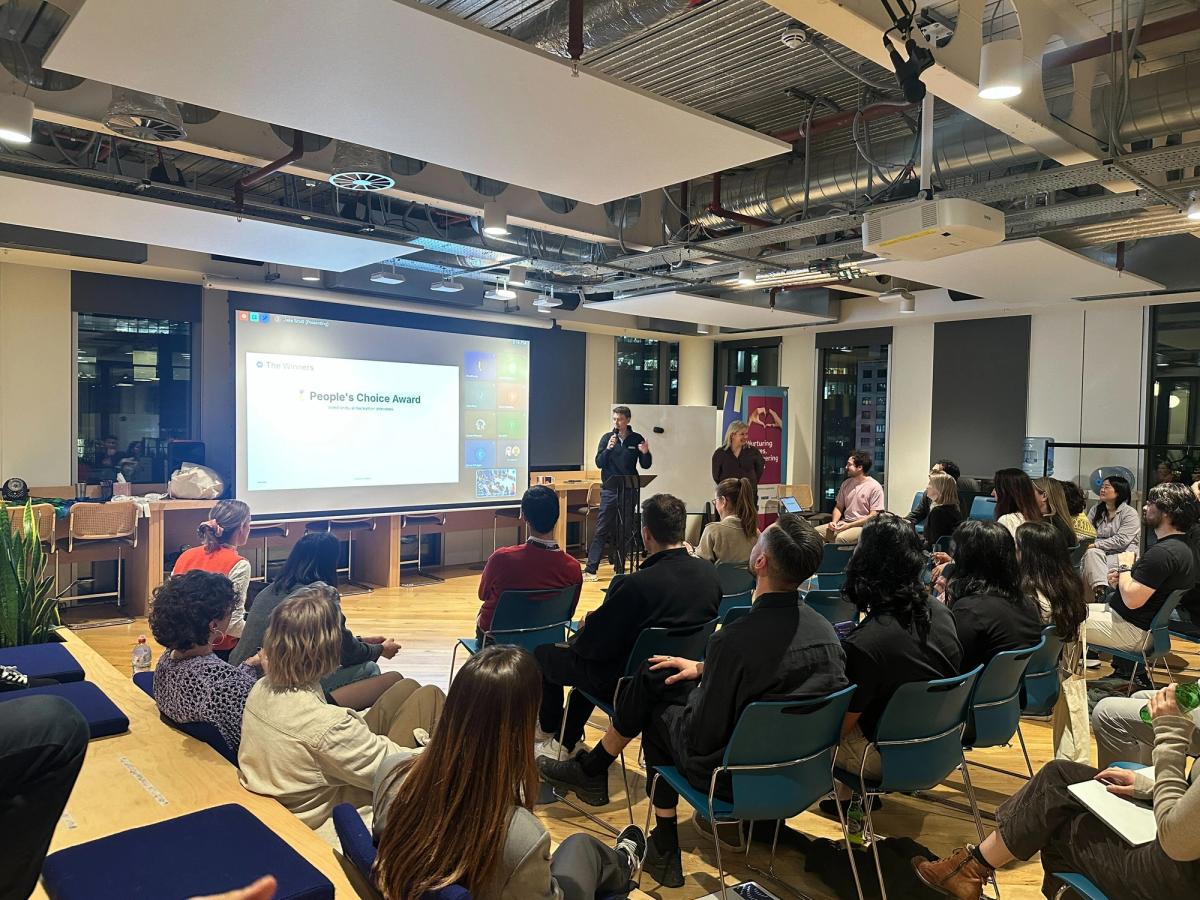
We saw a massive surge in AI adoption and Developer Experience tooling, balanced with a strong focus on directly improving the experience for our customers and learners, here are some examples:
- Learner experience: Many projects focused on improving the learner experience, such as linking learning directly to a learner’s project problems, personalising content for greater relevance, and designing gamified journeys that reward progress to drive daily engagement.
- AI agents and knowledge capture: One team designed a multi-agent system to automate support ticket research. Another team built bots to reduce repetitive Slack questions. Two groups tackled the challenge of retaining "tribal knowledge" by using Retrieval-Augmented Generation (RAG), unifying various scattered sources and transforming every GitHub PR and Linear Ticket into queryable institutional knowledge, not only improving developer experience but accelerating onboarding time for new joiners.
- DevEx wins: Teams built tools to automate code changes across multiple repositories, and smart test-selectors that identify exactly which tests to run based on codebase changes.
Thursday was the finale. Every single team presented a strict, three-minute pitch to show what they built in just three days.
Our Founder and CEO, Euan Blair, joined senior leaders from our Tech and Customer Success organisations to judge the projects across three specific categories:
- Most Impactful: How significantly does this improve the experience for customers, learners, or employees?
- Most Innovative: Does this push boundaries? Does it use AI in a novel way?
- Most Likely to Ship: How feasible is this? Can we realistically implement it?
We also had a People's Choice Award, voted on live by all hackathon attendees.
The shining light of the week though, in addition to the seriously impressive work in just a couple of days, was the collaboration and team culture we saw. Seeing people who might not usually work together, the diversity of opinions, and watching mid-level devs step up to lead complex projects was the real win.
“What stood out most was the speed to prototype, curiosity, collaboration, and care our teams brought to every idea. Seeing everyone learn from each other, explore new possibilities, and have fun together reminded me why moments like this are so special!”
- Helen, VP of Engineering
We aren't letting these ideas gather dust. We have already reviewed these to decide how best to productionise them and officially add them to our roadmap.
Does this sound like the kind of engineering culture you want to be part of? We are actively hiring in Tech, see live roles here.

Joining forces to shape the future of work: Multiverse acquires StackFuel
Life at Multiverse
Team Multiverse
We are thrilled to announce that Multiverse is officially expanding into Germany through the acquisition of StackFuel, the country’s top-rated data and AI training provider.
For anyone looking to join a company that is not just growing, but actively reshaping the European economy, there has never been a more exciting time to be here.
Our Growth Trajectory
This expansion comes at a time of strong momentum for Multiverse:
- Financial Strength: We recently surpassed the $100 million annual revenue milestone.
- Accelerating Growth: We’re adding more than 100 roles to our team this quarter.
- Operational Excellence: Alongside this growth, our EBITDA continues to improve, proving that we are building a sustainable, high-impact business for the long term.
The Mission: Solving Germany’s Digital Skills Gap
Germany is Europe’s largest economy, built on a foundation of industrial excellence. However, even the strongest economies face challenges. Currently, the German economy is at a crossroads: by 2040, it is projected to have a gap of over 660,000 unfilled IT roles, specifically in Data and AI. Six out of ten workers will need significant reskilling by 2030 just to keep pace.
The demand for change is coming from the ground up, but the supply isn't there yet: While more than 61% of German employees say they want AI training, only 5% of German companies currently provide it to all their employees.
This is where Multiverse comes in, to do what we do best: bridge the skills gap through high-quality upskilling programmes.
Why StackFuel?
To kick-start our entry into the German market, we knew we needed a partner that shared our values and our commitment to excellence. StackFuel is the leader in German data and AI training, bringing with them:
- A Proven Track Record: A reputation as the country’s top-rated training provider, with a 92% completion rate on their programmes.
- Practical learning: Their commitment to hands-on learning mirrors our own, with 90% of their training occurring in real business environments.
- Enterprise Relationships: A prestigious roster of Germany’s leading enterprises already using their platform, including Mercedes-Benz, Telefónica, Telekom, Siemens, and Miele.
- Government Trust: StackFuel holds the AZAV accreditation, the gold standard for government-funded training in Germany, providing regulatory funding for upskilling.
- Expert Talent: A team of specialists who understand the local market and the nuances of the German industrial landscape.
By combining Multiverse’s advanced AI expertise and financial firepower with StackFuel’s deep-rooted trust and reputation, we are creating a powerhouse capable of equipping the German workforce with the tools they need to thrive.
100,000 Careers, Transformed
Together with the StackFuel team, we have set a bold, immediate goal: to train 100,000 German workers.
This is the kind of scale and impact that defines Multiverse. We are building the infrastructure for the future of work, and we’re doing it across borders.
Join Us on the Journey
For those looking to build a career with impact, there has never been a more exciting time to work at Multiverse. When you join us, you are joining a company that is:
- Scaling rapidly: We are expanding our reach to help more people solve problems and unlock efficiencies through AI.
- Mission-driven: We believe our social contract depends on empowering everyone to benefit from AI opportunities.
- Innovation-focused: We derive learning goals from corporate strategies to ensure we are delivering the most relevant, future-ready skills.
As we scale our operations across Europe and continue to innovate in the AI upskilling space, we are looking for builders, thinkers, and changemakers to join our team. If you want to work at a company where your contributions move the needle on a global scale, we’d love to meet you.
Career Mobility at Multiverse: FY25 Update
Life at Multiverse
Serena Vaughan, People Enablement and Career Mobility Lead
We partner with over 1,500 of the world’s leading companies to build the critical skills their people need for the future, focusing on the AI, data, and technology capabilities that drive transformation. We believe this is the most direct path to unlocking both business growth and profound economic opportunity for people.
Our mission is brought to life internally through our Career Mobility strategy. It’s our commitment to our own team, built on the same principles we champion externally. Career Mobility is how we drive high-performance, create clear development pathways, and enable Multiversers to become their most AI-enabled selves.
Career Mobility 2.0
When we launched our Career Mobility strategy, we identified gaps in our approach to Diversity and Inclusion. As a result, our focus in 2024-2025 was mastering the tactical layer - specifically, further improving our performance and development ecosystem, and strengthening our culture of belonging.
Career Mobility represented an evolved approach, where equitable principles were embedded into our people strategy, instead of existing alongside it - to improve outcomes for all employees, including those from under-represented backgrounds, as a result.
For 2025-2026, we’ve simplified our framework to focus on two pillars, Empowered Careers and Empowered Culture.
Where is Multiverse today?
Our Data:
We focus primarily on collecting data related to characteristics which are protected under the law. As a result, our current focus areas are gender, ethnicity, disability (and neurodiversity), sexuality, religion and belief, and age. We also collect additional data including socio-economic status (social mobility), armed forces status and history, and parental and caregiving status because we believe this data is important in assessing our policies, processes, and benefits. The data in this report is a reflection of Multiverse as of July 2025.
Gender

49% of our population identify as women, surpassing the 29% of women in the UK tech sector, and 28% of women in US tech.
We know that one of the key drivers of our gender pay gap is representation of women at Director and above levels. 45% of our Director+ employees identify as women and 50% of our external hires at this level were women in FY25.
Since April 2024, we have appointed a new COO, CFO, both of whom are women, and appointed our Chief of Staff & Chief Performance Officer to the C-Suite team. This means our Executive team is currently gender balanced, which is something we are proud of. To put this in context, women occupy 43% of board positions and 35% of Leadership roles at the FTSE 350 level (source).
Ethnicity

56% of our global employees identify as White, compared to 68% in April 2024 - while 26% of employees identify as being from an underrepresented ethnic background vs 32% in April 2024. We attribute these shifts being primarily due to new joiners not completing our voluntary HRIS survey - something which we’re actively working to improve.
Despite this, we remain in-line with the UK Tech industry, where 25% of employees identify as being from an under-represented background. 7.5% of our employees identify as Black, compared with 5% in UK tech, however 9% of our employees identify as Asian which is below the 18% average in UK tech.
Our hiring data shows that our employee base reflects the diversity of our applicant pool, and that there are no stages in our recruitment process where we see disproportionate drop-out rates.
Sexuality

We’re proud that 13% of our employees identify as LGBTQ+, increasing from 12% in April 2024.
A comparative data set for sexuality was unavailable.
Disability & Neurodivergence


Our declaration rate for disability has significantly improved since April 2024, meaning around 5% of our workforce identifies as having a disability (physical, mental health, or learning-related). While this is just below the average of 6% in UK Tech, this has increased from 3% in our previous report.
Separately, almost 15% of our employees identify as neurodivergent. This is significantly above the 3% reported by UK Tech employers and is in line with the UK population figures.
Career Mobility in Action:
Case Study: Count Me In
In our first Career Mobility report, we identified that our voluntary employee census did not capture the information we needed, and that the majority of our employees had not self-declared.
To address this, in 2024, we refreshed the voluntary diversity questions we ask employees, to ensure we were in line with best practice and only collecting relevant and useful data. We now ask 11 global questions, with 3 additional UK-specific and 2 additional US-specific questions. This was a rigorous process, involving external research and benchmarking, and consultation with employees.
At the same time as refreshing our question set, we launched Count Me In, a campaign which aimed to increase declaration rates by educating employees on why we ask these questions and sharing in detail how the data is used. In the two-week campaign period, our average declaration rate increased from 46% to 65% - a result we are incredibly proud of and hope to build on. Already, this campaign has positively impacted employees; for example, we have increased our UK paid secondary partner leave (paternity leave) from 4 weeks to 6 weeks for employees with over two years tenure, the business case for which was supported by Count Me In data.
We’ve also since aligned the voluntary questions we ask in the recruitment process to align with our new internal survey as well.
Case Study: Lift All Boats
In line with our new mission of ‘equipping the workforce to win in the AI era’, we launched Lift All Boats in Q2 as part of our journey to enable every Multiverser to become the most AI-enabled version of themselves.
The first building block for this was Everyday AI, 90-minute interactive hands-on sessions, where the average attendee saves 4 hours/week on their work This session is built for those new to or experimenting with Gemini - no prior AI knowledge is assumed. Our expert coaches work with participants to show different prompting techniques and tailored use cases to help employees think about how they can start applying AI to their work.
This was followed by AI Skills Accelerator (AISA), a custom, 12-hour, 4 module AI course hosted in our Learning Platform and delivered by our expert coaches/instructors, as well as further Everyday AI sessions covering AI automations, NotebookLM and Advanced Gems. AISA was built for Multiversers looking to build their knowledge of AI, learn how to prompt effectively and understand how to implement data in their usage of AI and ultimately augment their ways of working at Multiverse.
To date (Oct ‘25), 537 and 184 Multiversers have taken part in Everyday AI and AISA respectively, with an average increase in Gemini usage of 24% above the rest of the business.
Case Study: ERGs at Multiverse
As well as equitable policies, processes, and practices, building an inclusive culture is a key focus for Multiverse because we know this enables and inspires our people to perform.
We currently have four ERGs:
- Black@Multiverse
- Disabilities@Multiverse
- LGBTQ+@Multiverse
- Women@Multiverse
Everyone is welcome to join our ERGs and participate in ERG initiatives, even if they do not identify as part of the community the ERG represents. MV ERGs have held 15 global events ranging from ‘Irrational Ways to Influence People’ to ‘The ABCs of LGBTQ+’, ‘A Fireside Chat with Financial Adviser and Author Bola Sol’ and ‘Championing Neurodiversity’.
Alongside events, ERGs have collaborated with the People team on key projects. Feedback from our Women@Multiverse ERG led to a complete refresh of our maternity leave process, including a new internal page with detailed checklists for employees and managers to use before, during, and after leave, as well as a new ticketing system to reduce pain-points for mothers and birthing parents.
What’s Next?
We are continuing to embed Career Mobility further into our People team strategy, for example:
- Employee consultation as part of the scoping phase of relevant projects, such as the Manager Success Series, where ERG members were among a pool of employees invited to take part in a pilot group, and our launch of Operating Principles, where ERG members have taken part in focus groups to support us in launching and embedding these critical behaviours.
- Continuing to Lift All Boats and bring AI opportunities to Multiversers, through:
- Bespoke AI onboarding, tailored to where new joiners are in their AI journey.
- An internal Multiverse cohort, completing a real MV AI apprenticeship.
- Creating an AI SWAT team to help teams across Multiverse build scaleable, effective AI solutions to real business problems.
- Introducing certified AI Builders internally, who can become the AI experts in their teams and have additional training around AI governance and ethics, as well as technical training.
We believe that by driving systemic improvements over the long term, we can create lasting impact for our employees and win as a business. Career Mobility provides the structured, equitable framework we need to build an inclusive, high-performing and resilient organisation, which is truly AI-first.
Multiverse Operating Principles: The blueprint for winning in the AI Era
Life at Multiverse
Team Multiverse
This is not a theoretical goal, it’s the driving force behind everything we do. Today’s workforce needs new skills to thrive, and without them, organisations and their employees will get left behind. We are going to transform both how our customers operate with AI, and crucially, how we operate with AI.
To do that, we’ve intentionally and strategically shifted our culture and established four new, highly actionable Operating Principles that define our standard of performance.
These principles aren’t just aspirational - they are embedded into how we work, how we hire, and how we measure performance at every level of the organisation. So if you’re joining the team or considering a role at Multiverse, be sure to read and understand how they might apply to your work.
The Operating Principles
These principles are an integral part of how we define high performance and potential. When we interview you, when we onboard you, and as you grow here - this is the standard we’ll measure against.
1. Solve for Customer Value
Every decision starts with: how does this create value for our customers?
We aren’t building Multiverse for ourselves. We’re doing it for the people who need and use the transformative upskilling that we make happen. Your work, regardless of your role, must connect back to our customers.
- The Multiverse Standard: You define the customer problem and the value of solving it before you start work. You choose the path that creates the most customer value, even when it’s harder.
- What we avoid: Measuring success by activity (features shipped) instead of customer outcomes (problems solved). Every workstream starts with a clear line of sight to the customer impact.
2. Drivers, Not Passengers
Be an owner, take accountability, and drive outcomes, while taking others along the journey.
We value accountability and proactively taking charge of your work, your career and the business’s success.
- The Multiverse Standard:You don’t duck the hard conversations - instead, you “Bottom line it”, which means solving problems the right way, not the easy way.
- What we avoid: Building for individual or department priorities over the business' best interest. You withhold bad news because it’s uncomfortable to deliver.
3. Be Decisive, Even in Ambiguity
Be bold: don’t stifle innovation through a fear of making the wrong call. Speed is the strategy.
To thrive in the rapid development cycle of the AI era, we must operate with velocity, valuing swift action over total certainty.
- The Multiverse Standard:We provide clarity on ownership so that everyone knows what decisions they can own. You embrace a test-and-learn mindset, finding opportunities to try out solutions and converting successful ideas into quality impacts. You course-correct quickly, and you challenge ideas early.
- What we avoid: Letting the fear of reversing a "fast" decision stallmomentum. We don't begrudge ambiguity, because change is part of Multiverse; we see it as an opportunity to own a problem and design a solution.
4. AI to Deliver Outcomes
AI is our engine, not an add-on. We become the defining case study for our customers.
This principle complements our ongoing transformation to being an AI-first business, ensuring we attract people that are AI-enabled, and willing to go on the upskilling journey to stay ahead of the curve.
- The Multiverse Standard: You ask “How would AI do this?” before starting any process improvement. You rethink existing problems as opportunities for design, not just resource, and explore AI solutions first. You demonstrate continual curiosity in AI, proactively upskilling,and always applying an ethical and compliant approach.
- What we avoid: Failing to engage with our AI-first approach or resisting AI-driven changes to workflows. We don't treat AI as a convenient tool, but rather as the core redesign approach for everything we do.
This is our operational standard for career and company success in the AI era. These four principles are how we deliver on that promise. If you’re excited by the challenge of transforming how the world works, and if you can embody these behaviours in our hiring process and beyond, then you are ready to lead the charge of transforming the workforce for tomorrow - here at Multiverse.

Ready to Win in the AI Era? Join Multiverse: The Upskilling Platform for AI Adoption.
Life at Multiverse
Team Multiverse
We are the upskilling platform for AI adoption, and that begins right here, with our own team. If you're looking to not just participate in the AI revolution but to lead it, you've found your home.
Why AI at Multiverse is different: Your opportunity to drive impact
We're taking a fundamentally different approach to AI. We don't just talk about AI, we embed it into our very DNA. Our commitment to upskilling for AI adoption isn't just for our customers; it's a core part of how we build our own world-class team.
We understand that AI skills are in high demand, and they come at a premium. But we also recognise that when a technology is advancing as fast as AI, a willingness to continually learn is just as crucial as existing skill. Without constant upskilling, even those who are advanced in AI today stand to fall behind.
Our unique approach to hiring and onboarding ensures we bring in not only individuals who are already proficient in AI, but also those who possess the curiosity and drive to explore its possibilities.
How we're investing in your AI journey: Consequential growth from day one
We're evolving our hiring and onboarding to ensure that every new Multiverser is set up for success in an AI-driven world. Here’s how our unique approach will benefit you, delivering tangible, measured outcomes for your career:
Smarter hiring: Recognising your true AI potential
Our enhanced interview process goes beyond basic checkboxes. We've integrated AI acumen into our core competency framework, assessing your proficiency with a nuanced, tiered approach:
- Foundational Skills & Explorative Mindset: You're keen to learn and ready to engage with Generative AI tools. Your "will" to embrace AI is what matters most here.
- Deeper Expertise & Frequent Use: You consistently use AI tools in your work and demonstrate a solid understanding. Here, we're looking for both your "skill and will."
- High Proficiency & Leadership: You're not just using AI; you're leading the way, pushing boundaries, and inspiring others. We see you as an AI leader.
This tailored assessment, incorporated into our interview questions and tasks, means we understand your starting point and can better support your growth, aligning with our commitment to driving impact through learning.
Bespoke onboarding: Accelerating your AI capability with impact
Forget generic training. Once you join Multiverse, your AI journey is personalised based on your assessed skill level, ensuring you get the most relevant and impactful development from day one:
- Pathway 1: If you're coming in with a strong "will" and foundational AI understanding, we'll fast-track your learning. Within your first three months, you'll complete four essential "Everyday AI" modules and dive into our intensive "AI Skills Accelerator" programme. This pathway is designed to rapidly upskill you, transforming your curiosity into concrete capability and demonstrating our belief that learning should drive impact.
- Pathway 2: For those with deeper expertise and a track record of high proficiency, you'll directly engage with the "AI Skills Accelerator" in your third month. This timing ensures you have the foundational business context to apply your advanced AI skills for maximum impact, making you an immediate driver of innovation.
This isn't just about training; it's about cultivating a workforce that is truly AI-proficient and future-ready, embodying our mission to empower the workforce with AI. We're committing to helping you become the most AI-enabled professional in your field, unlocking new levels of productivity and innovation.
Join us: Shape the future of work with multiverse
If you're ready to be part of an organisation that genuinely invests in your growth and empowers you to lead in the AI era, Multiverse is the place for you. We're not just hiring for today: we're hiring for the future, and we invite you to build that future with us.
Reporting our Gender Pay Gap 2024
Life at Multiverse
Paige Rinke, VP People & Talent
Headlines
- Our mean pay gap increased in 2024 to 13%, however, this remains lower than the average gender pay gap in comparable sectors, which is 16%.
- Our mean bonus gap declined slightly compared to 2023, and our median bonus gap was negative for the first time. Only 37% of reporting employers have a negative median bonus gap.
- In 2024, representation of women in our senior leadership roles declined; however, we have made a number of significant appointments since the 2024 snapshot date.
- We continue to see increased representation of women across our Tech team for the second consecutive year, with 39% of our Tech team identifying as women in 2024 (an 8% increase since 2022).
- The median gender pay gap for our Sales team was 0% in 2024. Even considering the varying effect that Sales commissions have on pay gap figures, this is something we are proud of.
The Gender Pay Gap explained
First - some technical bits. The gender pay gap is the difference between the average hourly pay of men and women within an organisation. The UK government requires businesses with 250 or more employees to report on the following metrics each year:
- Hourly pay gap - mean and median
- Bonus pay gap - mean and median
- Proportion of men and women receiving a bonus
- Proportion of men and women in different earnings quarters
The gender pay gap is distinct from unequal pay, which is illegal in the UK and has been since 1970. At Multiverse, we take active steps to ensure there is equal pay for equal work at all levels within our business, for example, regular pay audits and benchmarking. Reporting on our gender pay gap is an important moment for us to reflect on the initiatives we introduce to embed fairness and equality of opportunity in our business, and whether these are successful.
A note - HMRC specifies that Gender Pay Gap data sets should only include people who identify as a man or woman. Multiverse employees can voluntarily complete a series of census questions through our HR Information System, including their gender identity. To align with HMRC’s guidelines, we have excluded any employee who has self-identified as ‘Non-binary’ or ‘Another gender identity’. However, this approach is not in line with our internal pay audit practices or overall approach to gender identity and equality.
Key Figures
As a reminder, this report is retrospective and covers the period between 6th April 2023 - 5th April 2024, with a snapshot date of 05 April 2024.
Pay Gap
In the UK, Multiverse’s mean gender pay gap was 13%. This means that the average hourly pay of a man at Multiverse was 13% higher than the average hourly pay of a woman.
Multiverse’s median pay gap was 11.1%. The median pay gap is the difference between the salary in the middle of the range of all employees who are men, compared to the middle salary among all employees who are women. At Multiverse, the median man earned 11.1% higher than the median woman. The median is an important measure because it reduces the impact of what may be a small number of outlier values.
According to the Office for National Statistics (ONS), the 2024 UK median gender pay gap was 13.1% (source). Research also tells us that the mean gender pay gap in both the Technology and Professional Services sectors is approximately 16% (source), which are the sectors that offer the best comparisons to Multiverse.
Bonus Gap
In the reporting period, 48.8% of Multiverse’s UK employees received a bonus - 49.3% of women, and 48.3% of men.
Our mean gender bonus gap declined from 34% in 2023 to 33.2% in 2024. This means that on average across the 12 months leading up to 05 April 2024, the bonus of a man at Multiverse was 33.2% higher than the bonus of a woman.
Our median gender bonus gap declined from 11% in 2023 to -16.5% in 2024. This means the median man at Multiverse had a bonus 16.5% lower than the median woman. Our median bonus gap differs significantly from the mean gap because the median factors out some of the impact of outlier bonus amounts. We will explore what this means in greater detail later in the report.
Across all reporting employers in 2024, on average, 39% of women and 40% of men received bonuses, and in 63% of reporting employers, median bonus pay was higher for men than for women (source). We are proud of our results and the progress we are making here.
Earnings Quarters
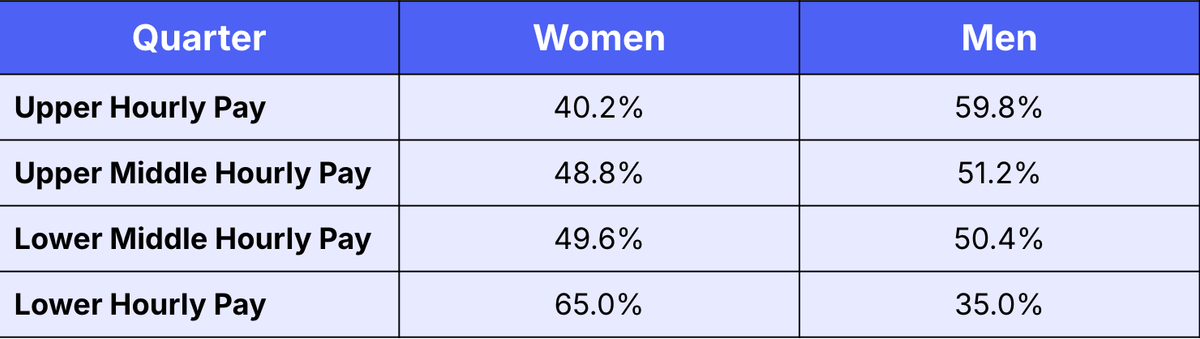
The proportion of men in our UK business increased from 2023 to 2024, leading to a decreased proportion of women at all quarters except for lower hourly pay, meaning that overall we have more men in our highest paid roles and more women in our lowest paid roles. While we are focused on ensuring our organisation is representative of the communities we operate in, at all levels, unfortunately, over-representation of men in high-earning roles is a systemic driver of the gender pay gap; it is at these levels where the most significant pay gaps exist and they have been the slowest to narrow (source).
Explaining our Data
While we are pleased our mean gender pay gap remains lower than the average for the UK Tech and Professional sectors, we acknowledge that our pay gap increased in 2024. While we are beating the average, we strive to be higher performing than the average. In pursuit of this goal, we will continue to work on identifying the causes of our pay gaps and how we can close these. This section sets out some key factors which have influenced our pay gap data this year.
Impacts on Pay
Through intentional steps, we have made progress in many of the focus areas we identified in last year’s report.
Gender Representation in Tech: According to the 2024 'Diversity in Tech' report, women make up 29% of the UK Tech industry. At Multiverse, we have made year-on-year improvements in the representation of women across our Tech team (Engineering, Product, and Data & Insight), which has increased from 31% in 2022, to 35% in 2023, and now 39% in 2024. This highlights how our transparent and consistent hiring framework is enabling us to source brilliant talent and increase our gender representation in critical areas at the same time. Roles in the Tech sector continue to attract more men than women (source) and these roles are often higher paid, so improving gender representation in our Tech team is vital.
Since the snapshot date of 05 April 2024, we have continued to make strides in this area, appointing several women into some of our most senior roles in Tech, including VP Engineering and Director of Product Design & Research. Research shows that women are underrepresented in these fields, making up 20% of Engineering talent (source) and 30% of AI roles (source). Our median Engineering team pay gap for 2024 was -3.8%; however, for Product it was 9.7%, and for Data & Insight 5%.
Sales Commissions: Commissions and other bonuses paid in the month of April are included in our calculation of an employee’s ordinary pay, as required by the UK government. At Multiverse, the only bonuses paid in April are Sales commissions. In previous years, many of our top-performing women in Sales joined our management pathway, which had an accelerating impact on our gender pay gap. We are proud that in 2024, due to several of our highest performing Sales reps being women, the median pay gap for our Sales team was 0%. It is important to note that there is an inherent variability in commission payments, because they are highly dependent on individual in-year performance, and so this picture can change year-on-year. Despite this, we hope our continued focus on bringing a diverse range of talent, including women, into our Sales teams and investing in enablement opportunities for all reps, will help us maintain our strong progress in this area.
However, some key factors have limited our progress:
Senior Representation: A contributing factor to our increased gender pay gap was lower representation of women at our upper pay quarter for 2024, which in real terms, means a decrease in women at “Director” and above levels. Representation at these levels changed from 58% in April 2023, to 42% in April 2024. This was fueled by the departure of our COO and CFO during the 2023-2024 tax year, both of whom were women. As an organisation of less than 1000 employees, we have a small overall population at senior levels and so a small number of key departures can have a significant effect. Since April 2024, we have appointed a new COO and CFO, both of whom are women. This means that our Executive team is currently gender balanced, which is something we are proud of - women occupy 43% of board positions and 35% of Leadership roles at the FTSE 350 level (source).
Lower-Level Representation: The increase in our pay gaps for 2024 is also the result of increased representation of women at our lower pay quarter. While we are always pleased to increase the diversity of our business, having more women in lower-level roles, which are associated with less pay, can particularly impact the mean pay gap. However, several of these lower-level roles held by women were in teams like IT and Finance, which are typically male-dominated, including at lower levels. Having women enter these areas of our business, combined with our aim to provide equitable access to development opportunities, provides a pathway to diversify our future leadership pipeline.
Impacts on Bonuses
Our mean bonus gap decreased in 2024; however, at 33%, it remains higher than we would like. This is closely related to the disproportionate representation of men in our most senior roles at this time, because larger bonus payments are typically granted to employees in these roles.
However, our median bonus gap significantly decreased to -16.5%. As the median figures lessen the impact of outlier figures on each end of the spectrum, this is a useful representation of the picture within Multiverse for the typical employee. The majority of Multiverse employees are on our annual bonus plan, rather than a commission plan. Since our 2023 report, we have made further progress on our approach to data-driven performance reviews, with a rigorous calibration process and structured approach to paying out bonuses based on both company and personal results. Performance ratings have a large impact on bonus payments, and so we believe this is evidence that our new approach is leading to improved outcomes for women at Multiverse.
Our Approach to Closing the Gender Pay Gap
In early 2024, we launched our Career Mobility strategy, which focuses on how we can bring Multiverse’s mission to life for our employees through an equity-first approach to People policies, processes, and practices. We have made a number of strides in our Career Mobility journey so far, which we believe over time will help us close our gender pay gap:
- Pay Philosophy - In late 2022, we started our journey towards pay transparency by creating our first organisation-wide pay philosophy, which is applied to all compensation decisions. Since our last gender pay gap report, we have appointed a dedicated Reward Lead to help us monitor pay equity more closely across the organisation and within departments. Additionally, all employees can now view the pay band for their position in our compensation tool, Pave, and where they sit in the band - a step that only 16% of UK companies have taken (source). We’re continuing to progress with this work and are moving towards even greater transparency, because we believe evidence-based compensation discussions are critical for interrupting bias.
- Equitable Performance Reviews - As discussed earlier in this report, we introduced a structured performance appraisal and calibration process in 2023. Our belief was, and still is, that this would enable us to make more accurate decisions for all employees regarding pay and progression - and we believe this is evidenced by our reduced mean and median bonus gaps. In 2024, we are evolving our approach by taking leaders through a ‘nine-box’ exercise to identify our highest-performing and highest-potential talent. This is the first step in succession planning, which we hope will enable us to take a long-term, business-area agnostic look at our organisation. From this, we will identify opportunities to strengthen and diversify pipelines for key roles, including at senior levels.
- Employee Resource Groups (ERGs) - As well as equitable policies, processes, and practices, building an inclusive culture where everyone can grow and thrive is a key focus for Multiverse. Effective ERGs are shown to increase engagement and reduce attrition for the communities they serve, which means they play a key role in helping us retain high-performing talent from underrepresented backgrounds, including women. In 2024, we launched Women@Multiverse, our fourth ERG. In the nine months since, over 100 employees have joined the ERG and members have held events ranging from ‘Irrational Ways to Influence People’ to ‘Having Challenging Conversations’. Since introducing these networks, employees have reported feeling a greater sense of belonging and community at Multiverse, which is measured by our quarterly employee engagement survey. When combined with the work we are doing to create fairer reward and progression structures, this is likely to increase retention for women across the organisation - something we will monitor across the next 12 months.
- Inclusive Leadership - We want to ensure all People Managers have the tools they need to lead high-performing teams, while supporting individuals to grow and thrive at Multiverse. In early 2024, we launched a 9-month training programme called M-Powering Managers, in partnership with an external training provider. The programme covered key leadership skills from Giving Feedback, to Coaching, and Managing Change. There was also a dedicated session on Diversity, Equity, and Inclusion, specifically focused on practical ways managers can create a sense of belonging within their teams. In 2025, we are planning to introduce a Manager Onboarding programme for all new people managers; inclusive leadership skills and interrupting bias will act as a thread underpinning all three modules.
Conclusion
While reporting our gender pay gap for the 2023-2024 tax year provides an important moment for us to reflect, the work to build a fairer and more equitable Multiverse for every employee does not pause between reports! We are committed to providing equitable access to opportunities internally, as well as in the wider workplace, and will continue to strive to make this a reality at Multiverse.
Tech @ Multiverse: Introducing our new VP of Engineering
Life at Multiverse
Team Multiverse
Helen brings a wealth of experience in the tech industry, most recently leading the engineering team behind Spotify's open-source Backstage product. Her expertise will be instrumental in driving innovation and scaling our engineering organisation as we continue to deliver cutting-edge learning experiences.
A passion for building and empowering:
Helen brings over 15 years of experience in the tech industry, most recently leading the engineering team behind Spotify's open-source Backstage product. Backstage streamlines workflows for developers, and its success is a testament to Helen's leadership in building user-centric and efficient developer tools.
Prior to that, Helen played a key role in launching Podcasts at Spotify, a major expansion of the platform's content offerings at the time. Her dedication to innovation and user experience is evident throughout her career.
"Growing up in a family of educators," says Helen, "I understand the transformative power of education. In today's world, upskilling is essential, and I'm excited to create a learning experience that equips the next generation of talent with the skills they need to thrive."
Beyond her technical expertise, Helen is passionate about fostering strong communities. She is a strong believer in building an engineering culture that not only drives performance but also empowers engineers to learn, grow, and contribute meaningfully to Multiverse's mission.
This new addition underscores our commitment to building a world-class organisation, filled with top talent. Want to join it? We're hiring.
Operations @ Multiverse: Introducing our new VP of Operations
Life at Multiverse
Team Multiverse
Asha joins us with a proven track record of success in building and scaling high-growth companies, most recently as co-founder of Framework. Her expertise in operations, sales and product management will be invaluable as we continue to scale our impact and deliver exceptional learning experiences to our learners.
A champion for growth and opportunity:
Asha joins Multiverse with a wealth of experience in operations, sales, product management, and talent acquisition. She co-founded Framework, a revolutionary edtech company that provides high-growth tech companies with a digital learning experience for their employees. Asha successfully led Framework through a rebrand and pivot, demonstrating her adaptability and strategic thinking.
Prior to Framework, Asha held leadership roles at Education First and boasts a diverse background spanning sales, partnerships, and product development.
"I'm passionate about helping people from all backgrounds grow further in their careers," says Asha. "Multiverse's mission to deliver high-quality, applied learning at scale deeply resonates with me, and I'm excited to be a part of the team."
Asha's proven track record in leading transformative change and her commitment to diversity and inclusion make her a valuable asset to Multiverse. She is eager to leverage her experience to further enhance the quality of Multiverse's offerings and help the company reach new heights.
This new addition underscores our commitment to building a world-class organisation, filled with top talent. Want to join it? We're hiring.
Career Mobility @ Multiverse: Alex Eacker
Life at Multiverse
Alex Eacker
Tell us about your recent career change at Multiverse.
I started at Multiverse over three years ago as a Learning Designer, hired to develop bespoke programs for our US Google partnership. The initial success of that partnership, due to the need to scale the project (developing six programs is a lotof work!), led me to move into a role as a Senior Learning Designer. Subsequently, I progressed to Senior Manager, where I was responsible for managing a team of Learning Designers working across a variety of bespoke programs.
When this new role opened up on the Enterprise team, I had established myself as an expert in creating bespoke programs for our global customers (Google, Verizon, Babcock, to name a few). The role fit well with the skill set I had been developing over the past few years, as well as giving me an opportunity to manage a larger team.
How are you enjoying your new team and remit?
I'm doing my best! This new role requires me to build strong relationships with leaders and teams across Multiverse, which has been a really awesome way to learn about the intricacies of our business and meet some really smart and passionate people.
It also requires me to be creative and challenge my assumptions about what's possible. My team’s aim is to unlock new revenue opportunities by building custom content for customers, but it's not always obvious how we should be doing this. The role requires my team and I to think critically about our product as a whole, and find ways to improve or modify it to meet customers needs.
Any career change comes with its challenges, what did you have to overcome and how did you approach this?
I mentioned this earlier, but I was independently developing six programs and the customer had high-expectations and often required us to create additional resources that took up a lot of time and energy. I needed a way to objectively demonstrate the workload to effectively manage client expectations and advocate for support within Multiverse. To address these challenges, I invested significant time in implementing project management tools and adopting Story Points as a framework for capacity planning. The data I was able to collect helped me visualize the scope of the project I was working on, and helped me identify trends in the workload over the year to determine when I needed the most support. These reporting mechanisms ultimately led to me building a case for a larger team, and pushed me into a management position.
If you could share one piece of advice for someone looking to develop their career or move internally, what would it be?
It's important to be open with your manager about your career goals and aspirations. Share what matters most to you in your role and how you envision your professional growth. These conversations can feel daunting! Especially if your ambitions seem challenging or different from current opportunities, but your manager should be supportive of your success, and work with you to get there. You might be surprised at how transparency can unlock new possibilities. Simply put, your manager and colleagues can't effectively support you if they don't know your goals and what you're striving for.
Want to join a company where career mobility is a priority? We’re hiring.
Sorry, no results found.