This week, we reported our gender pay gap for the 2023-2024 tax year. The report offers a snapshot of Multiverse’s gender pay gap on 05 April 2024, the government’s date for private sector reporting. At that time, we had 545 employees in the UK.
Headlines
- Our mean pay gap increased in 2024 to 13%, however, this remains lower than the average gender pay gap in comparable sectors, which is 16%.
- Our mean bonus gap declined slightly compared to 2023, and our median bonus gap was negative for the first time. Only 37% of reporting employers have a negative median bonus gap.
- In 2024, representation of women in our senior leadership roles declined; however, we have made a number of significant appointments since the 2024 snapshot date.
- We continue to see increased representation of women across our Tech team for the second consecutive year, with 39% of our Tech team identifying as women in 2024 (an 8% increase since 2022).
- The median gender pay gap for our Sales team was 0% in 2024. Even considering the varying effect that Sales commissions have on pay gap figures, this is something we are proud of.
The Gender Pay Gap explained
First - some technical bits. The gender pay gap is the difference between the average hourly pay of men and women within an organisation. The UK government requires businesses with 250 or more employees to report on the following metrics each year:
- Hourly pay gap - mean and median
- Bonus pay gap - mean and median
- Proportion of men and women receiving a bonus
- Proportion of men and women in different earnings quarters
The gender pay gap is distinct from unequal pay, which is illegal in the UK and has been since 1970. At Multiverse, we take active steps to ensure there is equal pay for equal work at all levels within our business, for example, regular pay audits and benchmarking. Reporting on our gender pay gap is an important moment for us to reflect on the initiatives we introduce to embed fairness and equality of opportunity in our business, and whether these are successful.
A note - HMRC specifies that Gender Pay Gap data sets should only include people who identify as a man or woman. Multiverse employees can voluntarily complete a series of census questions through our HR Information System, including their gender identity. To align with HMRC’s guidelines, we have excluded any employee who has self-identified as ‘Non-binary’ or ‘Another gender identity’. However, this approach is not in line with our internal pay audit practices or overall approach to gender identity and equality.
Key Figures
As a reminder, this report is retrospective and covers the period between 6th April 2023 - 5th April 2024, with a snapshot date of 05 April 2024.
Pay Gap
In the UK, Multiverse’s mean gender pay gap was 13%. This means that the average hourly pay of a man at Multiverse was 13% higher than the average hourly pay of a woman.
Multiverse’s median pay gap was 11.1%. The median pay gap is the difference between the salary in the middle of the range of all employees who are men, compared to the middle salary among all employees who are women. At Multiverse, the median man earned 11.1% higher than the median woman. The median is an important measure because it reduces the impact of what may be a small number of outlier values.
According to the Office for National Statistics (ONS), the 2024 UK median gender pay gap was 13.1% (source). Research also tells us that the mean gender pay gap in both the Technology and Professional Services sectors is approximately 16% (source), which are the sectors that offer the best comparisons to Multiverse.
Bonus Gap
In the reporting period, 48.8% of Multiverse’s UK employees received a bonus - 49.3% of women, and 48.3% of men.
Our mean gender bonus gap declined from 34% in 2023 to 33.2% in 2024. This means that on average across the 12 months leading up to 05 April 2024, the bonus of a man at Multiverse was 33.2% higher than the bonus of a woman.
Our median gender bonus gap declined from 11% in 2023 to -16.5% in 2024. This means the median man at Multiverse had a bonus 16.5% lower than the median woman. Our median bonus gap differs significantly from the mean gap because the median factors out some of the impact of outlier bonus amounts. We will explore what this means in greater detail later in the report.
Across all reporting employers in 2024, on average, 39% of women and 40% of men received bonuses, and in 63% of reporting employers, median bonus pay was higher for men than for women (source). We are proud of our results and the progress we are making here.
Earnings Quarters
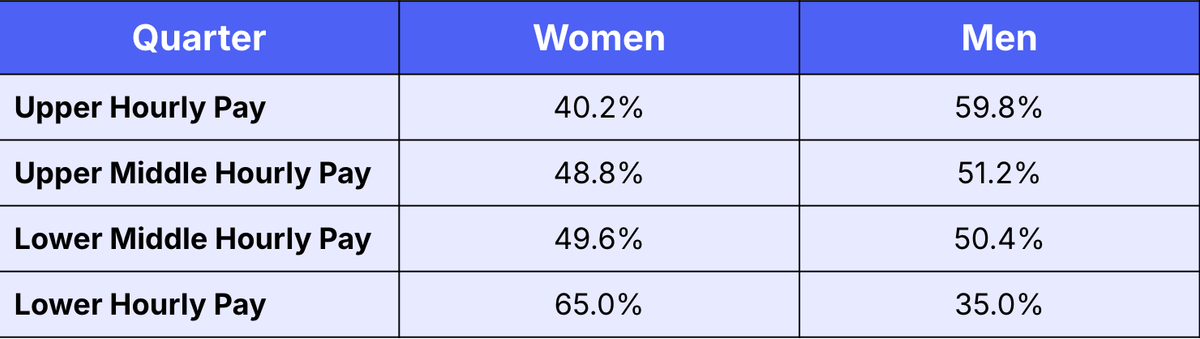
The proportion of men in our UK business increased from 2023 to 2024, leading to a decreased proportion of women at all quarters except for lower hourly pay, meaning that overall we have more men in our highest paid roles and more women in our lowest paid roles. While we are focused on ensuring our organisation is representative of the communities we operate in, at all levels, unfortunately, over-representation of men in high-earning roles is a systemic driver of the gender pay gap; it is at these levels where the most significant pay gaps exist and they have been the slowest to narrow (source).
Explaining our Data
While we are pleased our mean gender pay gap remains lower than the average for the UK Tech and Professional sectors, we acknowledge that our pay gap increased in 2024. While we are beating the average, we strive to be higher performing than the average. In pursuit of this goal, we will continue to work on identifying the causes of our pay gaps and how we can close these. This section sets out some key factors which have influenced our pay gap data this year.
Impacts on Pay
Through intentional steps, we have made progress in many of the focus areas we identified in last year’s report.
Gender Representation in Tech: According to the 2024 'Diversity in Tech' report, women make up 29% of the UK Tech industry. At Multiverse, we have made year-on-year improvements in the representation of women across our Tech team (Engineering, Product, and Data & Insight), which has increased from 31% in 2022, to 35% in 2023, and now 39% in 2024. This highlights how our transparent and consistent hiring framework is enabling us to source brilliant talent and increase our gender representation in critical areas at the same time. Roles in the Tech sector continue to attract more men than women (source) and these roles are often higher paid, so improving gender representation in our Tech team is vital.
Since the snapshot date of 05 April 2024, we have continued to make strides in this area, appointing several women into some of our most senior roles in Tech, including VP Engineering and Director of Product Design & Research. Research shows that women are underrepresented in these fields, making up 20% of Engineering talent (source) and 30% of AI roles (source). Our median Engineering team pay gap for 2024 was -3.8%; however, for Product it was 9.7%, and for Data & Insight 5%.
Sales Commissions: Commissions and other bonuses paid in the month of April are included in our calculation of an employee’s ordinary pay, as required by the UK government. At Multiverse, the only bonuses paid in April are Sales commissions. In previous years, many of our top-performing women in Sales joined our management pathway, which had an accelerating impact on our gender pay gap. We are proud that in 2024, due to several of our highest performing Sales reps being women, the median pay gap for our Sales team was 0%. It is important to note that there is an inherent variability in commission payments, because they are highly dependent on individual in-year performance, and so this picture can change year-on-year. Despite this, we hope our continued focus on bringing a diverse range of talent, including women, into our Sales teams and investing in enablement opportunities for all reps, will help us maintain our strong progress in this area.
However, some key factors have limited our progress:
Senior Representation: A contributing factor to our increased gender pay gap was lower representation of women at our upper pay quarter for 2024, which in real terms, means a decrease in women at “Director” and above levels. Representation at these levels changed from 58% in April 2023, to 42% in April 2024. This was fueled by the departure of our COO and CFO during the 2023-2024 tax year, both of whom were women. As an organisation of less than 1000 employees, we have a small overall population at senior levels and so a small number of key departures can have a significant effect. Since April 2024, we have appointed a new COO and CFO, both of whom are women. This means that our Executive team is currently gender balanced, which is something we are proud of - women occupy 43% of board positions and 35% of Leadership roles at the FTSE 350 level (source).
Lower-Level Representation: The increase in our pay gaps for 2024 is also the result of increased representation of women at our lower pay quarter. While we are always pleased to increase the diversity of our business, having more women in lower-level roles, which are associated with less pay, can particularly impact the mean pay gap. However, several of these lower-level roles held by women were in teams like IT and Finance, which are typically male-dominated, including at lower levels. Having women enter these areas of our business, combined with our aim to provide equitable access to development opportunities, provides a pathway to diversify our future leadership pipeline.
Impacts on Bonuses
Our mean bonus gap decreased in 2024; however, at 33%, it remains higher than we would like. This is closely related to the disproportionate representation of men in our most senior roles at this time, because larger bonus payments are typically granted to employees in these roles.
However, our median bonus gap significantly decreased to -16.5%. As the median figures lessen the impact of outlier figures on each end of the spectrum, this is a useful representation of the picture within Multiverse for the typical employee. The majority of Multiverse employees are on our annual bonus plan, rather than a commission plan. Since our 2023 report, we have made further progress on our approach to data-driven performance reviews, with a rigorous calibration process and structured approach to paying out bonuses based on both company and personal results. Performance ratings have a large impact on bonus payments, and so we believe this is evidence that our new approach is leading to improved outcomes for women at Multiverse.
Our Approach to Closing the Gender Pay Gap
In early 2024, we launched our Career Mobility strategy, which focuses on how we can bring Multiverse’s mission to life for our employees through an equity-first approach to People policies, processes, and practices. We have made a number of strides in our Career Mobility journey so far, which we believe over time will help us close our gender pay gap:
- Pay Philosophy - In late 2022, we started our journey towards pay transparency by creating our first organisation-wide pay philosophy, which is applied to all compensation decisions. Since our last gender pay gap report, we have appointed a dedicated Reward Lead to help us monitor pay equity more closely across the organisation and within departments. Additionally, all employees can now view the pay band for their position in our compensation tool, Pave, and where they sit in the band - a step that only 16% of UK companies have taken (source). We’re continuing to progress with this work and are moving towards even greater transparency, because we believe evidence-based compensation discussions are critical for interrupting bias.
- Equitable Performance Reviews - As discussed earlier in this report, we introduced a structured performance appraisal and calibration process in 2023. Our belief was, and still is, that this would enable us to make more accurate decisions for all employees regarding pay and progression - and we believe this is evidenced by our reduced mean and median bonus gaps. In 2024, we are evolving our approach by taking leaders through a ‘nine-box’ exercise to identify our highest-performing and highest-potential talent. This is the first step in succession planning, which we hope will enable us to take a long-term, business-area agnostic look at our organisation. From this, we will identify opportunities to strengthen and diversify pipelines for key roles, including at senior levels.
- Employee Resource Groups (ERGs) - As well as equitable policies, processes, and practices, building an inclusive culture where everyone can grow and thrive is a key focus for Multiverse. Effective ERGs are shown to increase engagement and reduce attrition for the communities they serve, which means they play a key role in helping us retain high-performing talent from underrepresented backgrounds, including women. In 2024, we launched Women@Multiverse, our fourth ERG. In the nine months since, over 100 employees have joined the ERG and members have held events ranging from ‘Irrational Ways to Influence People’ to ‘Having Challenging Conversations’. Since introducing these networks, employees have reported feeling a greater sense of belonging and community at Multiverse, which is measured by our quarterly employee engagement survey. When combined with the work we are doing to create fairer reward and progression structures, this is likely to increase retention for women across the organisation - something we will monitor across the next 12 months.
- Inclusive Leadership - We want to ensure all People Managers have the tools they need to lead high-performing teams, while supporting individuals to grow and thrive at Multiverse. In early 2024, we launched a 9-month training programme called M-Powering Managers, in partnership with an external training provider. The programme covered key leadership skills from Giving Feedback, to Coaching, and Managing Change. There was also a dedicated session on Diversity, Equity, and Inclusion, specifically focused on practical ways managers can create a sense of belonging within their teams. In 2025, we are planning to introduce a Manager Onboarding programme for all new people managers; inclusive leadership skills and interrupting bias will act as a thread underpinning all three modules.
Conclusion
While reporting our gender pay gap for the 2023-2024 tax year provides an important moment for us to reflect, the work to build a fairer and more equitable Multiverse for every employee does not pause between reports! We are committed to providing equitable access to opportunities internally, as well as in the wider workplace, and will continue to strive to make this a reality at Multiverse.