











We couldn’t find what you are looking for. Please try another way.
Apprentices
Thank you! Your submission has been received!
Oops! Something went wrong while submitting the form.
How much do apprentices get paid? Updated for 2024-2025
Apprentices
Team Multiverse
The short answer: It depends.
High-growth industries, like tech, may pay over £25,000 for entry-level apprenticeship roles. Apprenticeship opportunities in other industries might pay less. Your apprenticeship wage also depends on what company you work for and the level of your position.
To help you understand how much you could earn as an apprentice, we'll guide you through the following:
- What’s the apprenticeship minimum wage?
- Can apprentices earn more than the minimum wage?
- Multiverse apprenticeship wages
- How much money will you make as an apprentice?
- Apprentice working hours
- What else are apprentices entitled to?
- Is an apprenticeship right for you?
- What happens when I finish my apprenticeship?
- How to start your apprenticeship journey
What’s the apprenticeship minimum wage?
The apprenticeship minimum wage is the basic hourly amount employers must pay apprentices. The minimum pay depends on your age and how long you’ve been an apprentice.
For example, in 2024, the apprentice wage for those aged under 18 is £6.40 per hour. But if you’re 19 or over and have completed your first year, you’re entitled to the National Minimum Wage for your age group.
Here’s a breakdown of the minimum hourly wage for apprentices depending on your age and year of study. Note: these figures represent the minimum hourly wage for 2024. The 2025 minimum wages, which go into effect in April 2025, are also listed.
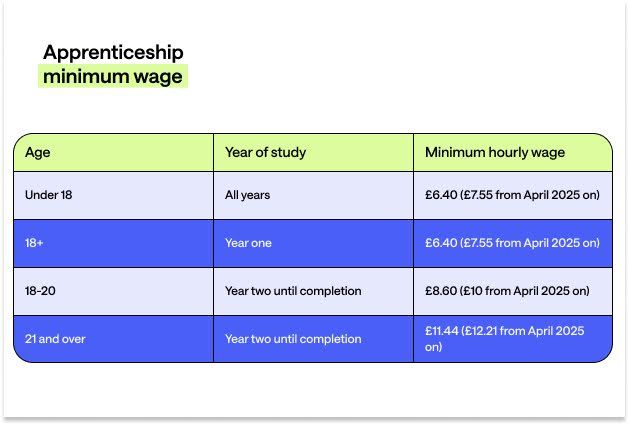
In the UK, the National Minimum Wage is updated each April. Apprentices aged 21 and over who’ve completed the first year of their apprenticeship are eligible for the National Living Wage.
Can apprentices earn more than the minimum wage?
The National Minimum Wage for apprentices is the minimum your employer must pay you. Many organisations (including Multiverse) pay you much more than the National Minimum Wage rate to complete your apprenticeship. For instance, if you’re entering a high-growth and in-demand field like tech, wages tend to be higher than the minimum.
Multiverse apprenticeship wages
At Multiverse, the companies we work with pay a minimum of £18,000 a year. But you’ll find roles on our platform that pay £25,000 or more per annum (per year). We focus on the skills of the future, offering high-quality apprenticeship opportunities across key sectors like Business, Digital and Tech.

Multiverse programmes include:
- Software Engineering (Level 4)
- Advanced Data Fellowship Whole (Level 4-6)
- Digital Business Accelerator (Level 3)
- Business Transformation Fellowship (Level 4)
How much money will you make as an apprentice?
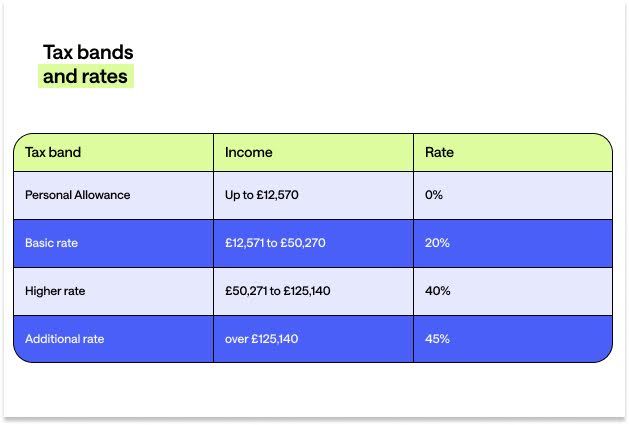
Let’s break it down. Your apprenticeship salary is the amount an employer pays you yearly before income tax and other deductions like National Insurance. How much income tax you pay depends on which tax band you’re in, and your total earnings determine your tax band.
You’re likely in the basic band if you’re working in an entry-level role. In the basic band, you’re taxed on income between £12,571 to £50,270. You don’t pay tax for income below £12,570 (your tax-free Personal Allowance limit). The UK Government taxes earnings in this threshold at 20%.
You’re in the next tax band (the higher rate) if you earn above the basic rate threshold. In the higher rate tax band, you’ll be taxed 40% for income between £50,271 and £125,140. An additional rate of 45% applies to incomes over £125,140.
Now for the maths. Let’s say your salary is £20,000 per annum (per year), and you’re doing an apprenticeship lasting 15 months. Yearly you’ll take home around £17,624 after tax and National Insurance. Monthly you’ll take home around £1,468. Throughout your entire apprenticeship, you’ll earn £22,020.
Apprentice working hours
To complete your apprenticeship full-time, you are typically expected to work at least 30 hours per week. However, if you have specific circumstances (for example, if you’re a carer for a family member), you may be able to work part-time. For part-time apprentices, such as those working 16 hours per week, the apprenticeship duration will be extended to ensure adequate training time.
Your employer must follow employment regulations regarding your working hours:
- Under 18: As a young worker, you can legally work a maximum of 8 hours per day and 40 hours per week.
- 18 and Over: For adults, the standard working limit is an average of 48 hours per week, though you may choose to opt out if desired.
In addition to your set working hours, apprenticeships require that you dedicate at least 20% of your working time to training or studying for your qualification. In a Multiverse programme, you’ll typically spend at least one day a week studying toward your apprenticeship qualification.
What else are apprentices entitled to?
Whether you complete your apprenticeship full-time or part-time, your employer will pay you for working and training hours. Aside from being paid to complete your apprenticeship, you’re legally entitled to employee benefits like holidays, sick pay and rest breaks.
Training
As an apprentice, you’ll be paid for your time at work. You’re also paid for the time you’re in coaching sessions and bootcamps with industry experts (off the job training). You’ll spend 80% of your time working for your employer and 20% of your time doing off the job training. You’ll also be paid for time working towards English and Maths qualifications if they’re part of your apprenticeship.
Holidays
As a full-time apprentice, you’re entitled to a minimum amount of paid holiday. For each year of your qualification, you’ll get at least 20 days of holiday pay plus bank holidays. Many employers provide apprentices well above the minimum paid holiday and offer company-wide shutdowns once a year.
Sick pay
If you’re too ill to work, sick pay offers peace of mind. You’re entitled to Statutory Sick Pay (SSP) as an apprentice. The minimum amount is £116.75 a week for 28 weeks. Some companies offer sick pay schemes that pay more than the basic weekly amount. For example, an employer might offer up to two weeks of paid sick leave at your usual weekly rate.
Rest breaks
You’re legally entitled to rest breaks at work like any other employee. If you’re under 18 and your working day is longer than 4.5 hours, your employer must give you a 30-minute break. If you’re 18 or over, you’ll get a 20-minute break if you work more than six hours daily. As with holiday and sick pay, many companies will offer apprentices above the minimum amount. For instance, you might get up to an hour for lunch and shorter breaks throughout the day.
Is a Multiverse apprenticeship right for you?
There’s never been a better time to start your apprenticeship journey. A Multiverse apprenticeship enables you to learn the skills you need to level up your career without taking time away from your current role. To top it off, you’ll continue to be paid for the time you spend learning on the job. All training is paid for by your employer once they partner with Multiverse.
Train in high-growth industries
Apprentices are in demand across the board, especially in high-growth sectors. Let’s take the tech industry as an example. In 2024, there were 122 “unicorn” startups — startups with a valuation of $1 billion (roughly £770 million) — in the UK alone. The UK tech sector is still growing in 2024, and companies need new, diverse talent. AI is also driving high levels of investment by tech companies. According to Multiverse data, 81% of tech leaders plan to increase investments in AI — including on human capital — over the next three years.
Get paid to learn
All apprentices get paid to work and learn. Some industries pay more than others. Companies with a skills gap will happily pay you to complete your apprenticeship and gain industry expertise in your field.

What happens when I finish my apprenticeship?
After you finish your apprenticeship, you may be in a position to grow your career through a new role or promotion. Promotions usually come with a pay rise as compensation for your increased experience and responsibilities. Having a new qualification will help you now and for the rest of your career.
Start your apprenticeship journey
If you're looking to gain new and exciting skills on the way to future-proofing your career in the dynamic tech industry, apply for a Multiverse programme in minutes today.

Differences between AI and machine learning: A breakdown
Apprentices
Team Multiverse
Artificial intelligence and machine learning are distinct but related concepts. AI refers to advanced software that imitates how humans process and analyse information. Machine learning is a subtype of AI that uses algorithms–or sets of rules–to perform specific tasks.
These technologies have many innovative uses in finance, healthcare, logistics, and other industries. But the number of people with artificial intelligence and machine learning skills has not kept up with soaring demand. A 2024 Red Hat survey found that 81% of UK Information Technology Managers see a critical AI skills gap, with 40% citing talent shortages as their main obstacle preventing their organisations from using AI to its full potential.
Expanding your AI and machine learning skills can help you keep up with the evolving tech landscape. We examine the differences between these technologies, applications in the workforce, and more.
What’s the difference between AI and Machine Learning?
Artificial intelligence is a broad term for software that mimics how humans perform complex mental processes. This technology analyses information, learns from its experiences, and solves problems.
Machine learning is one of the most popular branches of AI. This approach uses algorithms — or instructions — to guide decision-making and execute tasks. All machine learning is AI, but not all AI programmes use machine learning.
Businesses often use artificial intelligence without machine learning for repetitive or straightforward tasks. Some people call these applications “Good Old-Fashioned Artificial Intelligence” (GOFAI) because they don’t learn from data like machine learning algorithms. For example, GOFAI chatbots use rule-based systems to respond to customer inquiries. These chatbots provide pre-scripted answers but can’t learn from previous interactions or adapt to different contexts.
However, some organisations create hybrid systems by combining machine learning with symbolic — or rules-based — AI. These models rely on machine learning algorithms to process data, but they also use symbolic reasoning techniques to interpret information based on predefined knowledge.
This dual approach allows hybrid AI systems to mimic human reasoning and solve more complex problems. For example, Google DeepMind has developed geometry-solving software that blends neural networks with a symbolic AI engine. The neural networks use their “intuition” to guess the best way to solve a geometry problem, while the symbolic AI engine generates solutions based on this reasoning.
What is AI?
Artificial intelligence refers to machines and software that imitate human cognitive functions. This technology performs advanced processes that traditionally relied on human intelligence. For example, AI software can identify patterns in large datasets, recognize faces in photographs, and give personalised recommendations.
Businesses use advanced computer systems and infrastructure to build AI applications. On the hardware front, Graphics Processing Units (GPUs) and Tensor Processing Units (TPUs) enable machine learning models to process large amounts of data efficiently. GPUs have powerful parallel processing capabilities, perfect for analysing images and videos. By contrast, TPUs perform complex computations at lightning speed, allowing neural networks to learn faster.
Additionally, many organisations use cloud computing to optimise their AI software. Cloud platforms like Google Cloud enable businesses to draw on remote training data for machine learning models without investing in expensive infrastructure. Users can also access additional resources — such as cloud storage solutions and analytics tools — to improve their AI operations. This flexibility lets businesses scale their AI applications up or down as needed, boosting performance and reducing costs.
Popular AI business applications
One of the most popular types of AI are large language models (LLMS). Engineers use vast quantities of human-generated content to train OpenAI’s ChatGPT and other LLMs. The models learn context and language from the data and use this knowledge to respond to human input.
Engineers also use AI to create robots that respond to their environments and perform intricate tasks. For instance, AI-powered vacuum cleaners avoid obstacles in their paths, while AI surgical robots assist surgeons with operations.
Additionally, AI enables researchers to develop autonomous systems that operate without human guidance. Autonomous drones and vehicles use algorithms and sensor technologies to make real-time decisions and navigate their environment.
Smart assistants have also gained widespread popularity. Applications like Siri and Google Assistant use natural language processing to interpret and respond to human input. Users can ask these assistants to perform many functions, such as adding tasks to their calendars, controlling smart devices, and setting timers.
Finally, retailers and streaming services often use AI-powered recommendation engines to personalise the customer experience. For example, Amazon uses machine learning algorithms to analyse customers’ browsing behaviour and suggest relevant products. The retailer also uses an LLM to tailor product descriptions for individual consumers.
What is Machine Learning?
Machine learning is a subset of AI that uses algorithms to create intelligent systems that learn from datasets. The algorithms detect patterns in data, make predictions based on historical trends, and complete tasks. They refine their performance over time as they receive more data, so humans don’t need to tweak the programming.
There are three main types of machine learning with different applications:
Supervised learning
An algorithm processes datasets with historical inputs and outputs and identifies their relationships. The software generalises and extrapolates this knowledge to predict future outputs. Organisations use supervised learning to teach algorithms to classify items, detect abnormal data points, and forecast future trends.
Unsupervised learning
The algorithm looks for connections and patterns between unlabeled data points and generates insights into the dataset’s structure. For instance, an algorithm could analyse website traffic and sort customers into groups based on browsing behaviour.
Reinforcement learning
The algorithm gains positive or negative reinforcement from its environment and adjusts its behaviour accordingly. AI-powered robots and self-driving cars use reinforcement learning to learn new tasks and optimise performance. The streaming service Spotify also uses reinforcement learning to provide increasingly accurate personalised recommendations.
The role of Deep Learning in AI and Machine Learning
Deep learning is a specialised field within machine learning that uses many layers of neural networks for sophisticated pattern recognition and problem solving. It’s designed to mimic how the human brain processes information, learns from experience, and applies reasoning.
Traditional machine learning algorithms rely heavily on human intervention to learn and often struggle to process unstructured data efficiently. In contrast, deep learning models can interpret many data types and automatically improve their performance with minimal human input.
Deep learning has a wide range of applications across various industries, including automotive, aerospace, healthcare, and security. For example, autonomous vehicles use deep learning to automatically detect and avoid obstacles in the road. Similarly, computer vision programmes use deep learning to recognize faces and classify images.
Machine Learning and AI: How do businesses use them?
Organisations in all industries leverage AI and machine learning to improve their operations. These technologies complete repetitive tasks faster and more accurately than humans, enhancing productivity. Businesses also use AI and machine learning to drive innovation and develop more efficient processes.
To develop and use AI applications effectively, professionals need diverse tech skills. For example, Marketers should be proficient in prompt engineering to effectively use generative AI tools to develop personalised marketing campaigns. Meanwhile, strong data analysis skills enable Supply Chain Managers to use AI for demand forecasting and inventory optimisation.
Here are five use cases for AI and machine learning in different sectors.
Autonomous threat detection
Cybersecurity professionals use AI and machine learning to detect cyber threats more efficiently. This technology autonomously monitors computer networks and systems for abnormal behaviour and data points. Algorithms analyse these anomalies to determine if they’re caused by cyber attacks and trigger defence mechanisms.
Autonomous threat detection lets organisations respond more quickly to cybersecurity incidents. For example, Horizon3.ai’s NodeZero Autonomous Security Platform detects attackers and automatically diverts them to decoy systems, preventing them from accessing critical data. The platform also improves and adapts in response to emerging threats so organisations can stay two steps ahead of cybercriminals.
Diagnostic imaging
AI and machine learning have revolutionised medical imaging. Radiologists and other healthcare professionals use this technology to capture and reconstruct diagnostic images. For example, AI software can create synthetic images based on a single image, so patients spend less time in the radiology department.
AI also helps clinicians analyse images for lesions, tumours, brain aneurysms, and other conditions. In some cases, this technology may detect abnormalities missed by human eyes. This increased precision leads to faster and more accurate diagnoses and improves patient outcomes.
Personalised marketing campaigns
Marketers use artificial intelligence and machine learning to create more effective and targeted marketing campaigns. Machine learning algorithms analyse behaviour, demographics, and other data to gain insights into customers’ preferences. Companies use these findings to provide personalised product recommendations and promotions.
For example, Brewdog uses AI software to personalise its email marketing campaigns based on customers’ recent purchases, web activity, and other data. In a recent experiment, the company found that its personalised campaigns generated 13.8% more revenue than non-personalized ones.
Businesses also use AI to automate time-consuming marketing processes. AI-powered chatbots answer questions from prospective customers, while generative AI tools create articles and other marketing content. These innovations let marketers focus on tasks that require a human touch, like nurturing client relationships and developing the perfect brand voice.
Supply chain optimization
Products often travel through convoluted global supply chains before they reach customers. AI helps organisations streamline and optimise these processes so goods reach their destinations as efficiently as possible.
Sophisticated machine learning algorithms analyse historical data and forecast future trends. These models predict changes in customer demand, the availability of raw materials, and other market dynamics. Businesses leverage this data to anticipate supply chain fluctuations and respond proactively. For example, Unilever uses an AI application called Scoutbee to scrape web data to find alternative suppliers if demand for a product spikes or their usual distributors aren’t able to meet inventory needs.
Fraud detection
Any organisation can fall victim to internal and external fraud. AI fraud detection tools use machine learning algorithms to analyse data and identify suspicious or anomalous patterns. These applications also generate detailed reports that help humans investigate potentially fraudulent activity.
For instance, the UK government developed the Single Network Analytics Platform (SNAP) to detect fraud and organised crime. This AI system analyses data from the World Bank and other sources to detect suspicious activity and networks. With this tool, public sector organisations can effectively detect fraudulent claims and safeguard public funds from criminals.
Ethics in AI and Machine Learning: What professionals need to know
According to Multiverse’s ROI of AI report, 93% of professionals are confident that they use artificial intelligence ethically. However, despite this optimism, researchers and tech experts have raised alarms about the ethical dilemmas associated with this technology.
Bias is one of the most significant ethical challenges posed by AI. Models trained on biased datasets can perpetuate racism, sexism, and other forms of discrimination. For instance, an UberEats courier recently won a lawsuit after the company’s “racially discriminatory” facial recognition system barred him from accessing the platform. This case illustrates how AI systems that make automated decisions based on physical appearance can reinforce inequities.
Data privacy is another pressing concern. Many people worry that artificial intelligence tools collect and use their personal data and intellectual property without consent. In 2024, for example, the UK Information Commissioner’s Office revealed that LinkedIn had been training its AI models with user data without explicit consent. In response to these findings, the social media platform agreed to suspend this training until further notice.
Ethical frameworks can guide professionals as they develop and use AI and machine learning tools. For example, the UK government has created a seven-point framework to help civil servants use this technology responsibly. This blueprint promotes data integrity, fairness, transparency, and other key principles.
Demand for AI and Machine Learning jobs
The widespread adoption of AI and machine learning has opened new career opportunities in every industry. The World Economic Forum’s Global Risk Report 2024 predicts that the demand for AI and Machine Learning Specialists will increase by 40% by 2027.
Data science is one of the fastest-growing AI-related professions. Data Scientists use machine learning algorithms to interpret complex datasets and help business leaders make informed decisions.
Data Analysts and scientists rank sixth on the Future of Jobs Report 2023’s list of the fastest-growing occupations between 2023 and 2027. These professionals also command healthy salaries. Glassdoor data indicates Data Scientists in London earn a median salary of £60,000.
Additionally, LinkedIn’s 2024 Jobs on the Rise Report lists Artificial Intelligence Engineer as the tenth-fastest growing career. These experts use programming languages and technical skills to build, train, and maintain AI software. According to Glassdoor, Artificial Intelligence Engineers in London earn an average salary of £64,000.
Multiverse’s upskilling programmes can help you gain the essential skills to thrive in the evolving job market and pursue AI-related roles. Our AI for Business Value programme teaches you how to implement AI solutions to boost operational efficiency and drive organisational change. Similarly, the AI-Powered Productivity programme focuses on AI literacy, empowering you to use AI solutions to improve efficiency.
These programmes are fully funded by your employer and allow you to gain hands-on experience in your current role. You’ll get at least three hours of protected learning time weekly to complete structured training modules and collaborative projects. You’ll also practise applying your new AI and ML skills in the workplace, accelerating your professional development.
Future proof your career with in-demand skills
AI will disrupt approximately 40% of jobs worldwide, according to a 2024 report by the IMF. This statistic may sound alarming, but this technology will likely change most jobs, not eliminate them. Developing AI and machine learning skills will allow you to adapt to the evolving workforce and fill critical skills gaps.
Immerse yourself in the latest AI and machine learning developments with Multiverse’s free bite-sized AI training. These innovative training modules provide fast, actioned-oriented lessons on foundational AI principles, prompt engineering and teach you how to apply AI ethically in your current career.
Ready to become an AI expert? Talk to your employer about our AI for Business Value apprenticeship to start your journey.
Should I reskill or upskill to advance my career?
Apprentices
Team Multiverse
As technology advances, though, professionals in the tech sector are required to continuously develop their skills to remain competitive. For them, reskilling and upskilling should be top of mind.
But there’s also general confusion over the differences between upskilling and reskilling. If you’re looking to accelerate your career, you might wonder whether it makes more sense to reskill, upskill, or a combination of the two.
This article will help clear up some of the confusion over these distinct concepts. Below, we'll cover:
- What does it mean to reskill or upskill?
- Should I reskill or upskill to advance my career?
- The best ways to upskill in 2024
Let’s dive in.
What does it mean to reskill?
To reskill, a professional generally must develop new capabilities and specialised knowledge outside their existing skill set.
Reskillers come from all ages, specialisms, and industries. But unlike upskillers, reskillers aim to switch careers entirely.
For example, let’s say you've worked in sales and business development for five years. You’ve developed skills related to this career path, such as those based on customer-facing communications and outreach.
You recently learned, though, that the average data analyst salary is higher than your current pay. To become a data analyst, you’d need to develop a new core skill set. So, you retrain through a technical programme outside of working hours and switch from a sales specialist to a junior data analyst.
What is upskilling?
Upskilling is when a professional improves or develops the core job skills or abilities related to their existing career path.
Upskillers come from all ages and industries. But they share a desire to progress in their current field or industry to propel career growth, rather than switch careers entirely.
To illustrate an example: Let’s say you've been a generalist Software Engineer for three years. You enjoy the work, but you'd like to specialise in cyber security, as that skill set is in demand. You upskill and progress from Software Engineer to Cyber Security Engineer.
Should I reskill or upskill to advance my career?
It’s natural for working adults to question whether it makes greater sense to reskill or upskill to advance their careers.
Both upskilling and reskilling offer unique opportunities and benefits to professionals (more on this below). But to answer the question of which is right for you, it’s best to start from your unique, long-term goals and work backwards.
Here are some questions to ask:
- Do I enjoy the work I currently do? Does it feel meaningful to me?
- Does my current career path align help me achieve my long-term goals, be them personal, professional, or financial?
- Are there options to develop or expand upon my current skill set for greater success in my industry?
- Will demand for my current skills continue to grow in the future? Or could I do more to future-proof my career path?
While a simplification, the above questions can be a useful starting point for further exploration. But before we go any further, let’s examine some of the benefits of upskilling or reskilling for your career.
The benefits of reskilling or upskilling for employees
Workforce training benefits more than just HR Managers and business owners. Here are six ways reskilling or upskilling can also help you as an employee.
1. Increased salary and responsibilities
Data shows that upskilling or reskilling can lead to new job responsibilities, career advancement, and potentially higher earnings. In fact, 69% of apprentices who completed one of our upskilling programs have gained new job responsibilities, while 75% of employees who participated in upskilling have experienced career advancement. Additionally, over 5% of those who upskilled have seen an increase in average earnings compared to those who didn't.
While you're looking to progress in your current role or start a new career path, upskilling or reskilling is a solid business case for achieving your goals. You can learn the abilities needed for new and potentially more complex tasks in your existing role by upskilling. On the other hand, reskilling can provide you with the skills needed to start a new career with more responsibilities and higher earning potential.
2. Greater job security in 2024 and beyond
OpenAI released a demo of ChatGPT in late 2022. By early 2023, demand for new professions, like Prompt Engineers, had emerged. A full 69% of business leaders predict AI will create more demand for professionals with this specialism.
AI has shown us how quickly tech advances can change the way we work. Now is the time to learn the skills of the future and bring innovative approaches to your role. Doing so will increase your job security in the present, and it will also give you the new skills you need to adapt to future tech changes in the workplace.
3. Fewer education gaps
You don't need a new degree-level qualification to advance your career. For some careers, it helps. But there are other factors to consider.
Putting your career on pause to attend university is expensive and a significant time commitment. There's also no guarantee of a job after graduation. The pace of technological change, especially in the tech industry, means new graduates often emerge from university with skills gaps.
Fortunately, you have options. Multiverse offers learners the ability to earn a degree qualification through an upskilling programme without leaving your current role. You'll also earn a nationally recognised certification while working on real projects, meaning no career breaks or learning endless theory.
Check out our programme options for more information.
4. Enhanced productivity and problem-solving
More and more businesses see the value of employees investing time into their skills. One study showed that 93% of CEOs introducing advanced upskilling programmes see increased workforce productivity and fewer skills gaps or mismatches. A further 94% see greater innovation and accelerated digital transformation. Additionally, 95% see better employee engagement. But when your employer upskills or reskills the workforce, what does that mean for you as an employee?
Whether you're at the start of or mid-way through your career, evolving your skills will help you solve advanced problems. Plus, when your employer invests in you, you feel more valued and engaged. Being empowered to solve problems and feeling more engaged at work makes you more productive. You'll also be less likely to switch jobs, which is an indicator of greater job satisfaction.
5. Better work-life balance
Regardless of your position on the work-from-home debate, fully remote or hybrid working opportunities may bring better work-life balance. Still, that all depends on your preferences or commitments.
Some professionals prefer a clear separation of work and home, in which case an in-office role might be best. Others may prefer the option to eliminate the office commute so they can spend that time with their families.
In either case, learning in-demand tech skills lets you choose your preferred workplace setup. That's especially true of remote work, as many tech professionals can do their work from anywhere.
6. Increased confidence in the workplace
Experts predict that 85% of all job roles in 2030 have yet to be invented. Even as we speak, 90% of workers see the need to update their skills annually at a minimum.
So, if you want to thrive, rather than survive, in the future of work, now is the time to learn transformational skills.
With your new skills, you'll gain confidence in your abilities. That confidence will put you in the driver's seat of your career and help you meet current and future workforce demands. You'll also have the knowledge to effectively lobby for new tools, processes, and workflows that bring actual business results.
Best ways to upskill or reskill in 2024
Now you know why you should upskill or reskill, here are three ways to get started.
Take courses through learning platforms
Platforms like Coursera offer flexibility and the ability to use any professional development budget you have through work. Still, you might have to pay for them if your employer doesn't offer professional development. You may also have to dedicate time outside work to learning the course content. There could also be no support from industry experts or any actionable job-ready skills.
Take a full-time or part-time boot camp
Full-time and part-time boot camps give you the chance to upskill and reskill. If your employer offers a professional development budget, you could use this to pay for the boot camp. But even if your employer funds it, you still have to invest time—aka, use your own time outside of work to study. If you go full-time, you'll have to put your career on pause for course outcomes that might not suit your goals.
Pursue an on-the-job upskilling programme
Like online courses and boot camps, on-the-job upskilling programmes can allow you to upskill in the areas needed to advance your career. But unlike online classes and boot camps, you don't need to quit your job, self-fund the programme, or spend personal time completing the course.
Upskill for free with Multiverse without quitting your job
With a Multiverse programme, you can upskill on the job for free. There's also a focus on applied learning so you won't be stuck in a classroom reading endless theories. You'll get paid to learn and use your new abilities in your day-to-day role.
We tailor our programmes to give you durable and future skills, setting you up for success beyond the present. Plus, you'll learn from experienced professionals who have been where you are.
Fill out our quick application to get started today Our team can then double-check your eligibility and discuss apprenticeship options with you — including how to upskill with your current employer.
The best ways to upskill in 2024
Apprentices
Team Multiverse
U.K. professionals can use many resources to gain in-demand skills and advance their careers. For example, Multiverse’s tuition-free upskilling programs combine structured curricula with applied learning in the workplace. Upskillers can study AI, data analytics, transformative leadership, and other future-proof fields. Other effective strategies for upskilling include taking online courses and volunteering.
This guide explores the best ways to upskill in 2024. We’ll also highlight critical skills and emerging career opportunities to accelerate your professional journey.
Upskilling defined: Hard skills vs soft skills
Upskilling is a way to strengthen your core skill set and gain new knowledge related to your current career path. This process involves learning new best practices, methods, and technologies to adapt to industry changes.
People often confuse upskilling and reskilling, but they’re different processes. Upskillers expand their existing expertise to take on more advanced responsibilities and roles in their current fields. By contrast, reskillers learn new skills to pivot into different career paths or industries.
Upskillers typically focus on enriching two types of competencies: hard and soft skills.
Hard skills
Hard skills are the technical skills and knowledge needed to handle job-specific responsibilities and tasks. For example, Software Engineers must know how to use programming languages to write code for applications, while Data Scientists need a strong understanding of statistics to analyse datasets effectively.
The demand for hard skills has skyrocketed as industries increasingly become tech- and data-driven. However, many employers struggle to find employees with the right training. The British Chamber of Commerce’s June 2024 Business Barometer found that 62% of U.K. businesses face a skills shortage.
Upskillers can help meet this critical need by learning in-demand technical competencies and tools. According to the Robert Half 2024 Salary Guide, the most sought-after technical skills in the UK labour market include:
- Cloud computing
- Data analytics
- Data management
- Financial modelling
- Marketing automation
- Programming languages
- Software engineering
Soft skills
Soft skills are behaviours and interpersonal abilities that enable professionals to build relationships and navigate complex workplace dynamics. Workers use these skills to collaborate, lead teams, and resolve conflicts effectively.
A 2024 LinkedIn survey shows that 90% of U.K. employers value soft skills more than educational qualifications. Here are a few of the most in-demand soft skills:
- Communication
- Customer service
- Management
- Leadership
- Teamwork
- Project management
- Problem-solving
These universal skills transfer across many industries and roles. For instance, Product Managers and Marketers both need strong communication skills to coordinate cross-departmental projects.
How to assess your hard and soft skills
Evaluate your existing skill set to understand your strengths and identify opportunities for upskilling.
Start by self-reflecting on your current abilities and areas of expertise. What skills have you used in your current and past roles? What areas do you excel in, and where would you like to improve?
As you answer these questions, create a list of your hard and soft skills. Consider rating each skill as “Advanced,” “Proficient,” “Developing,” or “Needs Improvement.” This exercise allows you to assess your current abilities and detect areas where you could build your expertise.
Next, ask trusted colleagues and mentors for feedback on your performance and skills. Invite them to share their observations about your strengths and areas for growth. These conversations can help you evaluate your abilities objectively and gain fresh insights into the skills that matter most in your field.
Finally, consult job profiles on LinkedIn, Indeed, and other career boards to learn about the necessary qualifications and skills for your career path. Compare these competencies to your existing skill set to identify gaps and focus on these areas during your upskilling journey.
Upskilling and the jobs of the future
Professionals have always needed to upskill throughout their careers, but recent technological advancements have made this process more critical than ever.
Businesses across industries have increasingly embraced AI, automation, data science, and other innovations. This shift has profoundly disrupted the U.K. job market, with many traditional roles evolving or becoming obsolete. The Institute for Public Policy Research predicts that AI could affect the jobs of up to 8 million U.K. professionals in the next few years.
Upskillers can prepare for this shift by strengthening their digital fluency. Employers in all sectors seek candidates with proficiency in AI, data analysis, and emerging technologies, even outside traditional tech roles. For example, Marketers can use AI to generate content and automatically send emails. Developing these skills will help you drive innovation in your organisation and increase your marketability.
Upskilling can also unlock exciting career opportunities in emerging fields. According to a 2024 LinkedIn report, the fastest-growing jobs in the U.K. include:
- Sustainability Manager
- Sales Development Representative
- Underwriting Analyst
- Chief Revenue Officer
- Dental Therapist
- Home Health Aide
- Artificial Intelligence Engineer
Many of these roles require cutting-edge technical skills. For instance, Sustainability Managers must analyse environmental data, while Artificial Intelligence Engineers need proficiency in deep learning and machine learning algorithms. Continuous upskilling will enable you to future-proof your career and pursue leadership roles in these high-growth fields.
How to upskill in 2024
U.K. professionals can take advantage of many upskilling resources, from short YouTube tutorials to 18-month apprenticeships. The most effective upskilling opportunities focus on career-ready skills and allow you to practise applying your knowledge in real-world scenarios.
Digital learning and flexible courses
Online courses and certifications allow upskillers to acquire hard skills without the financial commitment of attending university. Platforms like Coursera and LinkedIn Learning offer online courses on various skills, such as data visualisation, prompt engineering, and user experience (UX) design.
Digital learning allows students to study countless topics at their own pace without commuting to campus. This flexibility and versatility make this approach ideal for busy professionals.
Volunteering and practical experience
Volunteering allows you to gain valuable hands-on experience while giving back to your community. Look for opportunities that enable you to gain relevant hard and soft skills as you contribute to meaningful causes.
For example, you could strengthen your JavaScript skills by developing a website for a local homeless shelter. Similarly, you might learn digital marketing by running social media campaigns for a food bank. These activities can boost your career progression and help you build a portfolio to show potential employers.
Upskilling on the job
Multiverse’s upskilling programmes allows professionals to gain new skills while working at their current roles. Upskillers expand their knowledge by attending live workshops, collaborating with peers, and completing virtual modules. They also gain hands-on experience by applying their newfound skills in their current roles.
Multiverse learners develop in-demand AI, business, data, and tech skills. For example, one apprentice used the tech skills he gained during his apprenticeship to launch a charity platform and secure a Project Manager job. Meanwhile, Jeffrey Owusu was promoted to a senior management role during his apprenticeship and helped his colleagues improve their productivity. These case studies demonstrate how Multiverse empowers professionals to make valuable impacts in their organisations and advance their careers.
Creating a SMART career plan
Follow the SMART framework as you shape your career development plan. This roadmap should include these elements:
- Specific: Set clear, short-term goals for consistent growth.
- Measurable: Identify specific metrics and milestones to track your progress.
- Achievable: Create a realistic plan that won’t interfere with your existing job, family responsibilities, and other commitments.
- Relevant: Choose upskilling activities that directly contribute to your career goals.
- Time-bound: Establish fair deadlines to meet milestones and goals.
Update your resume or CV frequently as you complete learning experiences and projects. This practice will allow you to track your skill development and stay prepared for unexpected job openings.
Why Multiverse is the best way to upskill in 2024
A Multiverse apprenticeship is the most effective way to upskill and future-proof your career. Our innovative programs combine practical experience with personalised coaching and industry-recognized certifications.
Apprenticeships receive hands-on training in high-demand fields, including:
- Advanced Software Engineering - Deepen your knowledge of cloud computing, data engineering, machine learning, and other advanced topics.
- Data Fellowship - Strengthen your data analysis and visualisation skills.
- AI for Business Value - Apprentices learn how to leverage AI responsibly to drive business outcomes and accelerate their careers in the workforce of tomorrow.
These flexible learning pathways allow professionals to upskill without sacrificing their current job or work-life balance. Depending on the programme, apprentices often receive several hours of protected learning time each week and apply their skills by completing relevant projects for their employers. They also get personalised coaching and mentoring to support their professional development.
A Multiverse apprenticeship can lead to rapid career growth. One in three learners get promoted during their apprenticeship or within six months of completion. Additionally, 52% of learners saw a salary increase since starting the program.
Accelerate your professional growth
Upskilling has become a necessity in 2024 as industries race to adapt to emerging technologies and changing market demands. Professionals must continuously expand their hard and soft skills to meet new challenges and stay relevant.
U.K. workers can pursue many upskilling opportunities, including online courses, certifications, and volunteering. Consider Multiverse’s upskiller programs if you’re looking for a structured, career-advancing upskilling experience – with no cost to participants. Apply today to get started.
What is Power BI?
Apprentices
Katie LoFaso
In the U.K., 21% of businesses analyse digitised data to gain new insights, and this percentage will continue to rise as more companies embrace data-driven decision-making. To streamline data analysis, many businesses turn to Microsoft Power BI. This advanced business intelligence tool synthesises data from various sources and extracts actionable insights.
Despite the growing reliance on Power BI, many employees lack the knowledge to use the tool effectively. The Multiverse Skills Intelligence Report 2024 found that 55% of professionals have no Power BI skills. This skills gap can affect productivity and prevent businesses from getting the most out of their data.
Learning Power BI will help you gain in-demand data analysis skills and open new career opportunities. This guide offers an in-depth overview of Power BI, its functions, and practical steps to start using this versatile tool.
What is PowerBI?
Power BI stands for business intelligence and refers to several Microsoft products and services designed for data analytics and visualisation. It lets users gather raw data from multiple sources and turn it into interactive dashboards and reports. Professionals can use this business analytics solution to gain actionable insights from almost any data type and make strategic decisions.
Say, for instance, a retailer sells perishable products and wants to reduce the amount of waste. They can use Power BI to analyse current stock levels, customer preferences, and sales trends. The platform helps identify slow-moving products and forecast demand. Based on these insights, the retailer can optimise its inventory orders to minimise waste while meeting customer needs.
Power BI is a suite of business intelligence solutions that allows users to analyse data and share reports across devices. This comprehensive solution is comprised of several visualisation products and services, including:
- Microsoft Power BI Desktop - Install this free Windows application on your computer to create data models, visualisations, and reports. It enables you to connect to multiple data sources, combine them into cohesive data models, and represent information as stylish graphics.
- Power BI Service - This cloud-based platform is designed for streamlined publication and distribution. It lets you visualise your data and share interactive dashboards and reports from your browser. You can also collaborate on reports with other Power BI users.
- Power BI Report Server - This on premises report server lets you analyse and visualise data on your local devices and network instead of the cloud. Companies often use this platform to analyse sensitive data and share insights securely.
- Power BI Mobile Apps - Microsoft offers several Power BI apps for IOS and Android devices. These apps allow users to connect to data and view dashboards and reports from mobile devices.
Core features of Power BI
Power BI is a flexible business intelligence tool with many sophisticated capabilities and features. These functions allow Data Analysts and other professionals to perform advanced analytics and create interactive reports.
Data visualisation
Data professionals often work with complex and vast datasets. Even the most experienced Analysts may struggle to understand the connections and trends within raw data. For instance, you may wonder how to make meaning from thousands of customer reviews.
Microsoft Power BI is an accessible and convenient solution that lets you visualise your data. The platform uses data analysis and artificial intelligence (AI) tools to interpret datasets and transform them into interactive graphics.
Here are a few types of visualisations you can generate with Power BI:
- Area chart - A variation of the line chart that uses shading to reveal the magnitude of change over time
- Bubble chart - Represents data points as bubbles with different colours and sizes
- Shape map - Uses shading to compare data across regions on a map
- Smart narrative - Combines visualisations with explanatory text
- Table - Displays data in rows and columns
These data visualisations allow you to spot patterns, trends, and anomalies at a glance. You can use these tools to uncover fresh insights that frequently go unnoticed with traditional data analysis methods.
For instance, transforming customer reviews into a shape map allows you to analyse regional trends effectively. This visualisation can help you identify areas with higher and lower customer satisfaction. Based on these data driven insights, your team can develop targeted strategies to improve the customer experience in these areas.
Data visualisation also enables you to share your findings with non-technical stakeholders. These audiences typically understand colourful graphics more readily than dense spreadsheets or technical reports. Presenting data visually lets you capture their attention and communicate insights more effectively.
Integration with multiple data sources
Microsoft’s advanced integration capabilities are among the top reasons to use Power BI. You can seamlessly connect data to Power BI from hundreds of sources, including:
- Amazon Redshift
- Azure
- Excel
- Google BigQuery
- Salesforce
- SQL databases
These integrations let you access data from external sources without converting it to another format or writing complex queries. Additionally, these connections enable you to synthesise and analyse data from multiple platforms to answer complex research questions.
For example, you could combine Google Analytics and Salesforce data to understand how your marketing efforts affect web traffic. This integration lets you determine which marketing campaigns drive the most visitors to your website, deepening your understanding of customer behaviour.
Real-time analytics
Microsoft Power BI enables real-time data streaming and analytics through interactive dashboards. Users can choose from several real-time semantic models, including:
- Push semantic model - Power BI automatically creates a new database to store real-time data as it gets pushed to the platform. This is the only model that lets users create reports and visualisations with the data.
- Streaming semantic model - Power BI stores the data in a temporary cache instead of building a database.
- PubNub streaming semantic model - Power BI reads an existing data stream from PubNub without storing data.
These models let businesses gain real-time insights from Power BI dashboards and make faster decisions. Organisations can analyse a wide range of real-time data, such as sensor readings and sales transactions. For instance, a factory could monitor manufacturing equipment sensors in real-time to detect anomalies and identify machines that need preventative maintenance.
Types of reports and dashboards in Power BI
You’ll likely need to compile and share your results with business leaders, managers, and other stakeholders. Power BI’s publication and distribution capabilities make it easy to share insights across your organisation.
Power BI reports present data through dynamic visualisations. Users can interact with these graphics by clicking buttons, filtering the data, zooming in, and more. These features allow viewers to drill down into the data and gain fresh insights.
You can use Power BI to build many types of reports, including:
- Digital marketing reports
- Financial summaries
- Key performance indicator (KPI) tracking
- Operational reports
- Sales analysis reports
- Spend analysis reports
Additionally, Power BI users can create custom dashboards for different teams and departments. Each dashboard has a single webpage that uses data visualisations — commonly known as “tiles” — to tell a cohesive story. These tiles are pinned from various reports, which viewers can access by clicking the visualisations. You can also add images, text boxes, and videos.
Dashboards are ideal for focused data analysis. They allow you to select the specific information you need to answer questions or gain insights about business operations.
For example, you could create an interactive dashboard that analyses employee productivity by tracking metrics like attendance and task completion rates. Managers could use this dashboard to gain insights into factors affecting efficiency and identify areas for improvement.
Steps to get started with Power BI as a beginner
Learning to use Microsoft Power BI may seem intimidating, especially if you don’t have extensive data analytics experience. However, this tool has many user-friendly features, so you can master the basics in just a few hours.
Download and install Power BI Desktop
Get started by installing Power BI Desktop on your computer. This free self service data analysis tool allows you to connect your data and build dynamic reports.

First, visit the Microsoft store or website to download Power BI Desktop. Once the application is installed, launch it and arrive at the home page. You may want to click “Intro–What is Power BI?” to complete a 21-minute tutorial on the Microsoft website. You can also sign up for a Power BI account to access more features.
Connect your data
Microsoft Power BI Desktop users typically import data from external sources, such as cloud platforms and Excel files. Click “Get data from another source” to view all your options. For instance, you can connect data from an Access or MySQL database.

Don’t have any data ready to use? Click “Learn with sample data” to create reports and visualisations with preloaded datasets. This convenient feature lets you start building your skills immediately without gathering real data.
Create your first visualisation
Once you’ve connected a data source, you’re ready to build a visualisation. Use the Navigator pane to select the data you want to include in your visualisation and click Load.

Next, select the type of visualisation you want to create and use the drag and drop interface to add fields from your data. For instance, you can create bar charts or line graphs to visualise sales trends. You can also insert buttons, explanatory text boxes, and other elements.
Explore Power BI tutorials and learning resources
Power BI has many built-in learning resources to build your confidence and skills. Click the Help tab in the top menu to access guided learning tutorials, training videos, and documentation. Additionally, this tab includes links to the Power BI blog and the Power BI forums.
These resources can help you gain more advanced skills and troubleshoot issues. For instance, you can learn how to create machine learning models, customise security features, and embed Power BI dashboards in websites.
Use cases of Power BI in industries
Here are a few reasons to use Microsoft Power BI in different industries.
Retail
Microsoft’s BI reporting and data visualisation tool has many applications in the retail world. Companies can use Power BI to track sales trends across different products and regions. These insights allow them to predict customer demand and optimise supply chains.
For example, Walmart uses Power BI to monitor customer preferences, inventory levels, sales, and other data. The retailer uses these insights to deliver personalised marketing and decrease stock outs, improving the overall customer experience.
Healthcare
Power BI allows healthcare organisations to analyse patient data and enhance care. For instance, INTEGRIS Health uses Power BI to monitor caregiver performance and reduce the risk of patient injuries. This tool also allows healthcare organisations to analyse clinical activities, employee productivity, and other metrics to improve operational performance.
Finance
Finance teams use Power BI to analyse financial data, create reports, and track KPIs. Metro Bank is one institution that relies on this tool extensively. The company uses Power BI to analyse online transactions, track customer complaints, and optimise staffing for peak activity times.
Master Power BI with Multiverse
Microsoft Power BI is an indispensable data analytics and reporting tool across industries. Its value and versatility comes from leveraging multiple data sources to create comprehensive reports that deliver data driven insights. Companies use this tool to analyse and improve customer service, marketing, supply chains, and other essential business functions.
While Power BI is relatively user-friendly, learning to use all its features and functions effectively takes time. Multiverse’s upskilling programs can help you learn how to navigate Power BI and leverage this tool in your career.
Multiverse offers several training programs related to Power BI, including Data Fellowship and Data & Insights for Business Decisions. These free programmes allow you to learn advanced data analytics concepts and tools. You’ll also gain hands-on experience completing real data projects for your employer, which may prepare you for more advanced roles.
Ready to join them and level up your skill set? Complete our quick application to get started.
What is a go-to-market strategy?
Apprentices
Katie LoFaso
A go-to-market (GTM) strategy allows companies to position their products effectively and stand out from competitors. This plan offers a structured framework for marketing and sales teams navigating complex product launches. It also includes performance metrics to help businesses measure their performance and swiftly adjust.
Businesses in all industries need skilled professionals to create effective go-to-market strategies. Upskillers can help meet this demand by learning relevant skills, such as business analytics and market research. This guide covers the key components of a go-to-market strategy, use cases, and careers involving GTM execution.
What is a go-to-market strategy?
A go-to-market strategy is a comprehensive road map for bringing a product or service to market. It outlines how a business positions and promotes its new offering to engage the target audience.
Businesses use GTM strategies in several scenarios, including:
- Releasing a new product in an existing market
- Expanding a current product's reach by entering a new market
- Updating an existing product to appeal to a new target market
Suppose a software as a service (SaaS) company plans to launch its top-selling event management platform in a new market. Their go-to-market plan could include market research to pinpoint target audiences and understand their event planning needs. These insights allow the marketing team to create focused and tailored messages. The GTM strategy may also include an industry analysis to evaluate competitors and highlight the platform’s distinct features.
GTM strategies offer many benefits for businesses. These plans enable companies to carefully outline every aspect of product launches. Marketing and sales teams use these clear blueprints to work toward common goals and create consistent messaging. For example, Sales Representatives may refer to GTM strategies when they give product demonstrations to ensure they address specific customer needs.
GTM strategies also help organisations focus on high-impact activities. Say, for instance, a SaaS company researches its customers’ preferred communication channels. They might discover that their target audience is highly active on social media but rarely engages with email marketing. Based on this finding, they could prioritise influencer partnerships and social media campaigns to reach customers more effectively. This strategic focus can save significant resources and help companies make a strong impact immediately.
Core components of a GTM strategy
Developing a go-to-market strategy may sound complicated, but you don’t need to create an elaborate 50-step plan. A solid GTM strategy includes these four key elements.
Target market identification
An effective GTM strategy starts by defining the target audience. After all, you can’t develop a focused marketing and sales plan if you don’t know who your ideal customers are and how to reach them.
Here are a few proven strategies to identify your target audience:
- Ask consumers directly: To truly understand your existing or potential customers, go straight to the source. You can engage them with focus groups, one-on-one interviews, and surveys. These methods allow you to gain first-hand insights into customers’ interests and needs.
- Conduct a competitor analysis: Use customer reviews, industry reports, and other resources to learn about your competitors’ client bases. This strategy can help you identify similar audiences interested in your product or service launch. Alternatively, you might uncover market gaps that established companies have overlooked, which you can capitalise on to uniquely position your offering.
- Use social media listening tools: Platforms like BuzzSumo and Keyhole let you monitor conversations related to your product or service on social media. For example, you could track specific hashtags to identify customers who might be interested in your offerings and understand their needs.
Once you’ve identified a broad target audience, divide them into more specific segments based on similar demographics, interests, and other characteristics. This process enables you to tailor your marketing efforts more effectively and maximise your impact.
Finally, develop ideal customer profiles for each segment. The personas should include age, income level, occupation, hobbies, and other relevant details. You can even give them memorable names, such as Sustainable Sophie for an eco-conscious teen. These profiles will help you visualise your target customers more vividly and create highly personalised content.
Value proposition and messaging
Every go-to-market strategy needs a strong value proposition. This statement summarises the unique advantages of your product or service. In other words, it answers the crucial question, “What makes my offering the superior choice compared to the competition?”
A compelling value proposition aligns with your target audience’s pain points. Use surveys and other types of market research to collect data about their challenges and needs. Say, for instance, customers report that they can’t find healthy meal kit delivery services with recyclable packaging. Your value proposition could address this issue by highlighting your meal service’s nutritional value and eco-friendly materials.
A value proposition can also give you a competitive advantage by distinguishing your product or service from others on the market. Refer to this statement as you develop marketing campaigns to make sure you consistently spotlight your brand’s unique features.
Distribution channels
Customers tend to gravitate toward specific distribution and sales channels. Many people prefer the convenience of e-commerce platforms and mobile applications. Others relish the adventure and in-person interactions provided by physical retail stores.
Research your target audience’s preferences so you can choose appropriate distribution channels that fit their shopping habits and behaviours. McKinsey & Company, the Harvard Business Review, and other market research firms frequently share insights into consumer trends and channel usage. You can also conduct focus groups and surveys to gain direct feedback from your customer base. By catering to these preferences, you can expand your reach and increase sales.
Pricing strategy
Even the most loyal customers won’t support a business if they view its pricing as outrageous or unfair. Avoid this issue by establishing competitive and strategic pricing for your products and services.
There are many factors to weigh when developing a pricing strategy for your go-to-market plan, including:
- Competitor pricing: Research what your competitors charge to understand what the market will bear. Use this knowledge and your unique value proposition to determine if your prices should match, undercut, or exceed theirs.
- Manufacturing costs: Calculate the total cost of producing your product or service, including equipment maintenance, labour, and raw materials. This cost is the minimum you should charge to cover expenses, though most businesses add a markup to guarantee that they’ll turn a profit.
- Market demand: The level of demand for your product or service will affect how much you can charge. You might set a higher price if you have no competition or customers are clamouring for your offering. By contrast, you may need to lower your pricing if demand is low or you’re catering to budget-minded consumers.
Types of go-to-market strategies
There’s no one-size-fits-all approach to creating a go-to-market strategy. Businesses can use several techniques to plan their product launch and reach potential customers. Here are three popular methods.
Sales-led GTM strategy
As the name suggests, the sales team drives the action for a sales-led GTM strategy. They help shape the overall strategic plan and use sales techniques to generate revenue.
In this go-to-market model, the sales team drives market entry by actively pursuing leads and building customer relationships. They focus on high-touch, consultative selling. For example, a Sales Representative could provide product demos to engage potential customers and nurture leads.
A sales-led GTM strategy allows businesses to deliver more personalised service throughout the customer’s journey. This attentive approach can improve customer acquisition and retention rates, leading to long-term growth.
Product-led GTM strategy
The product takes centre stage for this go-to-market strategy. This technique aims to make the offering so appealing that it attracts attention organically.
The product-led GTM strategy focuses on delivering an exceptional customer experience at every stage. For example, a business may test and refine its software extensively to improve accessibility and user-friendliness. The sales team could also create onboarding resources to help customers learn how to use their new purchases quickly. This strategy can significantly improve customer satisfaction and boost retention rates.
Account-based marketing
Account-based marketing targets specific high-value customers with personalised marketing and sales efforts. Businesses use this method to build lasting relationships with key accounts and secure large deals.
Marketing and sales teams use many strategies to appeal to major accounts, including:
- Create personalised content for each account
- Engage with an account’s social media content
- Invite account leaders to participate in podcasts or webinars
- Network with account managers at industry events
An account-based marketing plan allows businesses to focus on wooing a few major clients instead of engaging a broad audience. This strategy conserves resources and may reduce the customer acquisition cost.
Steps to build an effective GTM strategy
Follow these steps to organise and streamline the go-to-market process.
Conduct market research
Understanding the state of the market will help you make informed go-to-market decisions.
Start by analysing marketing trends to learn about emerging opportunities and potential challenges. Consult professional associations, thought leaders, and market firms for the latest data and research.
You should also analyse your customers and competitors. Tools like Ahrefs and Semrush provide insights into other companies’ search engine optimization (SEO) strategies. You can study their keyword usage, backlinks, and other tactics. This knowledge will help you develop a competitive digital strategy and build brand visibility. Additionally, customer testimonials and surveys can help you learn about your potential customers’ needs.
Develop customer segments
An effective marketing strategy recognizes the individuality of your customers. However, you don’t have to create marketing materials from scratch for each client. Segmentation lets you personalise your marketing without overwhelming your staff.
Sort customers into groups based on shared traits and tailor your marketing for each segment. For instance, a woman’s sporting goods company might partner with influencers to create engaging social media content for teen girls. By contrast, adult women may prefer simple email newsletters.
Create go-to-market messaging
A strong go-to-marketing strategy includes tailored messaging that resonates with each customer segment.
Begin this process by creating a consistent brand voice across marketing channels. This approach builds brand familiarity and makes your offerings more memorable.
Next, research each segment’s interests and pain points. This knowledge will help you develop personalised content that explains how your product or service will improve their lives. You can also use A/B testing to assess different variations of marketing materials and improve your content over time.
Align teams and set KPIs
Developing and executing a go-to-market strategy doesn’t happen in a vacuum. Encourage your marketing, product, and sales teams to collaborate for the best outcomes. You can promote cross-departmental facilitation by organising joint strategy sessions and group workshops. These events let all team members contribute to the go-to-market strategy and work toward shared goals.
Finally, gather and analyse key performance indicators (KPIs) to track GTM success. Relevant metrics include:
- Conversion rate: The percentage of users who perform specific actions, such as ordering a new product or subscribing to a service
- Customer acquisition cost: The average amount spent to gain a new customer
- Customer retention rate: The percentage of clients who keep using a product or service over a given period
- Engagement level: How frequently customers interact with your content
- Return on investment: The revenue generated by a go-to-market strategy versus how much a business spends on it
These KPIs will help you identify your successes and correct course if your GTM strategy isn't going as planned.
Challenges and solutions in go-to-market strategies
While go-to-market strategies offer many benefits, they also raise a few challenges.
Poor coordination can derail the best marketing plan. Keep all teams on the same page with consistent and regular communication. For example, you might organise a weekly group meeting to share updates and concerns.
Targeting the wrong audience is another common pitfall. Your team might spend weeks designing an elaborate marketing campaign, only to be met with crickets from consumers. Prevent this issue by researching your target audience thoroughly. You can also test your messaging on smaller groups before investing in a full-scale product launch to make sure your content resonates.
Examples of go-to-market strategies
Explore successful go-to-market strategies from different companies and industries for inspiration.
Slack
Slack uses a product-led go-to-market strategy to grow its customer base. The creators of the communication platform conducted preliminary tests to gain user feedback and improve their product. They also created training resources to help busy professionals learn Slack quickly. These features made the product irresistible for many companies and fueled Slack's rapid growth.
Salesforce
Salesforce has developed a sales-led GTM strategy. The customer relationship management (CRM) platform uses content marketing to establish its authority and deliver customer value. Additionally, Salesforce creates tailored marketing campaigns to promote its products to different customer segments, increasing sales.
HealthLink Dimensions
HealthLink Dimensions uses account-based marketing to promote its data services to hospitals, insurance companies, and other organisations. Sales Representatives use e-gifting as a personal touch to win over account managers, while the marketing team develops omni-channel marketing campaigns for key accounts. This GTM strategy increased the company’s customer acquisition rates by 234% in approximately one year.
Go-to-market strategies in careers
Companies hire many professionals to develop and implement their go-to-market strategies. Here are three career paths related to this popular strategic approach with salary data from Indeed.
Marketing Director
Average base salary: £72,000
A Marketing Director manages the marketing team as they create and execute GTM strategies. Their responsibilities include coordinating with leadership teams, managing the marketing budget, and overseeing campaign development.
Product Manager
Average base salary: £54,501
A Product Manager oversees the entire product development lifestyle, from conception to post-launch support. They collaborate with marketing and sales professionals to define and communicate the product's unique value proposition. Additionally, this expert contributes to the development of the GTM strategy by performing market research and planning product launches.
Sales Manager
Average base salary: £41,001
A Sales Manager shapes the sales strategy and ensures the overall go-to-market plan aligns with the business goals. They also mentor the sales team, monitor performance, and help Sales Representatives achieve performance goals.
Expand your marketing and sales knowledge
A strong GTM strategy can make the difference between a successful product launch and a disappointing flop. The right plan allows businesses to hit the ground running with a well-defined target audience, competitive pricing, and tailored sales strategies.
Developing an effective go-to-market strategy requires strong interpersonal skills and a thorough understanding of market dynamics. Gain the necessary knowledge with Multiverse’s free upskilling programmes. You’ll build future-proof skills while working for your current employer, so you won’t have to worry about pausing your career.
Upskillers study artificial intelligence, business analytics, digital marketing, and other in-demand fields. This content will prepare you to create and implement competitive GTM strategies in any industry. You’ll also receive personalised coaching to help you plan your career path and navigate the job market.
Take the next step in your career journey today by completing our quick application. The Multiverse team will reach out to discuss next steps.
SQL vs NoSQL: Understanding the difference
Apprentices
Team Multiverse
This shift toward data-centric operations highlights the crucial importance of selecting appropriate database management systems (DBMS). Businesses have two options when designing modern applications: SQL vs NoSQL. Each type of database has a place in modern tech stacks, but they serve different purposes. SQL databases allow businesses to manage structured data, while NoSQL databases excel at handling more diverse kinds of information.
This comprehensive guide lays out the key differences between SQL vs NoSQL databases to help you decide which one fits your business and data needs. We’ll also explore practical applications of SQL and NoSQL and career paths that use these databases.
What is SQL?
Structured Query Language (SQL) is a domain-specific language used to build and manage relational databases. Tech professionals use this programming language to handle a broad range of tasks, such as inserting, updating, and deleting data.
SQL organises data into tidy tables with different columns and rows. Each column represents a specific field of the data, while each row contains associated values for those fields. SQL relies on predefined schemas to place every datapoint in the appropriate spot within these tables.
Say, for instance, you build an SQL database to store contact information for potential leads. Each column could represent a different type of information, such as email addresses and the source of the lead. Meanwhile, each row would contain data for a single lead. Here’s a basic visualisation:

Traditional relational databases typically contain multiple tables with defined relationships. For example, your lead nurturing database could also include tables tracking your interactions with each prospect, their purchasing habits, and scheduled follow-up calls. This approach allows you to store all relevant data in a centralised database and maintain consistent records.
However, SQL databases can only handle structured data that fits into a table. This fixed schema means you can’t use this type of database to store unstructured data that lacks a predefined format. For instance, an SQL database wouldn’t handle audio recordings of sales calls or photos of the leads effectively.
Common uses for SQL
Businesses in all industries use SQL databases to manage structured data. These versatile systems are easy to build and have many practical applications.
Retailers often use SQL databases to streamline inventory management. The systems can sort products into different categories, record their locations inside physical stores, and track stock levels. When a specific product’s inventory runs low, the database can notify staff or automatically reorder the item. This approach helps retailers maintain consistent inventories with minimal human intervention.
Enterprise resource planning (ERP) is another popular application of SQL databases. Organisations use ERP systems to manage finances, human resources, and other core business operations in a centralised platform. Many ERP platforms are built on SQL databases, which can store and process vast quantities of data. For example, an SQL database can manage employee benefits data, track payroll, and generate reports.
What is NoSQL?
You might assume that NoSQL is the antithesis of SQL, but that’s not the case. This abbreviation stands for Not only SQL, which means this type is designed to complement SQL databases, not replace them.
NoSQL databases use a flexible schema to manage non relational data instead of rigid, predefined tables. This approach allows them to handle a wide range of data types, including:
- Unstructured data: This information doesn’t have a specific, pre-defined format. As a result, it doesn’t fit into conventional tables and can be challenging to organise. Examples of unstructured data include customer reviews, Instagram posts, and web pages with varying formats.
- Semi-structured data: This kind of data has some consistent traits but isn’t structured enough to fit into a table. It typically has metadata, enabling hierarchical data storage. For example, emails are semi-structured data because they have subject lines, sender addresses, and other defined elements. However, the content of emails varies widely, so they don’t fit in SQL databases.
- Structured data: Like SQL databases, non relational databases can store structured data, but they often use more flexible formats.
Types of NoSQL databases
NoSQL database systems use many different models to handle data, such as:
- Document databases store data in adaptable, semi-structured formats, such as JavaScript Object Notation and XML. Each document can have a unique structure, but they’re stored in a similar manner for speedy data retrieval.
- Key value databases assign a unique key — or identifier — to each value. The databases use these key value pairs to organise and retrieve data.
- Wide-column databases store data in column families, which group together related columns. Every column family can contain an unlimited number of columns with different data types. This highly flexible structure allows wide-column databases to store and manage vast quantities of information.
- Graph databases organise data in complex networks of interconnected nodes and edges. This structure allows them to query and analyse relationships between associated data points. For example, a supply chain management application could use graph databases to trace the connections between distributors, manufacturers, and stores.
Common uses for NoSQL
As data grows vaster and more complex, many businesses have turned to NoSQL databases to manage information. Here are a few areas where these databases excel:
- Big data analytics: NoSQL databases can scale horizontally to accommodate enormous and fast-growing datasets. They also integrate with big data platforms like Apache Spark to process this information in real time.
- Internet of Things (IoT): This interconnected network of devices generates highly variable data, such as sensor readings and wireless security camera footage. Non relational databases have the flexibility needed to accommodate this dynamic data.
- Social media platforms: Instagram, TikTok, and other social media channels must store and retrieve millions of photos, comments, user profiles, and other unstructured data. These platforms use NoSQL databases to efficiently manage this information so users can access it promptly.
Key differences between SQL vs NoSQL
SQL and NoSQL sound similar, but they have different structures and purposes. Here are a few key distinctions between SQL vs NoSQL:
Schema flexibility
SQL has a rigid schema structure consisting of predefined tables, columns, and rows. If a data point doesn’t fit into the established format, the database will reject it.
By contrast, NoSQL offers dynamic and highly flexible schemas. For example, a content management system could use a NoSQL database to manage many types of content, such as blog posts and videos, with drastically different formats.
Scalability
Traditional relational databases scale vertically by adding more data to a single server. This structure improves data integrity because information isn’t spread across many servers. However, the server’s capacity limits how much information the database can store.
NoSQL databases scale horizontally by distributing data across a network of interconnected computers or servers. Businesses can expand their capacity by adding more nodes to the network for nearly infinite growth. However, this distributed data handling can increase the risk of data breaches and other cybersecurity threats.
Data consistency
Both types of databases aim to preserve data consistency, but they have different priorities.
SQL focuses on complying with the four ACID principles:
- Atomicity: All database operations must succeed completely to count. This safeguard prevents partial transactions and rolls back failed operations.
- Consistency: Every transaction must meet predetermined rules.
- Isolation: Simultaneous transactions must occur independently and not impact each other, ensuring data validity.
- Durability: The database must permanently save completed transactions, even if the system fails.
These elements improve transaction management by maintaining data accuracy and consistency. They also reduce the risk of data corruption during critical transactions, such as bank transfers and medical record updates.
On the other hand, NoSQL databases prioritise flexibility and speed over strict consistency. These systems typically follow the CAP theory, which states that a database can only achieve two out of the three criteria:
- Consistency: Multiple nodes in the NoSQL network see the same data simultaneously
- Availability: Every request returns a response
- Partition tolerance: The system keeps operating if one node in the network fails
Which database should you choose? SQL vs NoSQL pros and cons
The type of database you choose will directly impact your application’s capabilities and performance. Here’s a few factors to consider as you compare options:
- Data structure: Consider your data complexity and consistency needs. SQL offers a more rigid structure and maintains data integrity, while NoSQL provides unparalleled flexibility.
- Performance and scalability requirements: Relational database management systems can handle complex data queries and transactions with ease. However, these SQL databases have limited capacity and process data in batches. By contrast, NoSQL databases scale horizontally and provide real-time data processing.
- Cost: The price of SQL vs NoSQL databases can vary widely depending on your infrastructure needs. Commercial SQL applications can be expensive, and you may need to invest in costly hardware to scale your database. Conversely, NoSQL systems often distribute data across multiple servers or cloud platforms, which can be more affordable in certain cases.
Pros and cons of Structured Query Language
SQL pros:
- Built-in data security features, including access control and user authentication
- Prioritises data consistency and integrity
- Requires minimal coding knowledge
SQL cons:
- Can only manage structured data
- Commercial SQL platforms can have high licensing fees
- Slower batch processing
Pros and cons of Not only Structured Query Language
NoSQL pros:
- Highly flexible and scalable
- Ideal for unstructured and semi-structured data
- Minimal maintenance requirements
NoSQL cons:
- Fewer educational resources due to its relative newness
- May sacrifice data consistency for speed
- May struggle to handle complex queries
Examples of SQL and NoSQL databases
Case studies can help you deepen your understanding of the most common types of databases. Look for examples from highly successful companies for inspiration.

For instance, Uber is powered by Docstore, a distributed SQL database built on MySQL. This database distributes data across multiple partitions made of MySQL nodes for optimal performance and scalability. This structure allows Docshare to process millions of requests per second.

This visualisation depicts how Apache Cassandra fits into Spotify’s personalization pipeline. Source: Spotify.
On the other hand, Spotify uses Apache Cassandra, a NoSQL database, to personalise playlist and song recommendations. The database has a flexible data model that allows it to handle vast amounts of real-time data from millions of users across different servers. Spotify uses this database to analyse user behaviour and offer custom music recommendations.
Jobs that use SQL and NoSQL
Many employers seek job candidates with SQL and NoSQL proficiency. Here are three roles that often use these skills and their average salaries based on data from Indeed.
Data Analyst
Average salary in the UK: £34,597
Average salary in London: £42,553
A Data Analyst collects, processes, and manages data. They use SQL and NoSQL to design and query databases. Other responsibilities include applying statistical methods to uncover patterns in data and derive actionable insights.
Database Administrator
Average salary in the UK: £45,417
Average salary in London: £56,007
A Database Administrator designs and maintains data architecture for organisations. This career requires a strong understanding of SQL and NoSQL for efficient data storage and management.
Software Engineer
Average salary in the UK: £46,504
Average salary in London: £56,458
A Software Engineer uses programming languages to develop and maintain software applications. They often integrate these products with SQL or NoSQL databases for efficient data storage and processing.
Develop database proficiency
SQL vs NoSQL is a constant debate for tech aficionados. These data structures allow businesses to manage and store data efficiently, but they have different characteristics and purposes. Research each option thoroughly before making a final decision for your application.
Gaining proficiency in these query languages can also help you advance your career. Many jobs require these skills in the tech industry and beyond.
A Multiverse apprenticeship can help you explore career opportunities and develop SQL, NoSQL, and data analytics skills. Our Data Fellowship program teaches you how to transform raw data into compelling stories and actionable insights. Upskillers study advanced concepts and gain hands-on experience by working for top employers.
Ready to launch your data career? Complete our simple application today, and the Multiverse team will get in touch.
What is Tableau?
Apprentices
Team Multiverse
As more businesses experience the benefits of data-driven decision-making, the demand for advanced data solutions has soared. Tableau plays a central role in addressing this need. This popular business intelligence tool helps professionals transform raw data into actionable insights. Business leaders can use these findings to cultivate a data culture prioritising evidence-based strategies.
Mastering Tableau can improve your data analysis skills and unlock new career opportunities. This guide examines how the platform empowers businesses and professionals to make strategic decisions. We’ll also highlight practical use cases and the career benefits of learning Tableau.
What is Tableau?
Tableau is a powerful visual analytics platform that allows users to analyse data and convert it into accessible visualisations. Users can explore datasets in real time, detect trends, and organise information in stylish dashboards. These capabilities can reveal unexpected insights and help businesses make more informed decisions.
Tableau’s advanced features and intuitive interfaces have contributed to its global popularity. As of June 2024, the Tableau Community has over four million members who share advice and resources. Some users rely on Tableau to analyse data for top businesses, while others use the platform for academic research or personal projects. Regardless of your goals, Tableau has the necessary tools to manage data and visualise complex information.
Why use Tableau?
Tableau has an approximately 15% market share in the fiercely competitive data analytics space. It offers several advantages that make it a preferred choice for many business users and upskillers aiming to build their analytical abilities.
First, Tableau has an intuitive drag and drop interface to streamline the design process. This convenient feature allows users of all skill levels to build sophisticated visualisations without prior programming knowledge. For example, you can create a complex chart by dragging data fields into rows and columns. To rearrange the visualisations, simply drag and drop the elements to new locations.
Additionally, Tableau allows users to build customised and interactive dashboards. These displays showcase multiple visualisations in a centralised location. Viewers can interact with the data by clicking individual charts and graphs, applying filters, and adjusting date ranges. These features increase engagement by allowing the audience to explore datasets and trends.

For example, Steven Wexler used data from the United States Census Bureau to create a Tableau dashboard titled “Are you over the hill?” Users can adjust a slider to select their age and view how many Americans are younger and older than them. They can also filter the chart by gender for more tailored insights into the country’s age distribution. This playful dashboard personalised demographic trends by making it relevant to the audience’s life stages.
Tableau also offers real-time data analysis and reporting. Users can build data pipelines that collect information from multiple data sources. For example, you might gather data from Google Cloud and your website. Tableau’s powerful engine organises this information into a structured database, visually maps it, and extracts meaningful insights. Additionally, Tableau enables users to create reports automatically and share their findings quickly.
Top applications of Tableau
Tableau is a highly versatile data analytics platform with many practical applications. Here are three ways this tool can provide insights and help businesses develop a data driven culture.
Data visualisation for business intelligence
Business Analysts frequently need to process and understand large datasets containing confidential information. For example, they might analyse thousands of financial transactions to detect fraud.
Tableau simplifies this complex data and extracts actionable visual insights. For instance, Business Analysts might use Tableau and R to mine data from financial records and detect irregularities. They can also create customised dashboards to compare historical trends and benchmark performance.
A data driven organisation can use Tableau to make strategic choices rapidly and seize emerging opportunities. Businesses can also use this business intelligence tool to respond to crises promptly and calculate risk.
Usage across industries
People often assume that only finance and tech companies use Tableau, but that’s not true. Many industries adopt this tool for efficient data analysis and management.
Healthcare organisations use Tableau to analyse and visualise patient data and operational metrics. These applications enable them to improve both patient care and operational efficiency. For example, Guy’s and St Thomas’ Charity uses Tableau to interpret geographic and patient data. The platform provides valuable insights into the relationships between demographics, places, and health issues. The organisation uses these findings to help address childhood obesity and other prevalent health disorders in the UK.
Additionally, Tableau’s data analytics capabilities allow retailers to gain critical insights about customer and employee behaviour. For instance, Tesco’s Customer Engagement Centre uses Tableau to analyse employee productivity and proactively monitor training needs. The platform also enables the grocery chain to analyse handwritten feedback from training course attendees and identify areas for improvement.
Mobile capabilities and collaboration features
Tableau offers many collaboration tools to promote accessibility and teamwork. For example, Tableau Server and Tableau Cloud allow teams to share data and collaborate in a centralised workbook. You can also create automated subscriptions to send regular updates to your team.
Work on your visual analytics projects from any location with Tableau Mobile. This mobile application lets you explore data from your tablet or phone, even without an internet connection. Automated authentication and other cybersecurity features protect sensitive data while you use the app.
Getting started with Tableau
Tableau makes it easy to start building and exploring data visualisations. This tool integrates seamlessly with many data platforms, including:
- Cloud-based systems like AWS and Dropbox
- Customer relationship management tools, such as HubSpot and Salesforce
- Spreadsheets from Microsoft Excel and Google Sheets
- SQL databases
These integrations allow you to import existing data into Tableau and start analysing it in minutes.
Tableau also has unique data blending capabilities, enabling you to combine information from different sources for more in-depth analyses. You’ll connect Tableau to two or more data sources, define their relationships to each other, and extract insights. The platform presents the results from each source in the same visualisation, so you can quickly compare the data.
Advanced features in Tableau
As you gain confidence and experience with Tableau, expand your skills by trying these sophisticated features.
Predictive analytics and AI integration
Advanced Tableau users can leverage artificial intelligence and predictive analytics tools. For example, the AI-powered Tableau Agent uses natural language processing to perform complex calculations and suggest ways to explore data. The platform also uses linear regression to develop predictive models based on existing data. These features provide deeper insights and accelerate the data journey.
Tableau extensions
While Tableau offers a broad range of features, you’re not limited to its built-in functionalities. Third party partners provide additional tools to extend the platform’s capabilities and develop industry-specific solutions. For instance, Synchronised Refresh enables real-time collaboration by refreshing shared dashboards for all users, while EasyDesigns lets you customise your dashboards with dynamic imagery.
How to use Tableau for your career growth
At first glance, Tableau might seem like a niche tool, especially if your current role doesn’t involve data visualisation. However, employers increasingly seek job candidates who can use Tableau to tell engaging stories about data.
Analytics ranks sixth on LinkedIn’s 2024 Most In-Demand Skills List, and the job board lists over 2,000 job openings in the UK requiring Tableau expertise. These statistics highlight the tool’s growing importance in the job market. However, the Multiverse Skills Intelligence Report found that 55% of workers lack familiarity with PowerBI and Tableau skills, leading to a critical skills gap.
You can help meet this demand by learning how to use data analytics tools effectively. Luckily, there are plenty of resources to help you master Tableau and pursue new career opportunities.
Careers that use Tableau
Professionals across industries rely on visual analytics to guide decision making and drive success. Here are two roles that frequently use Tableau and other modern business intelligence tools.
Data scientist
A data scientist uses advanced programming techniques and statistical methods to gain insights from data. They use these findings to help business leaders answer questions and make informed decisions.
The typical responsibilities for data science roles include:
- Gathering information from private and published data sources, such as employee attendance records and housing data
- Cleaning raw data and organising it into a usable format
- Analysing data to detect patterns, trends, and anomalies
- Training machine learning algorithms to interpret big data and build predictive models
- Creating visualisations with Tableau and other self service analytics tools
- Developing accessible and clear reports
According to Glassdoor, Data Scientists earn an average salary of £48,362 in the UK. However, pay can vary significantly by region. For example, Data Scientists in London earn £60,164 annually on average, though this elevated salary typically reflects the city’s higher cost of living.
Data analyst
A Data Analyst collects and analyses information from various data sources, from Google Analytics to tax records. Like Data Scientists, they use the insights they gain to address business problems and support decision-making processes. However, these professionals typically don’t use advanced data analysis methods like predictive modelling.
Here are a few tasks often performed by Data Analysts:
- Finding appropriate data sources
- Collaborating with Business Analysts, Data Architects, and other experts to build data pipelines
- Preprocessing and structuring data
- Using statistical methods and software to interpret data
- Visualising data with Tableau
- Communicating insights to non technical users
Glassdoor reports that Data Analysts in the U.K. earn £34,187 per year on average. In London, the average salary for Data Analysts is £41,211.
Skills development in data visualisation
Strengthening your data analytics skills can boost your career prospects and help you transition into new analytics-related roles.
Start by developing Tableau proficiency. Visit the website to start your free trial of Tableau desktop. This offer lets you spend 14 days exploring the capabilities and applications of the visualisation tool.
Once you’ve exhausted your free trial, the platform offers several affordable pricing options for individuals. For instance, Tableau Viewer gives you access to published dashboards and visualisations designed by other Tableau users. However, you can’t create or modify dashboards.
By contrast, Tableau Explorer and Tableau Creator let you build and manage new dashboards. Tableau Creator has more functionalities, so it works best for upskillers seeking hands-on experience with the platform. More advanced packages like Tableau Server are designed for enterprises and require at least one Creator licence to deploy data visualisations. Consider asking your current employer to provide access if you want the most comprehensive features.
Other in-demand data visualisation skills include:
- Data storytelling: Use data to tell engaging and persuasive narratives
- Programming proficiency: Data professionals often use Python and R to interpret data
- SQL: A programming language used for data management and processing
Learning resources and certificates
Tableau might seem daunting at first, but the platform offers a wealth of free resources to help beginners master the basics. You can watch the free introductory video sequence, explore Tableau Starter Kits, and ask questions in the Tableau Community.
While these self-learning resources provide foundational Tableau knowledge, many people prefer the guidance of a structured curriculum. Multiverse’s upskilling programme allows professionals to study advanced data science concepts, such as data management, data visualisation, and natural language processing.
Upskillers learn to analyse data with Tableau, traditional BI tools, and programming languages. They also gain hands-on experience by completing real projects for employers and develop a diverse portfolio.
Master data science tools
Tableau is one of the most powerful data discovery tools. This platform allows businesses to analyse almost any data, from Instagram comments to sales metrics. Organisations can use the insights they gain from this platform to gain a competitive edge and develop out-of-the-box solutions.
As more businesses embrace data driven decision making, the demand for Tableau skills will continue to grow. Expand your data science knowledge with Multiverse’s upskilling program. You’ll position yourself for new opportunities by building future-proof skills like advanced analytics, data visualisation, and machine learning. Our upskillers also gain practical experience and receive individual career mentorship.
Take the next step on your exciting data journey by completing our quick application.
What is the Internet of Things (IoT?)
Apprentices
Team Multiverse
As you get ready, you can check the weather on your smartwatch and adjust your smart thermostat from your phone. When you drive to work, your connected car recommends the best route to avoid traffic congestion. Later, you might switch on your smart security system before going to bed.
According to IoT Tech News, 99% of UK adults have at least one smart device, and households have an average of nine IoT-enabled devices. Many businesses also use smart devices to monitor and improve their operations. Smart sensors allow manufacturers to track equipment performance in real time, while smart devices let doctors monitor patients from anywhere.
As the Internet of Things expands, the demand for skilled IoT professionals has soared. LinkedIn features UK job postings related to IOT in healthcare, sustainability, tech, and other industries.
This comprehensive guide covers everything you need to know about the Internet of Things, its applications, and future trends.
What is the Internet of Things?
The Internet of Things refers to networks of physical objects that communicate with each other and with computers through the internet. These interconnected devices share data and allow users to remotely control and monitor their environments.
A brief history of IoT
The “Internet of Things” was coined by Kevin Ashton in 1999, but this technology predates the term by two decades.
In the early 1980s, a group of enterprising Carnegie Mellon University students created the first modern IoT device. They equipped a Coca-Cola vending machine with a computer board that communicated with the ARPANET, a precursor to the internet. The students used this groundbreaking device to monitor the quantity and temperature of Coke in the vending machine.
Today, consumers and businesses use many types of IoT devices, including:
- Autonomous vehicles
- Pet tracking devices
- Smart fitness mirrors
- Smart home security systems
- Smart lights
- Smart washing machines
- Smartwatches
- Vacuum and mop robots
How does the Internet of Things work?
The Internet of Things can sound complex. You might wonder how devices can exchange data or how IoT can help users.
Let’s say you install a smart home security system from Ring. You can mount wireless security cameras around the outside perimeter of your house, while alarm sensors get placed inside on doors and windows. These IoT devices connect to the internet for continuous monitoring.
You can access and control these devices remotely through a smartphone app. Say an outdoor camera detects motion in your backyard. The device sends a notification to your phone, and you open the application to view live footage from the camera. If you spot an intruder, you can sound the siren remotely to startle them and contact the police through the app.
The Ring system also allows you to automate tasks. For example, you can schedule wireless flood lights to turn on at 7 pm before you leave work. Tech-savvy users can also integrate their Ring system with Slack, Evernote, and other platforms. You could create an automatic workflow that sends a Slack notification or pauses your iRobot vacuum when someone rings your video doorbell.
An IoT network like the Ring security system offers many benefits. Connected devices provide peace of mind by allowing you to monitor and control them from afar. They also increase convenience and help people with disabilities navigate the world more independently.
Top applications for IoT in business and consumer markets
You might assume that only tech firms use the Internet of Things, but that’s not the case. This innovative technology impacts individuals and businesses across virtually all industries. Here are some of the most popular IoT applications and their benefits.
Business applications
Companies can use IoT devices to streamline and improve business processes. Common applications include:
- Smart manufacturing - Many manufacturers equip their machinery with computer vision systems, smart sensors, and other IoT devices. These tools collect vast amounts of data and provide insights into the equipment’s performance. Businesses can use this information to predict maintenance issues and improve quality control. For instance, Rolls-Royce uses IoT sensors to track manufacturing processes in its smart factories.
- Supply chain management - Businesses can use IoT devices to track inventory across supply chains and improve logistics. IoT sensors allow supply chain partners to track a shipment’s movements and condition. Additionally, many retailers use smart shelf technology to monitor in-store inventories and automatically order products when stock runs low.
- Healthcare - Internet connected devices allow medical professionals to monitor patients remotely. For example, wearable devices like glucose monitors and smartwatches collect real-time health data and transmit it to healthcare providers. Doctors can use this information to develop personalised care plans.
- Retail - Many stores use industrial IoT devices to improve customer experiences and optimise operations. For instance, Tesco is piloting a scan-free self checkout system that automatically detects products in customers’ carts. This technology enables users to pay for their items without scanning them, saving time and eliminating self checkout frustrations.
- Energy management - UK utility companies use smart grids to improve sustainability and reduce waste. These grids include communication networks, metres, systems, and other devices. Utility companies use these IoT technologies to gather real-time data on energy consumption and optimise energy usage.
Consumer applications
Tech companies have developed a broad range of affordable consumer IoT devices, such as:
- Smart home devices - Individuals can use IoT devices to transform their homes into interactive tech hubs. Smart thermostats and lights allow users to create the perfect environment from their smartphones. Similarly, smart security systems let homeowners monitor their property remotely for enhanced safety. Consumers can even use smart fridges to check their butter’s expiration date or see if they have milk at home while grocery shopping.
- Wearable devices - Fitness trackers and smartwatches let consumers carry IoT technology wherever they go. These objects track activity and health data, such as heart rate and number of steps taken. This information helps users set fitness goals and monitor their overall well-being. Many wearable devices also connect with smartphones to receive notifications and texts.
- Connected cars - Vehicles increasingly use IoT systems to protect drivers and improve performance. For instance, IoT devices can collect and transmit data about fuel consumption, tire pressure, and other critical metrics. This information helps service centres make more accurate diagnoses and recommend predictive maintenance. Meanwhile, infotainment systems let drivers control smart devices at home and access traffic data. The popularity of connected cars will likely continue to grow due to the recent passage of the Automated Vehicles Act, which will enable self-driving vehicles to drive on British roads beginning in 2026.
- Personal health devices - Many IoT devices empower users to monitor their health without frequent doctor visits. For example, smart scales track weight loss, while smart pill dispensers remind users to take their medications regularly.
IoT and edge computing
Edge computing is a distributed computing framework that processes and stores data as close to the source as possible. This approach contrasts with traditional cloud computing, which centralises data management in remote facilities.
IoT systems often use edge computing to process data on local devices or as close to the edge of the network as possible. This method reduces latency, allowing IoT devices to provide outputs almost instantly. This efficient data transfer is especially beneficial for devices that need to detect stimuli quickly, such as autonomous vehicles and medical monitors. Combining IoT and edge computing also saves money by reducing bandwidth usage.
Edge computing is still an emerging technology, with many applications still in the early stages. For example, BT Group recently launched a Narrowband Internet of Things (NB-IoT) system in the UK. This network will enable the creation of smart cities by connecting to smart street lighting, underground water sensors, and other IoT devices. By using edge computing to process data locally, the system will increase energy efficiency and detect infrastructure issues earlier.
Top companies in the IoT space
Many businesses are dedicating significant resources to developing innovative IoT devices. Here are a few industry leaders driving advancements in connectivity technologies.
Global tech giants
Several large tech companies have invented revolutionary IoT applications and devices.
Google has developed Google Nest to give consumers more control over their homes. This comprehensive automation system includes smart doorbells, security cameras, speakers, and thermostats. Approximately one in four smart home users in the UK use Google Nest.
By contrast, Amazon’s AWS IoT platform targets commercial clients. It gives businesses the tools to create scalable IoT applications and manage data. For example, Centrica partnered with AWS to develop its Hive smart home devices.
Microsoft Azure also offers an IoT platform for organisations. Companies can connect millions of devices to the Azure IoT Hub and manage data efficiently. Microsoft has also supported the expansion of other IoT ecosystems. In 2024, for instance, the company announced that it would become an equity investor in Vodafone’s managed IoT platform as part of a $1.5 billion (roughly £1.138 billion) deal to expand internet connectivity solutions across Europe and Africa.
UK-specific IoT companies
UK companies have also pushed the boundaries of IoT innovation across many industries.
BT Group has made significant contributions to the Internet of Things. For example, the company recently filed a patent for a computer-implemented security method to prevent cybersecurity attacks on IoT devices. BT has also partnered with Nokia and MediaTek to trial 5G Reduced Capability (RedCap) technology. This cutting-edge technology simplifies 5G IoT devices to conserve battery life and decrease bandwidth requirements.
Arm Holdings is another UK-based company driving innovation in the global IoT market. The company is known for adding artificial intelligence (AI) and machine learning capabilities to IoT devices to improve performance and efficiency. For example, it has designed innovative IoT chips that aim to power AI on even the smallest IoT devices.
The future of IoT and careers in the industry
The Internet of Things industry has experienced rapid growth in the past decade, and this expansion shows no sign of slowing down. The annual revenue generated by the UK IoT market is projected to nearly double in the next five years, rising from £3.88 billion in 2024 to £6.36 billion in 2029.
Several factors are driving this expansion, including:
- Smart city initiatives - Several UK cities are building IoT networks to drive progress and support growing populations more effectively. For instance, Manchester’s Bee Network uses smart technology to integrate a sustainable transport system comprising buses, trams, bicycles, and walking routes.
- 5G innovation - In 2023, the UK created a £40 million fund to help create 5G Innovation Regions. These areas will build stronger wireless networks to accelerate IoT deployments.
- Artificial intelligence - The Artificial Intelligence of Things (AIoT) is one of the latest innovations in the IoT industry. This term refers to consumer and industrial IoT devices with AI capabilities. These smart devices use AI to collect data and make strategic decisions without human intervention. For example, smart cities use AIoT devices to automatically adjust street lights based on traffic flow, reducing energy consumption.
Common job titles and roles in IoT
The growth of smart devices will lead to new career opportunities for people with IoT and AI skills. Here are five in-demand roles to explore.
IoT Solutions Architect
An IoT Solutions Architect designs and implements IoT devices that address business needs. They work closely with stakeholders to develop tailored solutions that fit the organisation’s existing infrastructure and goals.
This role requires a combination of interpersonal and technical skills, including:
- Communication - Understand stakeholder needs and explain IoT concepts to diverse audiences
- Problem-solving - Develop innovative solutions to business challenges
- Programming languages - Proficiency in JavaScript, C++, or Python
Some IoT Solutions Architects become Product Managers and oversee the development of IoT devices. Others pursue careers as IoT Consultants or Chief Technology Officers.
IoT Software Developer
An IoT Software Developer builds and maintains IoT platforms and software. Some professionals specialise in industrial devices, such as pressure and proximity sensors for machinery. Others develop consumer devices like smart thermostats and clothing.
To pursue this career path, you’ll need these essential skills:
- Hardware knowledge - Understand how to integrate physical devices and software to design cohesive IoT systems
- Machine learning - Use machine learning algorithms to process and analyse IoT data
- UX design - Create accessible, user-friendly interfaces for IoT devices
IoT Product Manager
An IoT Product Manager oversees every stage of IoT product development, from ideation to maintenance. They collaborate with stakeholders to define the product vision and establish technical specifications. They also coordinate with IoT Software Developers to manage the product lifecycle and troubleshoot issues.
Here are a few essential skills for IoT Product Managers:
- Customer engagement - Work closely with clients to understand their needs and deliver IoT products that meet their expectations
- Leadership - Direct cross-functional teams and shape the product development strategy
- Market research - Analyze IoT industry trends, identify gaps, and develop competitive products
Data Analyst for IoT
Data Analysts build pipelines to collect data from IoT devices and transform it into meaningful insights. They use these findings to help business leaders make data-driven decisions.
For example, a Data Analyst might analyse sensor data from smart factories to forecast equipment failures. This analysis allows the organisation to develop a proactive maintenance plan, improving efficiency and safety.
If you want to become a Data Analyst, focus on developing these skills:
- Data visualisation - Use Google Charts, Tableau, and other software to translate complex datasets into accessible charts and maps
- Python and R - These programming languages allow you to perform advanced statistical analysis
- Structured Query Language (SQL) - Build, manage, and extract information from structured databases
IoT Security Specialist
The consumer group Which? estimates that smart devices can experience over 12,000 hacking or scanning attacks per week. An IoT Security Specialist implements cybersecurity measures to protect IoT devices from these threats. These protocols help safeguard sensitive data and maintain device integrity.
Essential skills for an IoT Security Specialist include:
- Communication - Educate non-tech experts about IoT cybersecurity best practices
- Penetration testing - Use ethical hacking tools to try to infiltrate IoT systems and identify security weaknesses proactively
- Risk assessment - Detect potential vulnerabilities in IoT systems and develop strategies to mitigate these risks
Acquire future-proof skills from Multiverse
Looking to take your career to the next level? Consi
der future-proofing your skillset with the help of an upskilling program from Multiverse.
Multiverse’s AI for Business Value program teaches working professionals like yourself how to use artificial intelligence to drive organisational change and solve complex problems. You’ll learn how to analyse data, communicate with stakeholders, implement AI tools, and more. As a Multiverse apprentice, you’ll also get access to our in-depth AI Jumpstart module. The best part? Program costs are absorbed by your employer, and you won’t have to take a break from work to gain the skills you need to advance your career.
Ready to start upskilling? Complete our quick application today to see if you’re eligible.
How to prepare for a career change
Apprentices
Katie LoFaso
Across the UK, industries from construction to tech are grappling with a growing talent gap. In 2023, an astonishing 73% of organisations reported experiencing a skills shortage, and nearly one in three job vacancies go unfilled because employers can’t find the right talent.
These statistics may sound dire, but the skills shortage offers unique opportunities for professionals interested in a career change. As employers search for fresh talent, individuals with in-demand skills can break into new roles and industries. You can take advantage of this shift by upskilling and acquiring new tools for success.
Career transitions require careful planning and strategic skill development. This guide will teach you how to identify necessary skills, expand your professional network, and gain hands-on experience.
Preparing for a career change? Questions to assess your career situation
Are you thinking about changing careers? If so, you’re not alone. LHH’s Global Workforce of the Future reports that 47% of workers are exploring open roles, and 72% evaluate their career plans at least quarterly.
Many professionals seek new careers to improve their salaries, work/life balance, and job satisfaction. But a career transition isn’t right for everyone. These questions will help you evaluate your readiness and decide whether to stay or go.
Perform a self-assessment
Start by evaluating your current situation and your motivation for changing careers. Ask yourself the following questions:
- Which aspects of my current role do I enjoy?
- What would I like to change about my career situation?
- What are my long-term career goals?
- What would my ideal workday look like?
- What type of environment would I prefer to work in?
- Am I mentally and financially prepared to face the uncertainty of the job market?
- What are the potential risks and rewards of changing careers?
These questions will help you clarify your goals and identify potential career paths. For instance, if you want to flex your creative muscles, you might explore careers in marketing and UX design. If you enjoy solving technical challenges, a data analysis or software development role could be right up your alley.
Next, conduct a skills inventory to identify your current strengths and weaknesses. Create a list of transferable skills that can apply to a new career, such as:
- Collaboration
- Conflict resolution
- Problem-solving
- Project management
- Time management
- Writing
Conduct market research
After you complete your self-evaluation, research potential sectors and roles. This process will help identify viable career paths that fit your interests and skill set.
According to a 2024 report by the Edge Foundation, these UK sectors are facing the most severe talent shortages:
- Engineering
- Tech
- Creative
- Healthcare
- Construction
- Education
- Sustainability
These high-demand industries offer ample opportunities for career advancement and competitive salaries. For example, IT Business Analysts earn a median salary of £51,698, while Software Developers make £49,430 on average.
Once you’ve identified industries of interest, explore available positions on Indeed, LinkedIn, Reed, and other job boards. Identify high-demand areas by spotting popular roles and observing which positions frequently go unfilled.
Identifying and acquiring new skills
Set yourself up for success by gaining relevant knowledge and competencies. These abilities will help you develop a competitive resume and change careers smoothly.
Skills gap analysis
Review job descriptions for your target fields and create a list of skills that appear frequently across job postings in your target field. Compare these requirements to your existing skills to identify gaps in your knowledge.
Say, for instance, you want to pursue a career as a Data Analyst. You may excel at statistical analysis and have a strong grasp of Python and R. However, many positions require knowledge of data visualisation tools like Tableau, which may be unfamiliar to you. Learning this technology will help you bridge this skill gap and improve your qualifications for your desired role.
Learning and development
You don’t need to return to college to prepare for a career change. Here are a few ways to upskill effectively:
- Online courses: Many platforms offer free or affordable online courses. These classes let you study topics of interest at your own pace. Popular virtual learning platforms include Coursera, FutureLearn, and The Open University.
- Certifications: Professional organisations frequently offer certifications that can enhance and verify your expertise in specific areas. These industry-recognized credentials boost your credibility and allow you to gain new abilities.
- Professional apprenticeships: Professional apprenticeships combine traditional classroom learning with paid on-the-job training. These comprehensive learning experiences enable learners to quickly build competency in new areas. Multiverse offers several such programmes, including the Advanced Data Fellowship for data analysts, AI for Business Value, and Data & Insights For Business Decisions.
Leveraging new tools and technologies
Employers typically look for candidates who understand how to use emerging technologies and relevant tools. Get ready for a career change by becoming proficient in your new field’s tools of the trade.
Adopt industry-specific tools
Every professional uses specialised software and technologies to complete tasks. Browse job descriptions to identify necessary tools. You can also talk to professionals in the field to learn about the most commonly used applications and platforms.
Here are a few examples of industry-specific technologies:
- Customer relationship management (CRM) software: Sales Representatives use CRM applications to store client data, track leads, and strengthen customer relationships. Popular programmes include HubSpot and Salesforce.
- Data visualisation tools: Applications such as Microsoft Power BI and Tableau transform raw data into accessible graphics. Data Analysts, Business Intelligence Analysts, and Product Managers often use data visualisation tools.
- Project management software: Project Managers, Marketing Coordinators, and other professionals use these tools to organise complex projects. Asana, Jira, and Trello are commonly used project management applications.
Many platforms offer introductory tutorials, how-to guides, and free trials. Use these resources to familiarise yourself with their features and gain hands-on experience.
Study novel technologies
Gain a competitive edge by learning emerging technologies like artificial intelligence and automation.
AI and machine learning are the most desired skills for UK employers in all sectors. Businesses use these technologies to make strategic decisions and improve efficiency. For example, a fashion company can use AI to analyse thousands of social media posts about clothing and predict market trends.
Many companies also use automation software to handle repetitive tasks. A marketing company could automate email campaigns, while a retailer could use automation software for inventory management. These tools boost productivity and reduce the risk of human error.
There are many resources to help you master innovative technologies. For example, Multiverse offers an Artificial Intelligence (AI) Jumpstart module. This course teaches predictive modelling, machine learning, and other in-demand AI skills. You can also learn foundational concepts by completing online courses and watching relevant video tutorials.
Building a strategic network
Some career changers have connections in their new fields, but many professionals must build networks from scratch. These tips will help you make new contacts and nurture meaningful relationships.
Strengthen your networking skills
Networking is a vital part of career exploration and growth. A strong network can help you find jobs and provide support throughout your career change and beyond. Use these strategies to network effectively:
- Join existing communities: Look for formal and informal networks in your new field. For example, the Multiverse Community includes thousands of apprentices and alumni. Members exchange advice, mentor new professionals, and gather to discuss their experiences.
- Help others: Networking isn’t just about getting a job; it’s also about developing authentic, long-lasting friendships with peers. Develop mutually beneficial connections by cheering on others, offering assistance, and swapping resources.
- Go beyond small talk: Get to know your new contacts on a deeper level by asking thoughtful questions about their career goals and journeys. These meaningful conversations will strengthen your relationships and allow you to gain valuable insights.
- Stay in touch: Check in with your contacts periodically to maintain your connection. For example, you can share a relevant article or job opportunity.
Join professional organisations
Get involved with organisations in your sector to meet colleagues and potential mentors. Examples of UK associations include the British Computer Society and the Institution of Analysts and Programmers.
These associations often organise networking opportunities like conferences and industry meetups. Attend these events to make valuable connections and learn about industry trends.
Build a presence on LinkedIn
Join LinkedIn to connect with professionals in your desired field. Follow industry leaders to discover emerging trends and challenges. You can also create thoughtful posts to share your expertise and engage with other people’s content.
Seek mentors
Many experienced professionals are eager to offer advice and support for career changers. Some organisations have formal programmes to connect mentors and mentees. Alternatively, consider inviting people you admire for coffee to start building connections.
Conduct informational interviews
Deepen your knowledge of your new field with informational interviews. Ask people in your desired position for a short meeting so you can learn more about the role. Come prepared with a list of questions, such as:
- What are your daily responsibilities?
- What challenges have you encountered in this role?
- What are the most valuable skills for this career?
- What types of people excel at this company?
Planning for the transition
Transitioning into a new career can be exciting yet stressful. Careful planning will help you make the switch as smoothly as possible.
Create a transition plan
Develop a transition plan to stay organised throughout your career switch. This roadmap should include clear and specific goals. For example, you may aim to secure a position as a Project Manager or strengthen your data analysis skills.
Next, outline actionable steps, such as:
- Perform a skills inventory
- Follow thought leaders for inspiration and insights
- Complete online certifications to gain new qualifications
- Update your resume
- Consult a career coach for interview advice
- Apply to two jobs per day
Of course, even the most thoughtful plans don’t always go as expected. Stay flexible, and don’t hesitate to seize unexpected opportunities.
Establish your timeline
Transitioning to a new career can take months, especially if you must upskill or reskill. Stay motivated by setting reasonable timelines and milestones. For instance, you might aim to learn a new programming language in three months and build an online portfolio during a holiday weekend.
Manage your finances
A solid financial plan will give you peace of mind during your career transition. Consider sticking with your current work while you apply for new jobs to maintain a steady source of income and benefits. Alternatively, you can explore options to upskill your capabilities in your current role.
Some people save money in an emergency fund to cover their expenses for several months. This approach lets you dedicate yourself fully to upskilling and the job hunt.
Develop resilience
It’s normal to face obstacles while changing careers. Stay open-minded and positive as you explore your prospects, and protect your self esteem by celebrating small victories along the way.
Gaining practical experience
Hands-on experience will demonstrate your commitment to potential employers and strengthen your resume. Here are four ways to develop experience without leaving your current role.
Internships and part-time roles
Search job boards for paid internships and part-time jobs in your new field. These opportunities enable you to receive training and expand your network.
Volunteer
Volunteering allows you to build your expertise while contributing to a good cause. Contact local nonprofits to inquire about volunteer opportunities related to your preferred field. For instance, an aspiring Web Developer could volunteer to revamp an organisation’s website and social media presence.
Freelance and gig work
Once you’ve gained foundational skills, you can offer your services as a freelancer or gig worker. Create profiles on Freelancer, Fiverr, and other freelancing platforms to apply for short-term projects. These jobs can help you build your reputation and develop an impressive portfolio that showcases your abilities.
Complete a professional apprenticeship
Another excellent option for gaining practical experience is participating in an on-the-job training programme, like the professional apprenticeships offered by Multiverse. These programmes allow you to continue working while developing critical skills in data, tech, or business. You’ll learn through hands-on experience, guided by expert coaches, and apply new knowledge directly to your role. With employer funding and a nationally recognised qualification, these programmes help you future-proof your career and increase your promotion and salary potential.
Take control of your career trajectory
As the UK talent shortage continues, the demand for skilled professionals will keep rising. But you can future-proof your career by upskilling in high-demand areas like AI and data analysis. These exciting career paths offer many opportunities for career advancement and long-term job security.
Prepare for career growth today with Multiverse’s professional apprenticeships. The best part? You’ll expand your knowledge while gaining practical experience in your chosen field — and you can keep your current job as you level up your abilities. Complete our short application to get started.
Sorry, no results found.