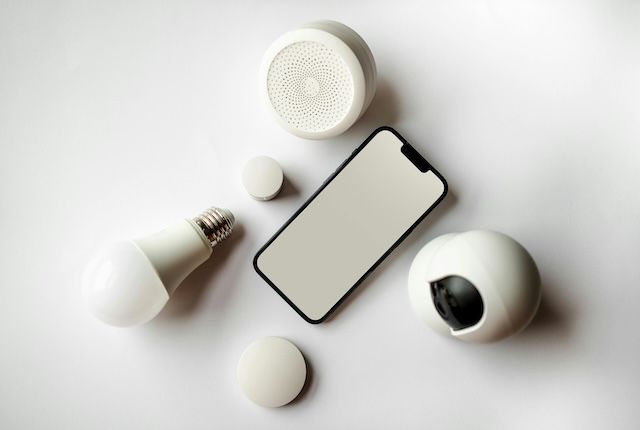
The Internet of Things (IoT) has become nearly as integral to daily life as cars and smartphones.
As you get ready, you can check the weather on your smartwatch and adjust your smart thermostat from your phone. When you drive to work, your connected car recommends the best route to avoid traffic congestion. Later, you might switch on your smart security system before going to bed.
According to IoT Tech News, 99% of UK adults have at least one smart device, and households have an average of nine IoT-enabled devices. Many businesses also use smart devices to monitor and improve their operations. Smart sensors allow manufacturers to track equipment performance in real time, while smart devices let doctors monitor patients from anywhere.
As the Internet of Things expands, the demand for skilled IoT professionals has soared. LinkedIn features UK job postings related to IOT in healthcare, sustainability, tech, and other industries.
This comprehensive guide covers everything you need to know about the Internet of Things, its applications, and future trends.
What is the Internet of Things?
The Internet of Things refers to networks of physical objects that communicate with each other and with computers through the internet. These interconnected devices share data and allow users to remotely control and monitor their environments.
A brief history of IoT
The “Internet of Things” was coined by Kevin Ashton in 1999, but this technology predates the term by two decades.
In the early 1980s, a group of enterprising Carnegie Mellon University students created the first modern IoT device. They equipped a Coca-Cola vending machine with a computer board that communicated with the ARPANET, a precursor to the internet. The students used this groundbreaking device to monitor the quantity and temperature of Coke in the vending machine.
Today, consumers and businesses use many types of IoT devices, including:
- Autonomous vehicles
- Pet tracking devices
- Smart fitness mirrors
- Smart home security systems
- Smart lights
- Smart washing machines
- Smartwatches
- Vacuum and mop robots
How does the Internet of Things work?
The Internet of Things can sound complex. You might wonder how devices can exchange data or how IoT can help users.
Let’s say you install a smart home security system from Ring. You can mount wireless security cameras around the outside perimeter of your house, while alarm sensors get placed inside on doors and windows. These IoT devices connect to the internet for continuous monitoring.
You can access and control these devices remotely through a smartphone app. Say an outdoor camera detects motion in your backyard. The device sends a notification to your phone, and you open the application to view live footage from the camera. If you spot an intruder, you can sound the siren remotely to startle them and contact the police through the app.
The Ring system also allows you to automate tasks. For example, you can schedule wireless flood lights to turn on at 7 pm before you leave work. Tech-savvy users can also integrate their Ring system with Slack, Evernote, and other platforms. You could create an automatic workflow that sends a Slack notification or pauses your iRobot vacuum when someone rings your video doorbell.
An IoT network like the Ring security system offers many benefits. Connected devices provide peace of mind by allowing you to monitor and control them from afar. They also increase convenience and help people with disabilities navigate the world more independently.
Top applications for IoT in business and consumer markets
You might assume that only tech firms use the Internet of Things, but that’s not the case. This innovative technology impacts individuals and businesses across virtually all industries. Here are some of the most popular IoT applications and their benefits.
Business applications
Companies can use IoT devices to streamline and improve business processes. Common applications include:
- Smart manufacturing - Many manufacturers equip their machinery with computer vision systems, smart sensors, and other IoT devices. These tools collect vast amounts of data and provide insights into the equipment’s performance. Businesses can use this information to predict maintenance issues and improve quality control. For instance, Rolls-Royce uses IoT sensors to track manufacturing processes in its smart factories.
- Supply chain management - Businesses can use IoT devices to track inventory across supply chains and improve logistics. IoT sensors allow supply chain partners to track a shipment’s movements and condition. Additionally, many retailers use smart shelf technology to monitor in-store inventories and automatically order products when stock runs low.
- Healthcare - Internet connected devices allow medical professionals to monitor patients remotely. For example, wearable devices like glucose monitors and smartwatches collect real-time health data and transmit it to healthcare providers. Doctors can use this information to develop personalised care plans.
- Retail - Many stores use industrial IoT devices to improve customer experiences and optimise operations. For instance, Tesco is piloting a scan-free self checkout system that automatically detects products in customers’ carts. This technology enables users to pay for their items without scanning them, saving time and eliminating self checkout frustrations.
- Energy management - UK utility companies use smart grids to improve sustainability and reduce waste. These grids include communication networks, metres, systems, and other devices. Utility companies use these IoT technologies to gather real-time data on energy consumption and optimise energy usage.

Consumer applications
Tech companies have developed a broad range of affordable consumer IoT devices, such as:
- Smart home devices - Individuals can use IoT devices to transform their homes into interactive tech hubs. Smart thermostats and lights allow users to create the perfect environment from their smartphones. Similarly, smart security systems let homeowners monitor their property remotely for enhanced safety. Consumers can even use smart fridges to check their butter’s expiration date or see if they have milk at home while grocery shopping.
- Wearable devices - Fitness trackers and smartwatches let consumers carry IoT technology wherever they go. These objects track activity and health data, such as heart rate and number of steps taken. This information helps users set fitness goals and monitor their overall well-being. Many wearable devices also connect with smartphones to receive notifications and texts.
- Connected cars - Vehicles increasingly use IoT systems to protect drivers and improve performance. For instance, IoT devices can collect and transmit data about fuel consumption, tire pressure, and other critical metrics. This information helps service centres make more accurate diagnoses and recommend predictive maintenance. Meanwhile, infotainment systems let drivers control smart devices at home and access traffic data. The popularity of connected cars will likely continue to grow due to the recent passage of the Automated Vehicles Act, which will enable self-driving vehicles to drive on British roads beginning in 2026.
- Personal health devices - Many IoT devices empower users to monitor their health without frequent doctor visits. For example, smart scales track weight loss, while smart pill dispensers remind users to take their medications regularly.
IoT and edge computing
Edge computing is a distributed computing framework that processes and stores data as close to the source as possible. This approach contrasts with traditional cloud computing, which centralises data management in remote facilities.
IoT systems often use edge computing to process data on local devices or as close to the edge of the network as possible. This method reduces latency, allowing IoT devices to provide outputs almost instantly. This efficient data transfer is especially beneficial for devices that need to detect stimuli quickly, such as autonomous vehicles and medical monitors. Combining IoT and edge computing also saves money by reducing bandwidth usage.
Edge computing is still an emerging technology, with many applications still in the early stages. For example, BT Group recently launched a Narrowband Internet of Things (NB-IoT) system in the UK. This network will enable the creation of smart cities by connecting to smart street lighting, underground water sensors, and other IoT devices. By using edge computing to process data locally, the system will increase energy efficiency and detect infrastructure issues earlier.
Top companies in the IoT space
Many businesses are dedicating significant resources to developing innovative IoT devices. Here are a few industry leaders driving advancements in connectivity technologies.
Global tech giants
Several large tech companies have invented revolutionary IoT applications and devices.
Google has developed Google Nest to give consumers more control over their homes. This comprehensive automation system includes smart doorbells, security cameras, speakers, and thermostats. Approximately one in four smart home users in the UK use Google Nest.
By contrast, Amazon’s AWS IoT platform targets commercial clients. It gives businesses the tools to create scalable IoT applications and manage data. For example, Centrica partnered with AWS to develop its Hive smart home devices.
Microsoft Azure also offers an IoT platform for organisations. Companies can connect millions of devices to the Azure IoT Hub and manage data efficiently. Microsoft has also supported the expansion of other IoT ecosystems. In 2024, for instance, the company announced that it would become an equity investor in Vodafone’s managed IoT platform as part of a $1.5 billion (roughly £1.138 billion) deal to expand internet connectivity solutions across Europe and Africa.

UK-specific IoT companies
UK companies have also pushed the boundaries of IoT innovation across many industries.
BT Group has made significant contributions to the Internet of Things. For example, the company recently filed a patent for a computer-implemented security method to prevent cybersecurity attacks on IoT devices. BT has also partnered with Nokia and MediaTek to trial 5G Reduced Capability (RedCap) technology. This cutting-edge technology simplifies 5G IoT devices to conserve battery life and decrease bandwidth requirements.
Arm Holdings is another UK-based company driving innovation in the global IoT market. The company is known for adding artificial intelligence (AI) and machine learning capabilities to IoT devices to improve performance and efficiency. For example, it has designed innovative IoT chips that aim to power AI on even the smallest IoT devices.
The future of IoT and careers in the industry
The Internet of Things industry has experienced rapid growth in the past decade, and this expansion shows no sign of slowing down. The annual revenue generated by the UK IoT market is projected to nearly double in the next five years, rising from £3.88 billion in 2024 to £6.36 billion in 2029.
Several factors are driving this expansion, including:
- Smart city initiatives - Several UK cities are building IoT networks to drive progress and support growing populations more effectively. For instance, Manchester’s Bee Network uses smart technology to integrate a sustainable transport system comprising buses, trams, bicycles, and walking routes.
- 5G innovation - In 2023, the UK created a £40 million fund to help create 5G Innovation Regions. These areas will build stronger wireless networks to accelerate IoT deployments.
- Artificial intelligence - The Artificial Intelligence of Things (AIoT) is one of the latest innovations in the IoT industry. This term refers to consumer and industrial IoT devices with AI capabilities. These smart devices use AI to collect data and make strategic decisions without human intervention. For example, smart cities use AIoT devices to automatically adjust street lights based on traffic flow, reducing energy consumption.
Common job titles and roles in IoT
The growth of smart devices will lead to new career opportunities for people with IoT and AI skills. Here are five in-demand roles to explore.
IoT Solutions Architect
An IoT Solutions Architect designs and implements IoT devices that address business needs. They work closely with stakeholders to develop tailored solutions that fit the organisation’s existing infrastructure and goals.
This role requires a combination of interpersonal and technical skills, including:
- Communication - Understand stakeholder needs and explain IoT concepts to diverse audiences
- Problem-solving - Develop innovative solutions to business challenges
- Programming languages - Proficiency in JavaScript, C++, or Python
Some IoT Solutions Architects become Product Managers and oversee the development of IoT devices. Others pursue careers as IoT Consultants or Chief Technology Officers.
IoT Software Developer
An IoT Software Developer builds and maintains IoT platforms and software. Some professionals specialise in industrial devices, such as pressure and proximity sensors for machinery. Others develop consumer devices like smart thermostats and clothing.
To pursue this career path, you’ll need these essential skills:
- Hardware knowledge - Understand how to integrate physical devices and software to design cohesive IoT systems
- Machine learning - Use machine learning algorithms to process and analyse IoT data
- UX design - Create accessible, user-friendly interfaces for IoT devices
IoT Product Manager
An IoT Product Manager oversees every stage of IoT product development, from ideation to maintenance. They collaborate with stakeholders to define the product vision and establish technical specifications. They also coordinate with IoT Software Developers to manage the product lifecycle and troubleshoot issues.
Here are a few essential skills for IoT Product Managers:
- Customer engagement - Work closely with clients to understand their needs and deliver IoT products that meet their expectations
- Leadership - Direct cross-functional teams and shape the product development strategy
- Market research - Analyze IoT industry trends, identify gaps, and develop competitive products
Data Analyst for IoT
Data Analysts build pipelines to collect data from IoT devices and transform it into meaningful insights. They use these findings to help business leaders make data-driven decisions.
For example, a Data Analyst might analyse sensor data from smart factories to forecast equipment failures. This analysis allows the organisation to develop a proactive maintenance plan, improving efficiency and safety.
If you want to become a Data Analyst, focus on developing these skills:
- Data visualisation - Use Google Charts, Tableau, and other software to translate complex datasets into accessible charts and maps
- Python and R - These programming languages allow you to perform advanced statistical analysis
- Structured Query Language (SQL) - Build, manage, and extract information from structured databases
IoT Security Specialist
The consumer group Which? estimates that smart devices can experience over 12,000 hacking or scanning attacks per week. An IoT Security Specialist implements cybersecurity measures to protect IoT devices from these threats. These protocols help safeguard sensitive data and maintain device integrity.
Essential skills for an IoT Security Specialist include:
- Communication - Educate non-tech experts about IoT cybersecurity best practices
- Penetration testing - Use ethical hacking tools to try to infiltrate IoT systems and identify security weaknesses proactively
- Risk assessment - Detect potential vulnerabilities in IoT systems and develop strategies to mitigate these risks
Acquire future-proof skills from Multiverse
Looking to take your career to the next level? Consi

der future-proofing your skillset with the help of an upskilling program from Multiverse.
Multiverse’s AI for Business Value program teaches working professionals like yourself how to use artificial intelligence to drive organisational change and solve complex problems. You’ll learn how to analyse data, communicate with stakeholders, implement AI tools, and more. As a Multiverse apprentice, you’ll also get access to our in-depth AI Jumpstart module. The best part? Program costs are absorbed by your employer, and you won’t have to take a break from work to gain the skills you need to advance your career.
Ready to start upskilling? Complete our quick application today to see if you’re eligible.