





We couldn’t find what you are looking for. Please try another way.
The Multiverse blog
Thank you! Your submission has been received!
Oops! Something went wrong while submitting the form.

Multiverse and Palantir partner to launch NHS FDP apprenticeships, supporting NHS transformation
News
Team Multiverse
Multiverse, the AI upskilling platform, and Palantir, a leading provider of AI-enabled software, are partnering to upskill staff on the use of the NHS Federated Data Platform (FDP) across the NHS. Together, the organisations will launch new, FDP-specific apprenticeship programmes, equipping staff with the critical AI and data skills needed to improve patient care and operational efficiency.
The NHS FDP, which is supplied by Palantir, connects vital data which is currently stored in separate systems, enabling staff to access the information they need in one safe and secure environment, and use it to improve how they work and deliver care for patients. It is currently delivering benefits such as more operations and quicker discharge in 77 NHS Trusts, with a further 73 signed up to the programme, along with 41 Integrated Care Boards.
This strategic partnership will leverage Multiverse’s proven capabilities in digital skills training to help NHS staff unlock the full potential of the NHS FDP to increase operations, improve care, drive up efficiency and drive down waiting lists. It marks a commitment to putting staff training at the heart of FDP implementation and broader healthcare data initiatives for patient benefit.
“To truly unlock the power of the NHS Federated Data Platform, the NHS needs a workforce that is confident and skilled in using data and AI,” said Euan Blair, Founder & CEO at Multiverse. “This partnership isn't just about implementing new technology, it's about investing in the people who will use it every day to make a tangible difference to patient care. We're proud to be a part of this crucial step in the NHS's digital evolution, deepening our existing relationship with the NHS.”
"The NHS FDP is already improving care for patients while cutting paperwork for doctors and nurses,” said Louis Mosley, Executive Vice President, UK and Europe at Palantir. “It has delivered 80,000 additional operations and reduced discharge delays by 15 per cent, while the Government is forecasting that it is on track to deliver £150 million of benefits each year by the end of the decade.”
“Now we need to double down on training to keep driving up the number of NHS staff who are trained on the technology – and this partnership will be central to that.”
Multiverse and Palantir will collaborate to create a suite of new apprenticeship programmes featuring training on the FDP, with the first cohorts launching in February 2026. The curriculum will be tailored to the unique needs of a diverse range of NHS roles, including analysts, administrators, managers and clinical staff. With a focus on practical, applied learning, the programmes will help NHS organisations implement the FDP directly into their work.
By further investing in the skills of its workforce, the NHS will reap the benefits of its technological investments, leading to improved operational workflows, more efficient resource allocation, and a tangible impact on patient health. This partnership represents a significant step towards unlocking the full potential of AI and data to support the NHS and its mission to deliver world-class care.
Multiverse's playbook for building an AI-powered workforce
Employers
Team Multiverse
As other People leaders scramble to compete for a scarce pool of highly skilled external AI talent, we have fundamentally shifted our approach to talent development to focus on building our own AI-ready workforce internally.
The shift: Hiring for AI will, not just skill
We recently launched a new hiring framework that focuses on assessing a candidate’s interest in AI. Why? Because we don't want to miss out on brilliant talent just because they haven't had the opportunity to engage with AI tools in their previous roles.
Our framework assesses candidates’ current level of AI competence through a series of questions and tasks built into our hiring process, matching them to one of four levels of AI maturity. The only group we exclude from hiring are those who demonstrate no will towards learning about AI. Everyone else, we’re confident we can equip with the necessary skills to fully adopt AI.
Bespoke onboarding: Building AI skills
This commitment to developing talent continues the moment a new hire joins. We have committed to our employees that they will become the most AI-powered versions of their profession.
Based on their assessed AI maturity, new hires are placed into a custom onboarding programme, receiving more than 20 hours of training in their first three months.
Demonstrable ROI: Quantifying the impact
Our internal upskilling isn’t just a feel-good initiative: it delivers measurable business impact. Last year, we grew our revenue per employee by 37% through strategic investments in AI and a cultural transformation to enable it.
We track several key outcomes, starting with tool usage. We’ve been able to demonstrate that those who engage with our AI upskilling programmes use our AI tools much more frequently than those who don't: for example, they log 73% more Gemini interactions.
We also look for impact stories, quantifying the results of the training, such as the reduced number of hours spent on certain activities or specific cost savings. Across our departments, we’ve logged more than 220 AI use cases created, representing how our team has reimagined their workflows to be more efficient and effective.
If you are a People leader looking to future-proof your organisation, the answer isn't a complex, expensive external hiring spree. The answer is empowering every member of your team with the skills and confidence to excel in the AI-driven future, right now.

Invisible AI workforce: How a startup employee built a £70k stock management system using AI
News
Team Multiverse
Recent Multiverse analysis of more than 2,500 people on AI apprenticeship programmes shows that over two-thirds are not in roles traditionally associated with tech. With AI learners with job titles like nurses, fundraisers, librarians and supply chain managers, we are helping to forge a new definition of ‘AI talent’.
This is the fifth piece in our series hearing from Multiverse's AI apprentices, based in varied jobs around the country. These learners are part of this emerging class of AI jobs - the 'invisible' AI workforce.
Birmingham is one of the top ten AI talent hotspots outside of London, according to our analysis of our 2,500+ strong AI apprentice base.
Read on to hear more about Birmingham-based startup employee Baljinder’s story.

Reducing stock waste at a nutrition company
For a growing nutrition business like Rem3dy Health, effective inventory management is critical, but a commercial ERP system can cost upwards of £70,000. Baljinder Singh, then a stock controller, was spending a full day each week manually tracking stock and updating spreadsheets.
Using skills from his AI apprenticeship, he designed and built a custom AI-powered dashboard that automates the entire process, creating a single, real-time view of all inventory. This has eliminated eight hours of manual work per week, improved accuracy, and reduced waste by providing a clearer picture of expiring stock.
Now Head of Supply Chain, a promotion earned through his initiative, Baljinder is expanding the project into a predictive tool that will function like a bespoke ERP system, saving the company tens of thousands of pounds and revolutionising its supply chain management.
Newark and Sherwood District Council launches AI training for 50 employees
News
Team Multiverse
Newark and Sherwood District Council (NSDC) is strengthening its digital capabilities by launching an AI and Data Academy with Multiverse. The 50-strong training cohort follows a successful pilot programme of 28 learners and will support the council to further increase digital literacy and AI adoption while helping to develop a digital culture that aligns with the council’s new Digital Strategy for 2025-2028.
With ambitions to become the most digitally equipped council, NSDC’s strategy aims to empower teams with the skills and knowledge to boost productivity through the use of AI tools and gather insights without the need for additional IT and technical support. This will help reduce admin bottlenecks and free up time that can be spent on improving public services.
Through the new Academy, staff will learn how to further improve efficiencies and make data-driven decisions through programmes such as ‘Data Insights for Business Decisions’. Meanwhile, the Level 3 ‘AI Powered Productivity’ will introduce AI fundamentals and upskill teams in tools such as Microsoft 365 Copilot and Gemini.
Sanjiv Kohli, Deputy Chief Executive at Newark and Sherwood District Council said: “Our new Digital Strategy builds on our commitment to empower our staff with critical and future-proofed skills, embracing key technologies and collaboration that yield smart and sustainable services to our region. With more change on the horizon, our partnership with Multiverse will help us to continue delivering on these commitments while building a digital-focused culture that ensures our services work for everyone. Our digital approach also ensures that no customer is left behind and through focusing on data led services, we really can target our services directly to our residents’ wants and needs providing them with the best service possible.”
Gary Eimerman, Chief Learning Officer at Multiverse said: “Public sector workers have a valuable opportunity to capitalise on the efficiencies that AI and digital skills can provide. By harnessing AI tools and improving digital capabilities, Newark and Sherwood District Council will be able to put AI-supported insights into action while improving productivity and preparing teams for future change.”
Multiverse is the upskilling platform for AI and tech adoption, which delivers personalised, on-the-job learning. Multiverse has trained more than 20,000 apprentices in AI, data and digital skills since 2016.
Over 1,500 companies work with Multiverse to deliver a new kind of learning that’s transforming the workforce at scale. Programmes are targeted at people of any age or career stage.
Multiverse Operating Principles: The blueprint for winning in the AI Era
Life at Multiverse
Team Multiverse
This is not a theoretical goal, it’s the driving force behind everything we do. Today’s workforce needs new skills to thrive, and without them, organisations and their employees will get left behind. We are going to transform both how our customers operate with AI, and crucially, how we operate with AI.
To do that, we’ve intentionally and strategically shifted our culture and established four new, highly actionable Operating Principles that define our standard of performance.
These principles aren’t just aspirational - they are embedded into how we work, how we hire, and how we measure performance at every level of the organisation. So if you’re joining the team or considering a role at Multiverse, be sure to read and understand how they might apply to your work.
The Operating Principles
These principles are an integral part of how we define high performance and potential. When we interview you, when we onboard you, and as you grow here - this is the standard we’ll measure against.
1. Solve for Customer Value
Every decision starts with: how does this create value for our customers?
We aren’t building Multiverse for ourselves. We’re doing it for the people who need and use the transformative upskilling that we make happen. Your work, regardless of your role, must connect back to our customers.
- The Multiverse Standard: You define the customer problem and the value of solving it before you start work. You choose the path that creates the most customer value, even when it’s harder.
- What we avoid: Measuring success by activity (features shipped) instead of customer outcomes (problems solved). Every workstream starts with a clear line of sight to the customer impact.
2. Drivers, Not Passengers
Be an owner, take accountability, and drive outcomes, while taking others along the journey.
We value accountability and proactively taking charge of your work, your career and the business’s success.
- The Multiverse Standard:You don’t duck the hard conversations - instead, you “Bottom line it”, which means solving problems the right way, not the easy way.
- What we avoid: Building for individual or department priorities over the business' best interest. You withhold bad news because it’s uncomfortable to deliver.
3. Be Decisive, Even in Ambiguity
Be bold: don’t stifle innovation through a fear of making the wrong call. Speed is the strategy.
To thrive in the rapid development cycle of the AI era, we must operate with velocity, valuing swift action over total certainty.
- The Multiverse Standard:We provide clarity on ownership so that everyone knows what decisions they can own. You embrace a test-and-learn mindset, finding opportunities to try out solutions and converting successful ideas into quality impacts. You course-correct quickly, and you challenge ideas early.
- What we avoid: Letting the fear of reversing a "fast" decision stallmomentum. We don't begrudge ambiguity, because change is part of Multiverse; we see it as an opportunity to own a problem and design a solution.
4. AI to Deliver Outcomes
AI is our engine, not an add-on. We become the defining case study for our customers.
This principle complements our ongoing transformation to being an AI-first business, ensuring we attract people that are AI-enabled, and willing to go on the upskilling journey to stay ahead of the curve.
- The Multiverse Standard: You ask “How would AI do this?” before starting any process improvement. You rethink existing problems as opportunities for design, not just resource, and explore AI solutions first. You demonstrate continual curiosity in AI, proactively upskilling,and always applying an ethical and compliant approach.
- What we avoid: Failing to engage with our AI-first approach or resisting AI-driven changes to workflows. We don't treat AI as a convenient tool, but rather as the core redesign approach for everything we do.
This is our operational standard for career and company success in the AI era. These four principles are how we deliver on that promise. If you’re excited by the challenge of transforming how the world works, and if you can embody these behaviours in our hiring process and beyond, then you are ready to lead the charge of transforming the workforce for tomorrow - here at Multiverse.

VIVO Defence Services launches data and AI training programmes with Multiverse to future-proof its team
News
Team Multiverse
Facilities Management company VIVO Defence Services has joined forces with upskilling platform Multiverse to provide its employees with data and AI training. VIVO is seeking to improve its team’s skills in data analytics, AI, and predictive modelling to help future proof its workforce and meet the increasing and changing needs of the Ministry of Defence (MOD).
As one of the largest providers of estate services to the MOD, VIVO collects crucial data. This partnership with Multiverse will enable VIVO’s staff to fully explore and utilise the insight this data provides.
The training programmes include Data and Insights for Business Decisions and AI for Business Value, designed to develop the technical skills required to effectively leverage data and AI to deliver business outcomes. This will empower the apprentices to make more informed operational business decisions.
The new training will inevitably play a part in ensuring VIVO has the resources in place to provide the best service possible for the Defence Infrastructure Organisation and carry out its important work for many years.
Paul Roberts, VIVO’s Energy & Sustainability Director and Innovation Champion, said: “The data we collect across our organisation is a strategic asset that provides us with real-time insights into the work we do. Further enhancing the way we use this data and AI to influence our operational business decisions will benefit our customer - the UK military. This is all about our mission to improve the lived experience for service personnel and to play our part in enhancing the UK’s defence capability.”
Gary Eimerman, Chief Learning Officer at Multiverse said: “VIVO Defence Services is demonstrating a clear commitment to its people and its mission by investing in these critical skills. By training its team in data and AI, it is not just future-proofing its workforce: it is directly enhancing its ability to serve the UK military and make a real-world impact. We are incredibly proud to partner with them on this journey.”
VIVO, which is 50/50 owned by Serco and Equans, works on behalf of the Defence Infrastructure Organisation (DIO). It provides maintenance, asset management and project management services at more than 100 military bases across the Buit Estate and at more than 27,000 Service Family Accommodation homes. It also works for the MOD’s Volunteer Estate and the government agency, the Defence Science and Technology Laboratory (Dstl).
These two new training programmes with Multiverse will strengthen VIVO’s commitment to provide employees with career enhancing training and development opportunities.
Maritime and Coastguard Agency saves 3000+ hours following data upskilling with Multiverse
News
Team Multiverse
The Maritime and Coastguard Agency (MCA) has saved more than three-thousand hours following the successful rollout of a data upskilling programme in partnership with Multiverse. The training of the 60-strong cohort has enabled the MCA to develop a data-first culture, supporting the organisation’s goal to harness data to improve safety at sea and to make our oceans cleaner.
Using new insights from machine learning and statistical modelling, data apprentices have started to drive significant value for the MCA, such as helping to predict vessel risks and environmental hazards and reporting on new insights across their remit.
Through improving and increasing the flow of data into the MCA Data Platform, utilising a Databricks data environment, learners have also driven improved uptake of data visualisation tools like Power BI across the agency. This helps key stakeholders like coastguards, surveyors and customer teams to do their jobs more effectively by enabling greater access to digestible, up-to-date information.
The training delivered by Multiverse, a Databricks and Microsoft partner, has assisted the MCA to drive greater adoption of data tools, and lay a strong foundation for developing more complex AI capabilities in the future. Combined with the Databricks data platform, the agency now has access to consistent and reliable data that is updated in near real time.
Since training began in 2022, nearly three quarters of the agency have become active data users with Power BI usage increasing from 43% to 94%. The MCA’s digital apprentices are now a primary engine behind data innovation, with over half of all 2024 and 2025 reports, dashboards, and apps created in the Power BI platform by an apprentice. The number of data super users, those who create multiple reports frequently, has also increased seven-fold since
the training.
Charis Doidge, Head of Data Science and Analytics at MCA said: “Ensuring safety in the maritime sector is our priority, and technology plays a key role in our ability to effectively deliver life-saving initiatives like responding to coastguard incidents and maintaining our UK Fleet.
“Multiverse’s training has helped our teams unlock insights from data, but it has also improved the adoption of data tools across the whole agency. The MCA Data Platform, which uses Databricks, gives us a foundation of analytically ready data, which is available 24/7 and refreshed daily. Now that we have this strong foundation, we’re excited to explore what’s next, including how AI can support our mission in saving lives, safer ships, and cleaner seas.”
One example of training in practice includes Senior IT Business Partner, Anna Stampira-Zerva, who harnessed skills curated during her programme to analyse the MCA’s coastal incident data and uncover regional and seasonal trends.
Gary Eimerman, Chief Learning Officer at Multiverse said: “At Multiverse, we want to make sure organisations don’t just have advanced tools, but also the skills and enthusiasm to use them effectively. As we’ve seen with MCA, improving data expertise in a long-term, scalable way across an organisation frees us time for more impactful work, improves productivity and opens doors to future AI opportunities.”

Invisible AI workforce: A Mencap charity fundraiser uses AI to transform learning disability support
News
Team Multiverse
Recently published Multiverse analysis of more than 2,500 of our AI apprentices shows that over two-thirds are in roles not traditionally associated with technology.
Nurses, doctors, surveyors and librarians are just some of the roles that make up our AI apprentice base, with learners based around the UK from Birmingham to Bradford, and Manchester to Milton Keynes.
This is the fourth in our series hearing from five of Multiverse's AI apprentices around the UK, who are part of this emerging class of AI jobs - that we’re calling the 'invisible' AI workforce.
Read on for Stephen’s story.

How an AI assistant is providing faster responses to people with learning disabilities
As Head of Public Fundraising at Mencap, based in Leigh-on-Sea, Stephen Mansfield is responsible for driving donations to fund Mencap’s work supporting and campaigning for people with a learning disability. A key channel of engagement is the charity’s Wills and Trusts service, which receives around 7,000 complex and sensitive queries each year from people who are anxious about their loved ones’ financial future.
Stephen built an AI-powered assistant that instantly searches Mencap’s expert knowledge base for answers, and helps coach the staff team to deliver excellent responses.
This smart tool dramatically speeds up response times, helping the team provide clear, accurate information to some of Mencap’s beneficiaries when they need it most.
Crucially, it is also designed to empower team members who have a learning disability to confidently and quickly find the right information for service users. Stephen is now exploring how AI can help create fundraising appeals, driving more donations for Mencap’s vital work.
AI ‘job crafting’ boosts employee engagement, Multiverse researchers find
News
Team Multiverse
The effect is activated by ‘task crafting’, with employees who redesign their roles seeing the most significant motivational benefits.
Employees who proactively reshape their jobs to incorporate artificial intelligence are significantly more engaged at work, according to a new study by researchers at Multiverse, the upskilling platform for AI and tech adoption.
The research, which surveyed 295 professionals who had actively used generative AI for at least six months, found a strong positive statistical relationship (R² = .184) between employee-AI collaboration and work engagement.
Crucially, Multiverse identified a key behaviour that unlocks this positive relationship: task crafting. This concept refers to the proactive steps employees take to alter the scope, number, or type of tasks that make up their job.
The study finds that the positive link between AI collaboration and employee engagement is stronger for employees who reported high levels of task crafting. For those who engaged in less task crafting, the relationship was not statistically significant.
Gallup’s latest employee engagement report shows that organisations scoring in the top quartile for employee engagement have 23% higher profitability, 18% higher sales and 78% lower absenteeism than those in the bottom quartile. If deeper AI collaboration could act to increase employee engagement, there is a clear case for employers to train their workforce to improve the quality of employees’ AI usage.
In turn, this could reduce the production of low-quality generative AI output, AI ‘slop’, which is created by low-effort engagement with AI tools.
The Multiverse study defines AI collaboration as the extent to which AI is embedded in core work cycles like problem-solving, drafting, and evaluation. Findings show that those who exhibit higher levels of AI adoption by this measure are more dedicated and absorbed in their roles, and thus score higher on employee engagement. This counters the prevailing narrative that heavy reliance on AI indicates lower quality of work output, and lower engagement with the work itself, as indicated by MIT’s study on ChatGPT reducing cognitive engagement.
“This research moves the conversation beyond AI as a tool solely for automation and efficiency," said Barry Goulding, organisational psychologist at Multiverse. "Our findings suggest AI can be a powerful job resource that directly fuels engagement - but not automatically. The benefits are activated by giving employees agency to shape their role around AI. This means they can transform their work from a collection of demands into a series of engaging challenges.”
"For business leaders, this is a playbook for maximising the return on their AI investments," said Laura Ball, Senior Director of Learning Science at Multiverse. “Companies must invest in a new kind of training that equips employees with the skills to become 'AI job crafters'. That means fostering proactivity, strategic thinking, and giving them the confidence to reimagine their roles - rather than using AI to create 'slop' at greater speed than ever."
These findings build on Multiverse’s growing bank of research into the mechanics of effective AI upskilling. Multiverse learning scientists recently unveiled the 13 critical durable skills required for AI adoption, including creativity, analytical reasoning and systems thinking.
Multiverse has trained more than 20,000 apprentices in AI, data and digital skills since 2016, working with over 1,500 companies to transform the workforce at scale. Programmes are targeted at people of any age or career stage.
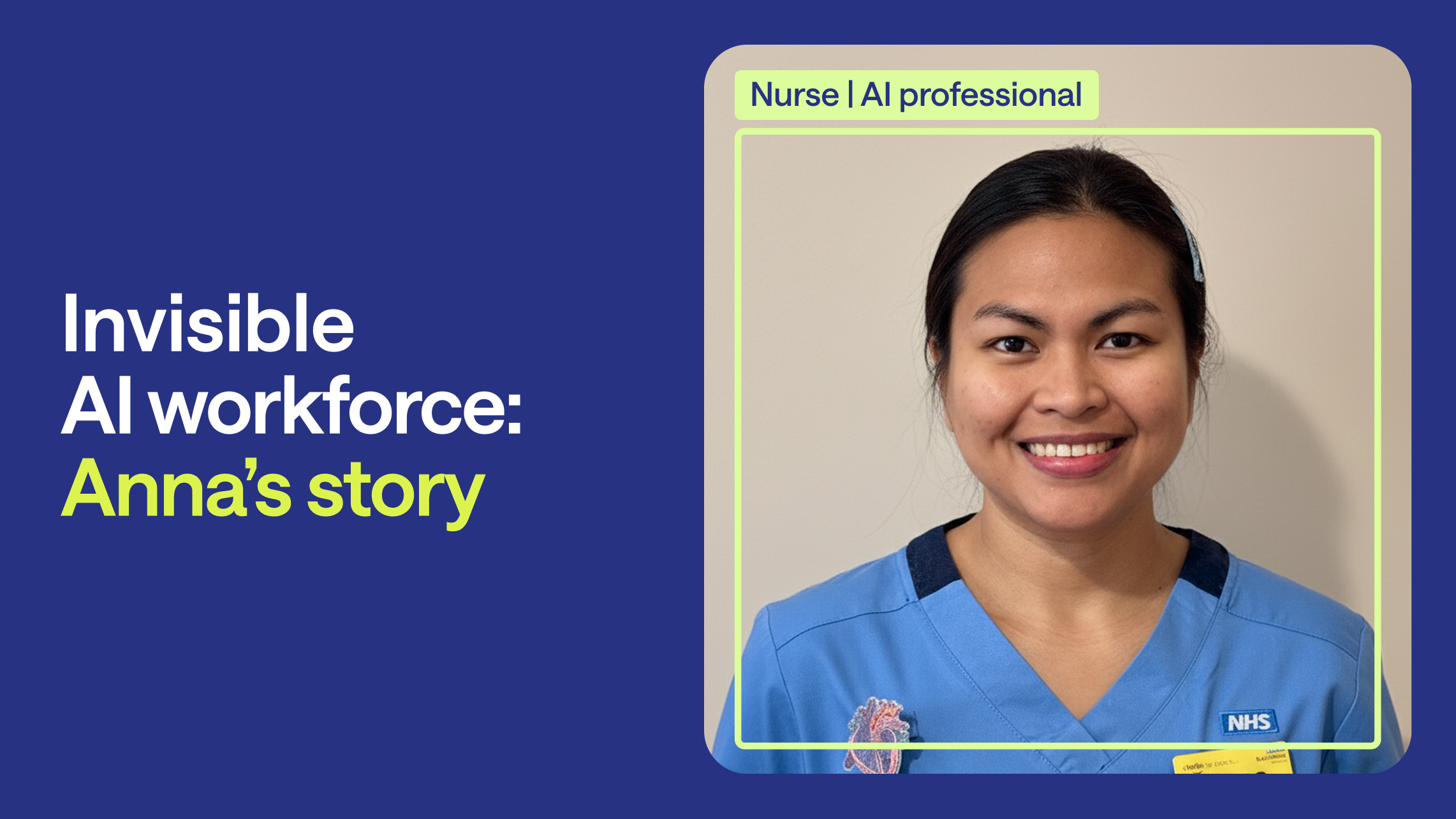
Invisible AI workforce: How a frontline nurse is using AI to give a voice to the critically ill
News
Team Multiverse
New Multiverse analysis of over 2,500 of its AI apprentices has revealed that over two-thirds of people applying AI at work are in roles not traditionally associated with technology, challenging the often narrow definition of ‘AI talent’.
Underlining this, the analysis shows that hospitals and healthcare is one of the top five industries with the highest density of AI apprentices outside of those classified by the ONS as ‘digital industries’. Nurses, doctors, psychiatrists, therapists and clinical leads are among the top 50 most common job titles in Multiverse’s AI apprentice base, demonstrating how front line workers are helping adopt AI in meaningful ways across the UK healthcare system.

This is the third in our series hearing from five of Multiverse's AI apprentices, based in varied jobs around the UK, who are part of an emerging class of AI jobs - the 'invisible' AI workforce.
Using AI to give a voice to intubated patients at Barts Health NHS Trust
In the critical care unit of Barts Heart Centre, senior nurse Anna Lazcano witnesses daily the challenges of intubated and tracheostomy patients, many of whom are unable to speak while they recover. This communication barrier can prevent clinicians from accurately assessing their needs.
Drawing from her frontline experience, Anna is pioneering "Project VOCAL", an innovative AI-driven tool to give these patients their voice back. The system is designed to use gesture tracking, speech synthesis and predictive text to help patients express their needs, even when mechanically ventilated. Bridging this critical communication gap would help hit key clinical goals like timely extubations, which in turn reduces complication rates and shortens hospital stays.
Sorry, no results found.