




We couldn’t find what you are looking for. Please try another way.
The Multiverse blog
Thank you! Your submission has been received!
Oops! Something went wrong while submitting the form.
Invisible AI workforce: From joinery to AI - the small business owner automating for growth
News
Team Multiverse
This includes nurses, surveyors, librarians and lecturers, challenging the narrow definition of ‘AI talent’.
This is the second in our series hearing from Multiverse AI apprentices, based in varied jobs around the UK, who are part of this emerging class of AI jobs - the 'invisible' AI workforce.
How AI helps reduce the burden of paperwork for one small business
An architect by trade, Rob Streather set up a small business with his brother in 2016. Now, running their bespoke kitchen and joinery practice, Shape London, means juggling everything from workshop safety to client strategy and marketing.

AI has helped Rob transform their operations by automating crucial but time-consuming administrative tasks. He has built systems to automatically collate complex health and safety documents and streamline machine inductions for new staff, improving workshop safety and simplifying compliance.
This has freed up invaluable time, allowing him to focus on business development and client-facing work. Rob is now using AI to assist with everything from creating marketing content to developing business strategy, enabling his small practice to operate with the efficiency and agility of a much larger firm.

AI is rapidly being adopted in critical sectors far beyond the technology industry. Underlining this, construction is one of the industries with the highest density of AI apprentices outside of those classified by the ONS as ‘digital industries’.
Invisible AI workforce: AI unlocks research innovation at the University of Manchester
News
Team Multiverse
In the coming weeks, we'll hear from five of Multiverse's AI apprentices, based in varied jobs around the UK, who are part of this emerging class of AI jobs - the 'invisible' AI workforce.

Using AI to unlock research innovation at the University of Manchester
Academic researcher Dr. Gail Millin-Chalabi has just closed out a project mapping the UK’s wildfires.
Having secured a promotion during her AI apprenticeship, in her new role as Head of Digital Reach at the University of Manchester Library, she is investigating how AI agents can improve access to the library's world-leading special and digital collections.
Drawing on her AI skills, Gail has also identified innovative solutions to streamline the completion of researchers’ Data Management Plans, a key part of the research lifecycle. This project will enable academics to concentrate on discovery and innovation instead of admin.
Not only will this speed up the pace of research, it will also bolster the university’s ability to attract and retain top academic talent, enhancing its reputation as a top global research institution.
In the analysis, Multiverse found that Higher Education was one of the top five industries with the highest density of AI apprentices, outside of those classified by the ONS as ‘digital industries’.

New research shows City is leading the way in the AI adoption, but falling behind on implementation
News
Team Multiverse
A survey of more than 14,000 white collar workers found that, of all the UK’s economic sectors, financial services is furthest ahead in the AI revolution. However, while it may be outpacing other sectors in adopting the technology, a new analysis of industry data reveals that its significant investment in AI has yet to pay off.
Recent research from AI upskilling platform Multiverse found that 67 per cent of financial organisations are using AI for process automation, yet only 37 per cent report transformative business results. The remaining 63 per cent are pouring money into AI technologies, without seeing a tangible ROI to match their level of investment.
This inefficiency is a major drain on productivity, with financial professionals spending an average of 2.7 hours per day on data tasks, according to additional Multiverse research. An estimated 32.5% of this time is spent ineffectively, leading to a loss of up to 25 days of productivity per year per employee that could be resolved through effective AI implementation. Those days, if recovered, could increase the sector’s economic output by as much as £28 billion.
Human capability is frequently cited as a blocker to realising the value of AI, but initial signs of overcoming this are not strong. Less than half (46 per cent) of financial services organisations are investing in AI upskilling, offering frequent and advanced training, and only 37 percent would rate their AI maturity ahead of competitors.
Financial institutions like Nationwide and Legal & General are leading the industry, investing in AI upskilling programmes through Multiverse. Their investment is already yielding results: Nationwide has seen learners save an average of one hour per week by applying their new skills. For instance, one apprentice developed a new workflow for data collection and management that saved 16 hours of work while also improving data accuracy.
Derrick Hastie, Chief Technology Officer, Asset Management at Legal & General has explained L&G’s philosophy on AI training this way: “AI isn't just a buzzword for us; it's a critical enabler of efficiency and growth. AI will soon be embedded in all our delivery teams, to help us create innovative solutions for our customers. But technology alone isn't enough. Education and skills are essential to ensure our people aren't just observers of change — they're active architects of it.”
By following these firms’ example and prioritising upskilling and empowering its workforce to effectively utilise AI tools, the UK financial services sector has a clear opportunity to solidify its position as the definitive leader in the AI era.

Nurses, lecturers, librarians, and surveyors lead AI adoption in the UK’s “invisible AI workforce”, finds Multiverse
News
Team Multiverse
Data shows geographically and demographically diverse AI workforce, with apprentices aged 19 to 71 and hubs emerging in Trafford, Birmingham, Cheshire West and Chester.
The UK’s artificial intelligence workforce is not confined to tech hubs and software developers, according to new jobs analysis from Multiverse, the upskilling platform for AI and tech adoption. Instead, an “invisible” AI workforce of nurses, librarians, surveyors, and doctors spread across the country are powering the UK’s burgeoning AI revolution.
12 million people in the UK are in ‘high-risk' occupations projected to decline in the next ten years due to technological change, according to the National Foundation for Educational Research. Reskilling opportunities, particularly in light of the UK’s aging population, must therefore be evenly distributed across the workforce to ensure everyone can benefit from AI’s productivity promise.
The analysis of over 2,500 people on Multiverse’s AI apprenticeship programmes reveals that over two-thirds (67%) are in non-tech roles - that is, roles whose job titles don’t include keywords related to tech, data and AI. Instead, among the 50 most common ‘invisible’ roles are frontline public service, education, healthcare and construction roles, including nurses, doctors, librarians, pharmacists, therapists, lecturers and surveyors.
Featuring in the full ‘invisible’ AI jobs list are occupations as varied as shipping clerks, biomedical scientists, charity fundraisers, creative directors, child protection workers, retail staff and merchandisers, tenancy managers, holiday let advisors – and even a herbarium curator.
The data underlines the fact that AI is rapidly being adopted in critical sectors far beyond the technology industry. Underlining this, the industries with the highest density of AI apprentices outside of those classified by the ONS as ‘digital industries’ are Financial Services, Government Administration, Hospital & Healthcare, Higher Education, and Construction.
Euan Blair, Founder and CEO of Multiverse, said: "Clinicians and council workers are just as integral to driving AI adoption as software engineers and data analysts. They are the ones finding practical ways to apply this technology to real-world problems, yet they're often a second order consideration. The UK has all the ingredients to become the original AI-first nation but we can’t get there by restricting AI use to the tech department. Meaningful progress will only come from upskilling everyone.”
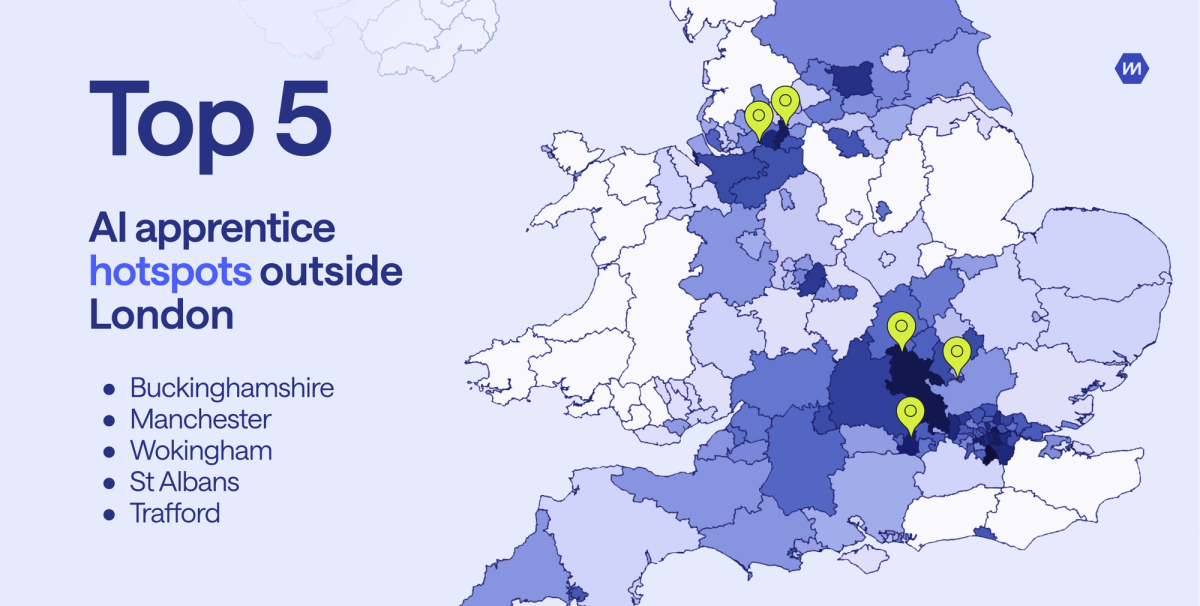
The analysis also maps the UK’s emerging AI hotspots, finding that while London remains a major centre, significant talent clusters are growing nationwide. The top ten districts with the most AI apprentices outside the capital include Trafford, Cheshire West and Chester, Leeds, and Birmingham. This geographic spread points to a democratisation of AI skills that is empowering regional economies.

Meanwhile, the top London borough for AI apprentice talent is Croydon, followed by Tower Hamlets, Lewisham and Wandsworth.
The UK’s emerging AI workforce is also made up of a diverse mix of ages and genders. The gender split is nearly even, with 45% of AI apprentices identifying as female and 54% male – compared to the 22% of women working in AI roles in the UK as a whole. The age range also spans from 19 to 71. This points to how workers at every career stage are embracing AI, from early talent to experienced workers seizing the opportunity to reskill.

Anna Lazcano, a nurse at Barts Health NHS Trust, is building an AI solution that can interpret communications from intubated and tracheostomy patients using gesture tracking and speech-to-text technology. She said: "Effective AI solutions in healthcare have to be driven by frontline clinical needs. My experience in critical care means I understand the requirements of my patients -- and now AI skills have essentially given me a new clinical tool to address their needs."
Stephen Mansfield, a fundraiser at Mencap, has built an AI assistant that surfaces relevant information to respond to the 7,000 annual queries received to its Wills and Trusts information service, vastly speeding up the pace of response. He said: “I never thought I’d be building AI tools within my charity role, but I’m now using AI to improve the services we offer to people with a learning disability and their support networks. It’s opened up a new dimension to my career and is delivering real efficiencies for the organisation, meaning that we can reach more people with our service.”
Multiverse is the upskilling platform for AI and tech adoption, equipping the workforce to win in the AI era. Multiverse has trained more than 20,000 apprentices in AI, data and digital skills since 2016, and has committed to training 15,000 AI apprentices in the next two years.
Over 1,500 companies work with Multiverse to deliver applied learning that’s transforming the workforce at scale. Programmes are targeted at people of any age, role, location and career stage.

Multiverse and NHS Apprenticeship teams collaborate to create a future-ready healthcare workforce
Employers
Team Multiverse
Together, in collaboration with NHS HR, Apprenticeship & Workforce professionals, we've successfully upskilled hundreds of NHS staff members across 100 NHS Trusts. This isn't just a number: it represents a fundamental transformation in how healthcare is delivered, from the frontline to the back office, as staff gain the confidence and expertise to harness the power of technology.
Our partnership was born with the aim of empowering existing NHS staff to drive innovation from within. In a sector with increasing demands and shrinking resources, data and AI present a much needed solution to a growing problem.
“Data more so than ever is a critical commodity in the NHS to support decision making, driving more efficient and effective outcomes for patients. We partnered with Multiverse to upskill our community in data science specialisms, and over the past 18 months, we’ve seen apprentices directly apply their learnings to deliver real results.”
Barbara Begg
Head of Central Commercial Function – Commercial Capability at NHS England
"We identified digital literacy as a key learning need early on, and our partnership with Multiverse supported us in addressing it through high-quality apprenticeships. The Multiverse team has always been responsive and collaborative, making it easy to support learners and keep momentum going.”
Roxanne Moran
Talent, Learning and Development Manager at National Institute for Health and Care Excellence
Apprentices are already putting their new skills to use, building innovative solutions that transform their work.
At Royal Free London NHS Foundation, an administrator migrated patient management processes to a digital system, doubling the daily department case load from 30 to 60 patients and reducing wait times from more than 30 minutes, to only 10.
Meanwhile at Medway Foundation Trust, an endoscopy nurse built a Power BI dashboard to automate the theatre audit processes, reducing delays, minimising errors and enhancing resource allocation.
None of this would have been possible without the hard work of HR, Apprenticeship & Workforce professionals across the NHS, who have supported learners to achieve these incredible results, in partnership with senior executive leadership teams.
"The NHS has the highest potential to benefit from technology of any institution in the UK, and its commitment to upskilling its people with the digital and AI skills needed for the future is a testament to its leadership,” said Euan Blair, Founder and CEO at Multiverse. “We've been consistently inspired by the apprentices and the leadership teams who have championed them—they are the true innovators, driving change to make a tangible difference in patient care and operational efficiency."
“Working with Multiverse has been seamless from our very first conversation. The team is responsive, supportive and willing to adapt to our needs as an organisation. Multiverse has also been very effective at understanding our strategic objectives, ensuring our apprenticeships have maximum impact to improve our processes, and ultimately, the delivery of care.”
Samantha Ibison
Apprenticeship and Employability Lead at Leeds & York NHS Trust
We really have enjoyed working with Multiverse – they’re engaged, responsive, and flexible to the changing (and sometimes conflicting!) needs of a big organisation like ours. The apprenticeships have been really popular and are clearly helping us meet the needs of our workforce. We’re excited to continue our partnership with Multiverse and to see the lasting impact it will have on our staff and the care we provide to patients.”
Susana Lucena-Amaro
Associate Director for Learning & Development and Apprenticeships at Barts Health NHS Trust
By equipping the NHS workforce with the latest digital and AI skills, Multiverse is not only helping individuals grow their careers but also empowering the entire healthcare system to become more efficient, innovative, and resilient.
The staff Multiverse has trained are now the data champions, the digital pioneers and the AI innovators who are helping to make the NHS more ready for the challenges of tomorrow.
South Gloucestershire Council expands training in latest upskilling and digitisation drive
News
Team Multiverse
South Gloucestershire Council is doubling down on efforts to leverage technology and drive efficiencies by training more of its team members in AI and data skills. Following a successful pilot programme, delivered by Multiverse, the council has extended the training, bringing the total number of learners to 60 in efforts to continue improving local services for South Gloucestershire residents.
The Transformation Academy builds on initial training to equip more of its people with the skills to enhance organisational performance, modernise processes and secure cost savings, extending the scope of training to feature AI programmes. Digital skills gained from these courses have already seen team members secure thousands of pounds worth of savings across the council, and hours of time through increased efficiencies.
Multiverse’s Skills Intelligence Report found that nearly 30% of local government employees’ time working with data is spent unproductively. This skills initiative marks South Gloucestershire Council’s efforts to empower its employees with the training they need to drive greater efficiency and impact, in turn benefiting local residents.
The new academy will see staff enrolled from all three of the major areas of the Council, such as the ‘People’ Directorate, including Housing, Children and Adult’s Care, Education and Public Health, as well as Resources and Business Change and the 'Place' Directorate, which includes Planning, Place Shaping, Operations and Streetcare. This demonstrates the broad-reaching efforts to upskill the organisation’s data and AI capabilities, which will ensure decision making is evidence-based and existing manual processes are streamlined.
Key to the new cohort’s training will be the inclusion of AI programmes, such as the Level 4 AI for Business Value and Level 3 AI Powered Productivity. These programmes will introduce AI fundamentals and boost engagement with tools like Microsoft 365 Copilot and Gemini, building on the success of previous training.
Programmes also include ‘Data Insights for Business Decisions,’ which equips teams with the technical skills and knowledge to confidently navigate the data landscape, and the 13-month ‘Data Fellowship’, which is a Level 4 apprenticeship upskilling data-literate staff into high-performing analysts and data science professionals.
Nigel Riglar, Executive Director of Place at South Gloucestershire Council said: “This training is already helping us make better decisions, cut costs, and modernise how we work. By adding AI skills, we’ll go even further in delivering the best service for our residents.”
Gary Eimerman, Chief Learning Officer at Multiverse said: “Our research shows that many councils struggle with a data skills gap. Through this Data & Business Academy, South Gloucestershire Council will give its team members boosted confidence in data, ultimately enabling them to deliver better service outcomes for local residents.”

Ready to Win in the AI Era? Join Multiverse: The Upskilling Platform for AI Adoption.
Life at Multiverse
Team Multiverse
We are the upskilling platform for AI adoption, and that begins right here, with our own team. If you're looking to not just participate in the AI revolution but to lead it, you've found your home.
Why AI at Multiverse is different: Your opportunity to drive impact
We're taking a fundamentally different approach to AI. We don't just talk about AI, we embed it into our very DNA. Our commitment to upskilling for AI adoption isn't just for our customers; it's a core part of how we build our own world-class team.
We understand that AI skills are in high demand, and they come at a premium. But we also recognise that when a technology is advancing as fast as AI, a willingness to continually learn is just as crucial as existing skill. Without constant upskilling, even those who are advanced in AI today stand to fall behind.
Our unique approach to hiring and onboarding ensures we bring in not only individuals who are already proficient in AI, but also those who possess the curiosity and drive to explore its possibilities.
How we're investing in your AI journey: Consequential growth from day one
We're evolving our hiring and onboarding to ensure that every new Multiverser is set up for success in an AI-driven world. Here’s how our unique approach will benefit you, delivering tangible, measured outcomes for your career:
Smarter hiring: Recognising your true AI potential
Our enhanced interview process goes beyond basic checkboxes. We've integrated AI acumen into our core competency framework, assessing your proficiency with a nuanced, tiered approach:
- Foundational Skills & Explorative Mindset: You're keen to learn and ready to engage with Generative AI tools. Your "will" to embrace AI is what matters most here.
- Deeper Expertise & Frequent Use: You consistently use AI tools in your work and demonstrate a solid understanding. Here, we're looking for both your "skill and will."
- High Proficiency & Leadership: You're not just using AI; you're leading the way, pushing boundaries, and inspiring others. We see you as an AI leader.
This tailored assessment, incorporated into our interview questions and tasks, means we understand your starting point and can better support your growth, aligning with our commitment to driving impact through learning.
Bespoke onboarding: Accelerating your AI capability with impact
Forget generic training. Once you join Multiverse, your AI journey is personalised based on your assessed skill level, ensuring you get the most relevant and impactful development from day one:
- Pathway 1: If you're coming in with a strong "will" and foundational AI understanding, we'll fast-track your learning. Within your first three months, you'll complete four essential "Everyday AI" modules and dive into our intensive "AI Skills Accelerator" programme. This pathway is designed to rapidly upskill you, transforming your curiosity into concrete capability and demonstrating our belief that learning should drive impact.
- Pathway 2: For those with deeper expertise and a track record of high proficiency, you'll directly engage with the "AI Skills Accelerator" in your third month. This timing ensures you have the foundational business context to apply your advanced AI skills for maximum impact, making you an immediate driver of innovation.
This isn't just about training; it's about cultivating a workforce that is truly AI-proficient and future-ready, embodying our mission to empower the workforce with AI. We're committing to helping you become the most AI-enabled professional in your field, unlocking new levels of productivity and innovation.
Join us: Shape the future of work with multiverse
If you're ready to be part of an organisation that genuinely invests in your growth and empowers you to lead in the AI era, Multiverse is the place for you. We're not just hiring for today: we're hiring for the future, and we invite you to build that future with us.
What is transformational leadership?
Apprentices
Team Multiverse
With the ground constantly shifting under their feet, many employees are naturally turning to their leaders for guidance. But only 39% strongly agree that their leadership is visibly supporting transformation, according to Multiverse’s Skills Intelligence Report 2025.
With the AI revolution just getting started, employees need inspiring leaders to help them adapt. The answer? Transformational leadership. It focuses on creating positive change and motivating teams to grow.
Looking to take on more responsibilities in your current role or level up your career? Gaining transformational leadership skills will help you guide your workplace into the future.
What is transformational leadership?
Transformational leadership embraces new ideas and motivates employees to face change with enthusiasm and positivity. It’s all about empowerment and bringing people together to achieve a shared vision.
This leadership style is the opposite of the transactional leadership approach, which uses rewards and punishment to motivate followers. It’s a stricter approach that centers on hierarchies and structure.
Is a development team dreading working on a tricky update? A transformational leader will rally them to the cause and build excitement, while a transactional leader might say, “Do it by Friday, or you’re getting written up.”
Similarly, a transformational leader could encourage junior employees to pitch product ideas. But the transactional leader might only let senior staff weigh in — or, more positively, offer an incentive for the best suggestion.
As you might guess from these examples, the transformational approach often works better with today’s workers, who are less tolerant of unfair or harsh leadership. In fact, 67% of UK employees have quit or thought about leaving a job due to poor management.
Younger workers are also quick to reject the usual workplace status quo. Only 14% of Gen Z professionals believe traditional hierarchies work, and 30% would prefer a team-based structure.
Transformational leadership responds to these changing expectations by creating a supportive environment — one without any Devil Wears Prada-esque tyrants.
The four pillars of transformational leadership
Transformational leaders might sound like cheerleaders or especially chipper coaches, but this approach is actually quite nuanced. Here are four key components of transformational leadership:
Idealised influence
Transformational leaders don’t keep their core values a secret. They’re role models who lead by example. Someone who cares about open communication, for instance, might hold monthly town halls or explain why they promoted one employee over another.
They also inspire followers to focus on personal growth. This could be as simple as talking about how you’re upskilling by learning prompt engineering or showing your latest surreal Midjourney creation.
Inspirational motivation
A transformational leader encourages followers to work together to accomplish something great, whether that’s building a hospital or just fixing a bug. They’ve got a compelling vision that inspires motivation and enthusiasm, even when the team faces challenges.
For instance, GSK CEO Emma Walmsley reenergised the stagnant pharmaceutical company by shaking up the leadership team and investing more in consumer healthcare products and vaccines.

Intellectual stimulation
Challenging assumptions is another hallmark of transformational leaders. They invite team members to look at problems and opportunities from new angles, which helps inspire innovation.
In 2014, Anne Boden founded Starling Bank, one of the UK’s first fully digital banks. At first, potential investors were sceptical — or downright derisive. “Nobody believed me!” she explained in a McKinsey interview. “People thought building new technology was impossible and also impossible to build from scratch.” Despite these doubts, Starling Bank now earns hundreds of millions of pounds in revenue.
Individualised consideration
Transformational leaders focus on mentoring team members and offering personalised support. For example, they may schedule monthly one-on-one feedback sessions. They also value continuous learning and create opportunities for employees to learn new skills like data analytics or public speaking.
Why develop transformational leadership skills?
Like public speaking or writing a memo, mastering visionary leadership takes effort and practice. Here are a few reasons why it’s well worth the investment.
Elevate your career
Almost three out of four tech leaders plan to invest more in AI in the next one to two years. That means transformation isn’t stopping any time soon.
Becoming a transformational leader can help you handle these changes with confidence — and, more importantly, get your team excited about what’s coming. For example, you might organise workshops on new AI tools or mentor individual followers who want to learn how to use Tableau. A little encouragement and positivity can make change — well, maybe not fun, but motivating.
Plus, gaining transformational leadership skills can future-proof your career. According to the Future of Jobs Report 2025, the top five in-demand skills are:
- Analytical thinking
- Flexibility and agility
- Leadership and social influence
- Creative thinking
- Motivation and self-awareness
These are also key traits of an effective transformational leader — and that’s not a coincidence. Employers are actively searching for people who can lead change and help their organisations adapt.
Lift your organisation
The transformational leadership style also directly influences organisational effectiveness. And no, you don’t need to be a CEO or even a C-level executive to make an impact.
When employees feel valued and supported by their leaders, they have a better experience. For example, nurses who worked with transformational leaders during COVID-19 had higher job satisfaction and reduced burnout. Other research shows that transformational leaders create an “innovation climate” and promote employee well-being.
The transformational style also improves retention. Take Savers’ “We Love Ideas” initiative, which invites employees to share their thoughts and help shape the company’s direction. Programmes like this have encouraged the retailer’s staff to stick around, with 28% of workers staying between six and 20 years.

How to start building these skills
You don’t need to take on a management role to learn inspirational leadership. These strategies will help you level up your abilities, no matter where you’re at now.
Look for structured learning opportunities
While you can definitely study transformational leadership by yourself, a structured programme will give you a well-rounded foundation.
For example, Multiverse’s free Transformative Leadership programme teaches practical leadership skills. You’ll learn how to lead change, manage diverse teams, and use AI to support your organisation’s mission. It’s all designed to help you lead high-performing teams, either in your current role or the next one.
Seek feedback from leaders you trust
Getting constructive criticism may seem scary, but it’s an unavoidable part of professional development. Plus, honest feedback is a key part of transformational leadership, so you might as well start early.
For the best results, don’t just ask your supervisor, “Am I a good leader?” You might just get a yes or no. Instead, ask specific questions like these:
- What are two areas I should focus on to become a better leader?
- I’m working on improving my creative problem-solving skills. Any tips?
- What can I do to collaborate more effectively with team members?
- How would you rate my communication skills during that presentation on Tuesday?
Go into every feedback session with an open mind, and don’t respond defensively. If someone tells you that you struggle with critical thinking, for instance, you might join a debate club or play logic games to improve.
Strengthen your emotional intelligence
Emotional intelligence means you can recognise and manage your feelings, while also understanding and — this is key — empathising with others.
As a leader, this skill helps you create a sense of psychological safety where team members feel comfortable expressing themselves. For example, if an employee seems nervous about a big presentation, you can notice it and offer support.
People often assume that emotional intelligence is innate, like a sixth sense, but it’s just as learnable as data analysis or coding. Here are a few ways to improve it:
- Study the psychology of body language, like how stiff shoulders can be a sign of anger or anxiety.
- Practice deep breathing exercises during stressful situations, like a meeting with an upset client.
- Use a mindfulness app like Headspace or Happify to get in tune with your emotions.
Practice vision-setting
A great transformational leader knows how to set a clear vision, whether that’s reshaping the organisation’s goals or just convincing skeptical team members to try a new accounting software.
These strategies will help you become a visionary leader that people are eager to follow:
- Imagine the absolute best-case scenario for your organisation in five years, and consider how you might get there.
- Hold a vision-a-thon with your team to play with ideas and scenarios.
- Use storytelling techniques — like metaphors or even characters — to make your vision feel real.
Take the next step with Multiverse
Become a change-maker with Multiverse’s Transformative Leadership programme. Over 15 months, you’ll build your leadership skills through asynchronous modules, interactive workshops, and coaching from leadership experts. For more specialised content, join the optional Women in Leadership modules.
Plus, about 70% of the apprenticeship involves hands-on projects in your current role. That means you get to start using your new leadership skills immediately, gaining real experience as you learn and earn.
Ready to transform your career and your organisation? Fill out our quick application today.

8 time management tips for busy professionals in the AI age
Apprentices
Team Multiverse
If all those responsibilities make you feel overwhelmed, you’re not alone. Nine out of ten UK employees say they’ve experienced high or extreme pressure in the last year.
You probably can’t cut your to-do list in half — at least, not if you want to advance your career. But you can get more done with less stress with these time management tips.
Spotting the signs of poor time management
Sometimes, it’s hard to recognise that your time management skills are lacking. Sure, you might be crossing things off your list and meeting most of your deadlines. But that doesn’t necessarily mean you’re being productive — or finding a healthy work-life balance.
You probably need help managing your time if:
- You’re always scrambling to hit deadlines at the last minute.
- Most days, you add more to your agenda than you finish.
- Important tasks at home keep getting overlooked, until you realise you haven’t vacuumed in weeks.
- You constantly stay late at the office or spend half your Saturday working to get everything done.
- Sometimes, you don’t even know what to start working on.
- You rarely have time to upskill, so you feel like you’re falling behind your colleagues.
Look out for sneaky time wasters, too. You might spend hours reading emails or trudging to boring meetings. Or maybe you’re multitasking all the time, like typing out a memo while you nod along in a Zoom meeting. These nonproductive activities may make it seem like you’re doing a lot, but they’re actually making you less efficient.
8 ways to take back control of your schedule
You can’t pick and choose all your tasks, but you can control how you handle them. Get ahead with these simple time management strategies.
1. Set clear goals and priorities
Creating goals is the foundation of effective time management. They help you prioritise tasks and say no to things that won’t help you move your career forward.
Use the SMART framework to set professional and personal goals that are:
- Specific - Imagine what you want to achieve in detail.
- Measurable - Make sure you can easily track your progress.
- Achievable - Pick something you can realistically accomplish with your current resources.
- Relevant - Your objectives should fit your long-term career plan.
- Time-based - Set deadlines and milestones.
Let’s say you’re a Software Developer with a mile-long debugging backlog. You could aim to clear out half of it in two months by fixing at least five bug reports a week.
Once you’ve got your big goals, don’t just stick them at the top of your to-do list. That’s too intimidating. Instead, break them down into bite-sized tasks that you can chip away at. Want to clear out hundreds of unread emails in your inbox? Schedule two blocks a day to answer and delete messages, and set time limits so you don’t get lost reading months-old emails.
As you work on your goals, the Eisenhower Matrix can help you spot high-priority activities. It sorts tasks into four quadrants:

For example, reading random e-newsletters goes in the “delete it” category, so use the unsubscribe button liberally. A time-sensitive client email, on the other hand, needs an immediate response.
2. Build a realistic weekly schedule
A digital calendar can significantly improve time management at work and in your personal life. Choose a mobile-friendly platform like Google Calendar so it’s always accessible.
Before you open your calendar, write down all your upcoming tasks and sort them by priority, like this:
- High: Client presentation on Friday, report due Monday morning
- Moderate: Daily standup meetings, study sessions for learning data analysis skills, walking the dog every evening
- Low: Checking email, putting away laundry
Estimate how much time you’ll need for each item, and be honest with yourself. If that detailed report usually takes four hours, don’t say you can do it in three, or you’ll just feel stressed.
Use this list to start mapping out your weekly schedule. Create colour-coded time blocks for similar tasks — like meetings and presentation prep time — so you can see what’s coming up at a glance. Schedule at least a few hours a week for deep focus, too, so you can work on creative tasks without interruption.
And don’t forget to pencil in plenty of breaks and buffer time. Sure, you could rush to six back-to-back meetings, but you’ll probably feel too drained to work on anything else. Regular breaks reduce stress and improve your overall well-being.
3. Tackle challenging tasks first
You’ve got limited energy, no matter how much coffee you chug. Start your day by “eating the frog” — a.k.a starting with the hardest or most urgent tasks on your list. This helps you build momentum and frees up time later for routine tasks.
The Pomodoro technique can help you maintain focus for those big tasks. It breaks work into 25-minute intervals, followed by five-minute breaks. After you complete four pomodoros, take a longer 30-minute break. This strategy lets you accomplish tasks faster without burning out.
Whenever possible, avoid packing your schedule with too many difficult tasks. Quality over quantity is key to protecting your mental health and productivity.
4. Minimise distractions
While most time management tips focus on doing more, you should also cut down on tasks that sap your attention. Social media and texting are two of the biggest culprits. Turn off notifications during focus time and use app blockers to stop yourself from scrolling on TikTok for “just five minutes.”
A tidy workspace can also help you concentrate. Get rid of clutter, such as random bobbleheads and knick-knacks, and create quiet zones free from unnecessary tech.
5. Use the right tools
Many professionals use time management tools to stay organised. Here are just a few options:
- Toggl Track to record your time and see where it’s going
- Digital calendar apps to schedule tasks and set reminders
- Forest to encourage you to put your phone away and focus
- Todoist to track and manage tasks
Experiment with a few programmes to see what works best, but don’t feel like they’re mandatory. If old-fashioned sticky notes and written calendars boost your productivity, stick with that.
6. Organise notes and tasks in one place
Nothing wastes time like searching for a scrap of paper on a messy desk — or worse, trying to remember something that your boss told you three weeks ago.
Save time by jotting everything down in a digital note-taking app like Notion or Google Keep. Keeping everything together decreases stress by making sure you always have clear, up-to-date information.
7. Avoid procrastination with small wins
Nothing kills motivation like slogging through an ocean of tasks. Give yourself something to celebrate by setting micro-goals. A major white paper might take days to complete, but treat yourself to a fancy coffee after drafting each section. Little victories will help you stay motivated and recognise your progress.
Don’t let perfectionism paralyse you, either. Just start, and tell yourself you can always fix it later.
The two-minute rule also stops little tasks from piling up. If something takes less than a couple of minutes, do it right away, even when you don’t feel like it.
8. Review and adjust your system
Mastering time management won’t happen overnight, especially if you’re a chronic procrastinator or easily distracted.
Start small by choosing just two or three of these practical strategies to increase productivity. At the end of each week, spend 10 minutes reviewing your progress and analysing how you’re spending time.
Not making progress? Try new time management apps or switch up how you prioritise tasks. You could even use AI to automate basic tasks like sending appointment reminders to clients.
Above all, flexibility is key. Your personal life may get busy, or you might decide to focus more on upskilling. Adapting your time management system will keep everything moving smoothly.
Apply these skills in your Multiverse journey
Time management skills can benefit all professionals, but they’re especially critical for apprentices. Techniques like time blocking and the Pomodoro method will help you balance work, training, and projects.
Multiverse’s free Project Management and Transformative Leadership apprenticeships allow you to apply and build these valuable skills. You’ll learn how to delegate tasks and identify areas for improvement in your organisation. These hands-on programmes also help you future-proof your career with in-demand AI and leadership skills.
Complete our quick application to learn more about how a Multiverse apprenticeship can improve your time management.
The 7 best project management courses in the UK for 2025
Apprentices
Katie LoFaso
Virtually every industry relies on Project Managers, from construction to healthcare and tech. These professionals don’t just tell teams what to do. They lead transformation and manage rapid changes, such as artificial intelligence and supply chain challenges.
There are plenty of opportunities for project management training in the UK, but they’re not all created equal. You need a flexible course that fits your hectic schedule and goes beyond memorizing Agile jargon. Here are seven of the best project management courses. With a mix of accredited, free, and hands-on options, there’s something for every upskiller.
1. Multiverse Project Management Course
Multiverse’s Project Management programme provides paid, on-the-job training through an apprenticeship model.
It’s designed for working professionals without a traditional university degree who want to gain real-world experience. The structured curriculum teaches you how to plan and deliver projects successfully while leading diverse teams.
Learn in-demand project management skills that employers are seeking, including:
- Agile, hybrid, and waterfall approaches
- Budgeting
- Quality control
- Risk management
- Stakeholder communication
- Strategic thinking
- And much more
As an apprenticeship, Multiverse also places a lot of emphasis on hands-on learning. You’ll immediately start applying what you learnt by managing projects at your current employer. For example, you might try the Agile project management approach to see if daily stand-ups actually help your team communicate better.
Multiverse’s apprenticeships are completely free for students, and you’ll earn a salary as you learn. They also include one-on-one coaching from experienced project professionals and networking with a community of ambitious, supportive peers.
Duration
13 months for course delivery, plus two months for assessment
Price
Free for students
2. APM Project Fundamentals Qualification (PFQ)
Interested in beefing up your CV with an industry certification? Consider the Association for Project Management’s Project Fundamentals Qualification (PFQ).
This certificate is designed for early-career professionals who are still learning all the jargon and basic techniques. It covers introductory topics, including project life cycles and scope management.
You can study online for the PFQ by yourself, or take a short course with an APM Accredited Training Provider. You’ll also need to pass the one-hour, 60-question exam to earn the official APM PFQ certification.
Duration
Typically two to three days with a Training Provider
Price
The certification exam costs £238.80 for APM members and £256.80 for non-members. The cost for accredited courses ranges from £324.17 to over £1,300.
3. PRINCE2® Foundation and Practitioner Certification
PRINCE2® stands for Projects in Controlled Environments. This structured approach was originally developed by the UK government in the 1990s, but now it’s used by organisations around the world. It guides projects through several phases, from startup all the way to delivery.
The Foundation certification introduces you to PRINCE2®’s basic practices and principles. You’ll learn all the steps to manage projects and how to be a good team player.
Building on the Foundation level, the Practitioner certification tests whether you can apply the PRINCE2® approach to real projects. It covers more complex topics like managing group dynamics and overcoming roadblocks.
You can take in-person or online courses through providers like Axelos and QA. Expect these classes to be mostly theoretical, with a few case studies or training scenarios sprinkled in. Some people prefer this approach, but the lack of hands-on experience may not make it the best option for quick upskilling.
Duration
Two to three days, depending on the course and format
Price
Courses start at around £540 for the Foundation level and approximately £800 for the Practitioner.
4. Google Project Management: Professional Certificate (via Coursera)
Project management probably isn’t the first thing that comes to mind when you think of Google, but the tech giant certainly knows a lot about launching major initiatives. It shares some of its knowledge and strategies through the Project Management Professional Certificate.
Available on Coursera, this certificate is geared toward beginners interested in entry-level project management careers. It was developed by experienced Project Managers at Google and includes successful (and sometimes not-so successful) case studies from the tech industry.
The programme usually takes about six months to finish, though enthusiastic upskillers may move through it faster. You’ll complete seven self-paced online courses about different project management methodologies and team dynamics.
But it’s not all about theory. In the concluding capstone unit, you’ll put your new skills to the test with real-world projects. The certificate also includes a module about using AI to assist your job search, which could help you step into a new role.
Duration
Approximately six months, but you can study at your own pace
Price
A Coursera Plus subscription costs $59/month or $399/year.
5. University of Oxford — Project Management Programme
For more academic-minded professionals, the University of Oxford’s Lifelong Learning department offers an intensive project management course.
This programme is designed for people with prior experience managing projects, and it focuses on more advanced topics than some of the other options on this list. You’ll attend three in-person or online sessions on content like:
- New approaches to project management
- Key technical issues
- People-power politics
Consider this option if you want to network with successful Project Managers and catch up on the latest trends and methods.
Duration
Three days
Price
£615.00
6. FutureLearn: Project Management Courses
Maybe you’ve just started exploring a project management career, and you’re not sure if you want to go all-in. Dip your toes in the water with FutureLearn’s project management courses.
These short courses are the perfect place to learn about introductory topics, like how to use Jira software or the difference between Agile and Scrum.
It’s free to audit FutureLearn courses if you’re purely interested in learning. But you could also pay to earn “microcredentials” through the Institute of Project Management and several universities. For example, you can earn a Fundamentals of Project Management certificate from the Nottingham Business School by taking courses through FutureLearn.
Price
It’s free to join individual classes for four weeks. For unlimited access to course materials, you must purchase each class for around £80 each or pay for an annual subscription of approximately £250.
7. Project Management Institute: Certified Associate in Project Management (CAPM)
No list of project management training courses would be complete without mentioning the Project Management Institute (PMI). It’s based in the US, but don’t let that scare you off. Its certificates are globally recognised, so they’ll still help your application stand out to UK employers.
The Certified Associate in Project Management is completely beginner-friendly — no work experience necessary. It tests your knowledge of basic project planning and other foundational concepts. While you probably won’t be able to manage the most complex projects by the end, it could help you qualify for entry-level Project Manager jobs.
Before you can sign up for the exam, you’ll need to complete at least 23 hours of project management training. The PMI offers an on-demand course for self-study, or you can take an instructor-led class.
If you have at least three years of experience, you can earn the PMI Project Management Professional certificate. The Institute calls it the “gold standard” for industry certification because it demonstrates your ability to lead projects in any industry.
Duration
At least 23 hours of coursework for the CAPM, followed by a three-hour exam.
Price
The CAPM exam costs around £160 for PMI members and approximately £220 for non-members. Training courses start at around £260.
How to choose the right course for you
There’s no universal “best” project management qualification. It all depends on your career ambitions and what you want to get out of your training.
Here’s how the seven options on this list stack up:

Consider how much time you’re able to invest, too. Can you only sneak in a couple of hours of studying a week? Try a low-stakes online course from FutureLearn. If you want to immerse yourself in all things project management, a Multiverse apprenticeship guarantees that you’ll get at least six hours of protected learning time a week.
Cost is another huge factor. Multiverse’s project management programme is completely free and lets you keep earning your current salary. But an APM qualification or a PMI certificate can cost hundreds of pounds, especially if you study with an instructor. Ask your employer if they offer professional development funding before you pay for training out of pocket.
Strengthen your project management skills with Multiverse
Becoming a confident and savvy Project Manager can help you future-proof your career, especially in the age of AI. After all, ChatGPT might be able to plan a basic project, but it can’t respond to crises on the fly like a human. And it certainly can’t mediate a client dispute or convince a competitor to share an out-of-stock piece of equipment.
Multiverse’s Project Management course will help you gain the interpersonal skills and theoretical knowledge needed to thrive in this fast-paced field. It combines structured learning, coaching, and applied practice to give you a well-rounded foundation.
Make upskilling your next big project. Complete our quick application today to learn more!
Sorry, no results found.