









We couldn’t find what you are looking for. Please try another way.
The Multiverse blog
Thank you! Your submission has been received!
Oops! Something went wrong while submitting the form.

The Office for Students has extended Multiverse’s degree-awarding powers, unlocking more opportunities for employers and apprentices
Employers
Team Multiverse
This significant extension allows Multiverse to further its model, enabling more high-impact, debt-free degree pathways.
Multiverse is the UK's only independent training provider with degree-awarding powers, a distinction that confirms the quality of education it provides its apprentices. In the National Student Survey commissioned by the OfS, it has held the highest satisfaction rating within the Digital & Technology Solutions Professional standard for the past two years, currently sitting at 85.6%.
This expansion immediately enables the launch of Multiverse’s newest degree apprenticeship programme, AI Product Engineering (AIPE), which is uniquely designed for the future of the industry, amplifying software engineers' capabilities through AI so they are able to deliver more value, faster. The AIPE programme is focused on training engineers to design end-to-end systems and effectively integrate AI across the Software Development Lifecycle. It teaches engineers how to use AI as a co-engineer to amplify their productivity and deliver better commercial outcomes.
The AIPE programme will be quickly followed by additional degree-level programmes within the Chartered Manager and Project Manager standards.
"This recognition from the OfS reinforces our approach. We are proud to be the UK's only independent provider with this power, and its extension means we can rapidly scale up the creation of vital, high-growth degree pathways," said Euan Blair, Founder & CEO at Multiverse. "By expanding our degree-awarding scope, we can deliver more high-quality, job-relevant qualifications that produce the talent the UK economy desperately needs."
The value of this model is best described by those currently benefiting from it. Louise Gardner, a Multiverse degree apprentice, spoke about the programme’s impact: "Doing a degree apprenticeship has helped me advance my career - after graduating, I was able to step into a secondment in the global corporate responsibility team. But more than that, it provided me with critical insights and skills, which I’ve leveraged to add tangible value to my team by improving how we use data to inform decisions.”
This expansion allows Multiverse to deliver more impactful, degree-level apprenticeships that directly address the skills needs of the UK economy, preparing a new generation of talent for the future of work.
Multiverse’s playbook for delivering impactful learning
Employers
Team Multiverse
Last year, our commitment to empowering our team’s AI use resulted in a 37% growth in revenue per employee. We believe the most powerful AI tool is not a new piece of software, but a workforce that has been taught how to effectively use it.
Our transformation shows that true AI adoption requires more than just access to technology—it demands an entire behaviour change.
Beyond the tool: It's a mindset shift
Many leaders believe their teams just need to learn a new tool to achieve meaningful results, but true transformation demands more. It involves reimagining entire workflows and understanding where the AI tool fits—or where it completely replaces existing processes. Furthermore, it requires focusing on the essential human skills, like critical thinking, to filter results and identify inaccuracies.
Leading a team through this shift, especially when some are reticent to adopt new tech, is a core element of culture change.
How our Learning team uses AI for impact
Our dedicated Learning team is constantly adapting, recognising that in the world of AI, continuous, real-time learning is paramount.
1. Improving the learner experience
We are focused on using AI to deliver a hyper-personalised, contextualised, and enjoyable learning experience.
- Personalisation at scale: AI allows us to move beyond one-on-one mentoring, which was previously necessary for deep customisation, by using the knowledge of LLMs to personalise and contextualise content for each learner.
- Real-time relevance: The world of AI moves fast, so we created protected learning time for our subject matter experts to stay current. We also use AI agents to scan the entire market, collect information, and bring back reports to highlight where we need to focus our attention, ensuring our content is always up-to-date.
- Innovative tools for apprentices: AI is interwoven into the apprentice experience to make learning easier. Our contextual, AI-powered coach, Atlas, helps learners understand why they are stuck and how to unblock themselves, rather than just giving the answer.
- Tools for creators: We've built internal AI tools that remove the challenge of the "blank page" for our learning designers, helping with initial creation, automation, and consistency.
2. Delivering outcome-driven learning
In the AI era, learning is not for learning’s sake; it is for enabling new individual or company capabilities.
- Measuring impact: The rise of AI and modern data systems means we can now connect learning to concrete, measurable results. We can get a "before and after snapshot" to understand the true impact that learning has on outcomes in a way that was never possible before.
- Outcome focus: This capability makes learning truly outcome-focused. We start with what we’re trying to achieve, and work backwards from there to understand what skills our learners need to develop in order to get there.
The foundation of our success is understanding that human adoption drives technology's value. By shifting our internal culture, we are not just keeping pace with AI—we are actively shaping the future of work, delivering personalised experiences for our learners that deliver true transformation.
Wigan Council upskills staff with AI training to enhance local services
News
Team Multiverse
Wigan Council is bolstering its teams’ digital and AI strengths by training 30 staff through a Multiverse AI Academy, funded through the Growth and Skills Levy. This cohort will enable the council to improve efficiencies across its departments, helping them to deliver better services for local people by streamlining time spent on manual tasks and relieving capacity pressures on teams.
The new Academy will see staff enrolled on Multiverse’s AI for Business Value programme. This Level 4 course is designed to enable learners to identify opportunities to engage with ethical AI and embeds AI for optimised processes that deliver measurable results. The Academy will also support the council’s aim to reduce digital skills gaps, enabling teams to forecast demand surges and relieve frontline pressures on services, like SEND support for children, that are seeing an uptick in demand.
This training programme follows the council’s ongoing work to modernise its processes and embrace digital technologies and infrastructure that improves inclusivity and connectivity. Investments such as the launch of Technology Enabled Care roles for adult social care will break down silos and make sure people have access to the services they need.
Councillor Nazia Rehman, cabinet portfolio holder for finance, resources and transformation at Wigan Council said: “We are passionate about innovation, so we can provide the best and most efficient services to residents. This new AI Academy with Multiverse is an exciting step forward, enabling our staff to use AI ethically and strategically, as a tool to make the best use of staff time, enabling our teams to do their jobs faster and better while keeping people and our residents at the heart of all we do.”
Gary Eimerman, Chief Learning Officer at Multiverse said: “We are very proud to support Wigan Council in developing its in-house AI capabilities, working towards the meaningful goal of reducing waiting times and improving services for its community. By unlocking efficiencies, councils like Wigan can harness savings to feed back into their services, while protecting staff from the increasing pressures that come with mounting demands.”
Multiverse is the upskilling platform for AI and tech adoption, which delivers personalised, on-the-job learning. Multiverse has trained more than 20,000 apprentices in AI, data and digital skills since 2016.
Over 1,500 companies work with Multiverse to deliver a new kind of learning that’s transforming the workforce at scale. Programmes are targeted at people of any age or career stage.

The University of Bath launches Data, AI and Leadership training across its faculties and professional services departments
News
Team Multiverse
The University of Bath is upskilling 50 employees with the launch of a Data, AI and Leadership Academy with Multiverse. The initiative aims to enhance team members’ engagement with AI tools, equipping them with the knowledge and confidence to use data to boost efficiencies, while delivering improved insights and services to students.
This cohort includes learners from across 21 academic and professional services departments at the university, spanning the faculties of Science, Humanities and Social Science and including Research & Impact Services, Campus Infrastructure, Campus Services, IT, Human Resources and Finance. While learning, the group will also act as champions supporting their wider teams at the University to work more effectively with AI and data.
Building on digital skills developed through an initial training programme with Multiverse earlier this year, the new Academy will see learners enrol into Multiverse’s AI Powered Productivity, Management Jumpstart and DevOps Engineering Jumpstart courses.
The Level 3 AI Powered Productivity supports learners to embrace AI tools like Microsoft 365 Copilot. Management Jumpstart, another Level 3 programme, combines data and AI with management skills to drive informed decision-making and help individuals to become effective people-managers. The Level 4 DevOps Engineering Jumpstart equips teams with the skills needed to build robust digital infrastructure, achieve improved productivity through automation and enhance collaboration between development and operations.
Dr Ghazwa Alwani-Starr, Chief Operating Officer at the University of Bath, said: “We are very proud to be taking the next step in our plan toward AI adoption, a journey which we know will result in improved productivity across our organisation and, critically, better services for our students and staff. Previous cohorts that took part in our pilot have already begun making a substantial impact, with over 50 real time active projects across the university under way. We are excited to see what range of projects this cohort proposes.”
Gary Eimerman, Chief Learning Officer at Multiverse said: “Multiverse’s AI and leadership programmes are perfectly designed to meet the needs of a sector, like higher education, that is facing increasing pressure to improve efficiencies and achieve time and cost savings. Our latest cohort with the University of Bath will be trained to use digital skills to deliver these savings and we look forward to working closely with the organisation in the next stages of its digital evolution.”
Multiverse is the upskilling platform for AI and tech adoption, which delivers personalised, on-the-job learning. Multiverse has trained more than 20,000 apprentices in AI, data and digital skills since 2016.
Over 1,500 companies work with Multiverse to deliver a new kind of learning that’s transforming the workforce at scale. Programmes are targeted at people of any age or career stage.
Multiverse's playbook for creating a culture of experimentation
Employers
Team Multiverse
At Multiverse, we have seen firsthand that investing in AI isn’t just about the technology—it’s about the people building it. This approach has yielded tangible results: last year, we grew our revenue per employee by 37%, a direct result of our investment in AI technology and the cultural transformation that enabled it.
So, how do you shift an engineering mindset from traditional development to AI-first innovation? Here is how we approach AI transformation within our engineering capability:
Embracing experimentation
The key to unlocking innovation lies in individual empowerment, giving team members the freedom to experiment, trusting them and their domain expertise to get things done.
To truly build with AI, teams must shift their perspective on failure. In our engineering team, we encourage engineers to try, learn, and even fail, knowing they might not succeed on the first attempt.
- Learning at pace: We view experimentation not through the lens of risk aversion, but as an instrument for learning at pace.
- Dedicated time: Innovation doesn't happen if it isn't on the calendar. We utilise "Hack Weeks" and allocate 10-20% of our engineers' time specifically for learning and experimentation.
Balancing Speed with Security
A common hurdle in AI adoption is the fear of security risks. How do you balance the need for speed with the necessity of safety?
Our approach is to create guardrails so that our builders don't have to overthink compliance while they are in the creative flow.
- Programmatic boundaries: Whether it is through role-based access control or context-setting files in coding tools, we ensure engineers know it is safe to experiment within specific environments.
- Removing friction: By making security programmatic, engineers don't stumble over administrative fears; they can roll into their creativity and embrace the technology.
Overcoming the fear of failure
With any new movement, there is a natural human fear of humiliation or failure. To foster a true builder’s mindset, leadership must prioritise psychological safety.
By democratising the technology, we remove the fear that AI is rocket science. When the team sees that failure is just part of the process, they gain the confidence to build the future.
- Leading by example: Leaders need to embrace the technology themselves so they’re able to lead from the front.
- Celebrating the losses, as well as the wins: We openly share our mistakes to show that failure is just part of the process. This builds the confidence needed to try something new.
Innovation in action: AI grading
When you combine psychological safety, clear guardrails, and a culture of experimentation, you get tangible results. A prime example of this approach in action is our AI Grading capability.
An engineer on our team identified that grading homework was a prime opportunity to leverage AI and built a solution from scratch to address it. This tool has transformed how we operate:
- Empowering coaches: It reduces a massive amount of hours for our human coaches, freeing them up for higher-order activities like spending actual face time with learners.
- Faster feedback: Learners now receive faster feedback on their work, motivating them in their drive to improve.
This is the power of a builder mindset: when engineers are empowered to experiment, they build solutions that elevate the entire learning experience.
Career Mobility at Multiverse: FY25 Update
Life at Multiverse
Serena Vaughan, People Enablement and Career Mobility Lead
We partner with over 1,500 of the world’s leading companies to build the critical skills their people need for the future, focusing on the AI, data, and technology capabilities that drive transformation. We believe this is the most direct path to unlocking both business growth and profound economic opportunity for people.
Our mission is brought to life internally through our Career Mobility strategy. It’s our commitment to our own team, built on the same principles we champion externally. Career Mobility is how we drive high-performance, create clear development pathways, and enable Multiversers to become their most AI-enabled selves.
Career Mobility 2.0
When we launched our Career Mobility strategy, we identified gaps in our approach to Diversity and Inclusion. As a result, our focus in 2024-2025 was mastering the tactical layer - specifically, further improving our performance and development ecosystem, and strengthening our culture of belonging.
Career Mobility represented an evolved approach, where equitable principles were embedded into our people strategy, instead of existing alongside it - to improve outcomes for all employees, including those from under-represented backgrounds, as a result.
For 2025-2026, we’ve simplified our framework to focus on two pillars, Empowered Careers and Empowered Culture.
Where is Multiverse today?
Our Data:
We focus primarily on collecting data related to characteristics which are protected under the law. As a result, our current focus areas are gender, ethnicity, disability (and neurodiversity), sexuality, religion and belief, and age. We also collect additional data including socio-economic status (social mobility), armed forces status and history, and parental and caregiving status because we believe this data is important in assessing our policies, processes, and benefits. The data in this report is a reflection of Multiverse as of July 2025.
Gender

49% of our population identify as women, surpassing the 29% of women in the UK tech sector, and 28% of women in US tech.
We know that one of the key drivers of our gender pay gap is representation of women at Director and above levels. 45% of our Director+ employees identify as women and 50% of our external hires at this level were women in FY25.
Since April 2024, we have appointed a new COO, CFO, both of whom are women, and appointed our Chief of Staff & Chief Performance Officer to the C-Suite team. This means our Executive team is currently gender balanced, which is something we are proud of. To put this in context, women occupy 43% of board positions and 35% of Leadership roles at the FTSE 350 level (source).
Ethnicity

56% of our global employees identify as White, compared to 68% in April 2024 - while 26% of employees identify as being from an underrepresented ethnic background vs 32% in April 2024. We attribute these shifts being primarily due to new joiners not completing our voluntary HRIS survey - something which we’re actively working to improve.
Despite this, we remain in-line with the UK Tech industry, where 25% of employees identify as being from an under-represented background. 7.5% of our employees identify as Black, compared with 5% in UK tech, however 9% of our employees identify as Asian which is below the 18% average in UK tech.
Our hiring data shows that our employee base reflects the diversity of our applicant pool, and that there are no stages in our recruitment process where we see disproportionate drop-out rates.
Sexuality

We’re proud that 13% of our employees identify as LGBTQ+, increasing from 12% in April 2024.
A comparative data set for sexuality was unavailable.
Disability & Neurodivergence


Our declaration rate for disability has significantly improved since April 2024, meaning around 5% of our workforce identifies as having a disability (physical, mental health, or learning-related). While this is just below the average of 6% in UK Tech, this has increased from 3% in our previous report.
Separately, almost 15% of our employees identify as neurodivergent. This is significantly above the 3% reported by UK Tech employers and is in line with the UK population figures.
Career Mobility in Action:
Case Study: Count Me In
In our first Career Mobility report, we identified that our voluntary employee census did not capture the information we needed, and that the majority of our employees had not self-declared.
To address this, in 2024, we refreshed the voluntary diversity questions we ask employees, to ensure we were in line with best practice and only collecting relevant and useful data. We now ask 11 global questions, with 3 additional UK-specific and 2 additional US-specific questions. This was a rigorous process, involving external research and benchmarking, and consultation with employees.
At the same time as refreshing our question set, we launched Count Me In, a campaign which aimed to increase declaration rates by educating employees on why we ask these questions and sharing in detail how the data is used. In the two-week campaign period, our average declaration rate increased from 46% to 65% - a result we are incredibly proud of and hope to build on. Already, this campaign has positively impacted employees; for example, we have increased our UK paid secondary partner leave (paternity leave) from 4 weeks to 6 weeks for employees with over two years tenure, the business case for which was supported by Count Me In data.
We’ve also since aligned the voluntary questions we ask in the recruitment process to align with our new internal survey as well.
Case Study: Lift All Boats
In line with our new mission of ‘equipping the workforce to win in the AI era’, we launched Lift All Boats in Q2 as part of our journey to enable every Multiverser to become the most AI-enabled version of themselves.
The first building block for this was Everyday AI, 90-minute interactive hands-on sessions, where the average attendee saves 4 hours/week on their work This session is built for those new to or experimenting with Gemini - no prior AI knowledge is assumed. Our expert coaches work with participants to show different prompting techniques and tailored use cases to help employees think about how they can start applying AI to their work.
This was followed by AI Skills Accelerator (AISA), a custom, 12-hour, 4 module AI course hosted in our Learning Platform and delivered by our expert coaches/instructors, as well as further Everyday AI sessions covering AI automations, NotebookLM and Advanced Gems. AISA was built for Multiversers looking to build their knowledge of AI, learn how to prompt effectively and understand how to implement data in their usage of AI and ultimately augment their ways of working at Multiverse.
To date (Oct ‘25), 537 and 184 Multiversers have taken part in Everyday AI and AISA respectively, with an average increase in Gemini usage of 24% above the rest of the business.
Case Study: ERGs at Multiverse
As well as equitable policies, processes, and practices, building an inclusive culture is a key focus for Multiverse because we know this enables and inspires our people to perform.
We currently have four ERGs:
- Black@Multiverse
- Disabilities@Multiverse
- LGBTQ+@Multiverse
- Women@Multiverse
Everyone is welcome to join our ERGs and participate in ERG initiatives, even if they do not identify as part of the community the ERG represents. MV ERGs have held 15 global events ranging from ‘Irrational Ways to Influence People’ to ‘The ABCs of LGBTQ+’, ‘A Fireside Chat with Financial Adviser and Author Bola Sol’ and ‘Championing Neurodiversity’.
Alongside events, ERGs have collaborated with the People team on key projects. Feedback from our Women@Multiverse ERG led to a complete refresh of our maternity leave process, including a new internal page with detailed checklists for employees and managers to use before, during, and after leave, as well as a new ticketing system to reduce pain-points for mothers and birthing parents.
What’s Next?
We are continuing to embed Career Mobility further into our People team strategy, for example:
- Employee consultation as part of the scoping phase of relevant projects, such as the Manager Success Series, where ERG members were among a pool of employees invited to take part in a pilot group, and our launch of Operating Principles, where ERG members have taken part in focus groups to support us in launching and embedding these critical behaviours.
- Continuing to Lift All Boats and bring AI opportunities to Multiversers, through:
- Bespoke AI onboarding, tailored to where new joiners are in their AI journey.
- An internal Multiverse cohort, completing a real MV AI apprenticeship.
- Creating an AI SWAT team to help teams across Multiverse build scaleable, effective AI solutions to real business problems.
- Introducing certified AI Builders internally, who can become the AI experts in their teams and have additional training around AI governance and ethics, as well as technical training.
We believe that by driving systemic improvements over the long term, we can create lasting impact for our employees and win as a business. Career Mobility provides the structured, equitable framework we need to build an inclusive, high-performing and resilient organisation, which is truly AI-first.
Dignity launches AI and Data Academy for 55 employees with Multiverse
News
Team Multiverse
Dignity, the leading end-of-life care provider in the UK, has launched an AI and Data Academy for 55 team members to help improve data visibility across its 570+ branches, while enhancing efficiency and productivity through the use of AI.
Dignity previously devoted significant time to manual processes, including branch-level forecasting, handling over 100,000 paper cheques annually, and tracking leases and sites via spreadsheets. By equipping its team members with AI and data skills, the organisation will avoid future inefficiencies while also building a confident AI-first workforce, able to embrace new tools and lead transformation.
Programmes include Multiverse’s Level 5 AI and Strategy Leadership, which equips non-technical leaders with the skills to strategically leverage AI in their functions. The Level 4 AI for Business Value focuses on building AI literacy and empowers teams to transform manual processes, while the Level 3 AI Powered Productivity helps learners effectively and responsibly integrate GenAI into their daily tasks, driving efficiencies with tools such as Microsoft CoPilot and Gemini.
Zillah Byng-Thorne, CEO at Dignity said: “At Dignity, we recognise that investing in our people is key to driving meaningful transformation. By equipping our teams with advanced AI skills through these programmes with Multiverse, we are empowering them to embrace innovation, streamline processes and lead with confidence in an AI-driven world. This initiative enhances individual growth while also positioning Dignity to deliver greater efficiency and impact for the communities we serve.”
Gary Eimerman, Chief Learning Officer at Multiverse said: “By providing employees with practical skills to harness the power of AI and data, Dignity is building greater visibility and consistency across its branches while readying its workforce to tackle complex challenges, enhance decision-making and deliver greater value.”
Multiverse is the upskilling platform for AI and tech adoption, which delivers personalised, on-the-job learning. Multiverse has trained more than 20,000 apprentices in AI, data and digital skills since 2016.
Over 1,500 companies work with Multiverse to deliver a new kind of learning that’s transforming the workforce at scale. Programmes are targeted at people of any age or career stage.
Multiverse supports KPMG UK with AI training programme and qualification
News
Team Multiverse
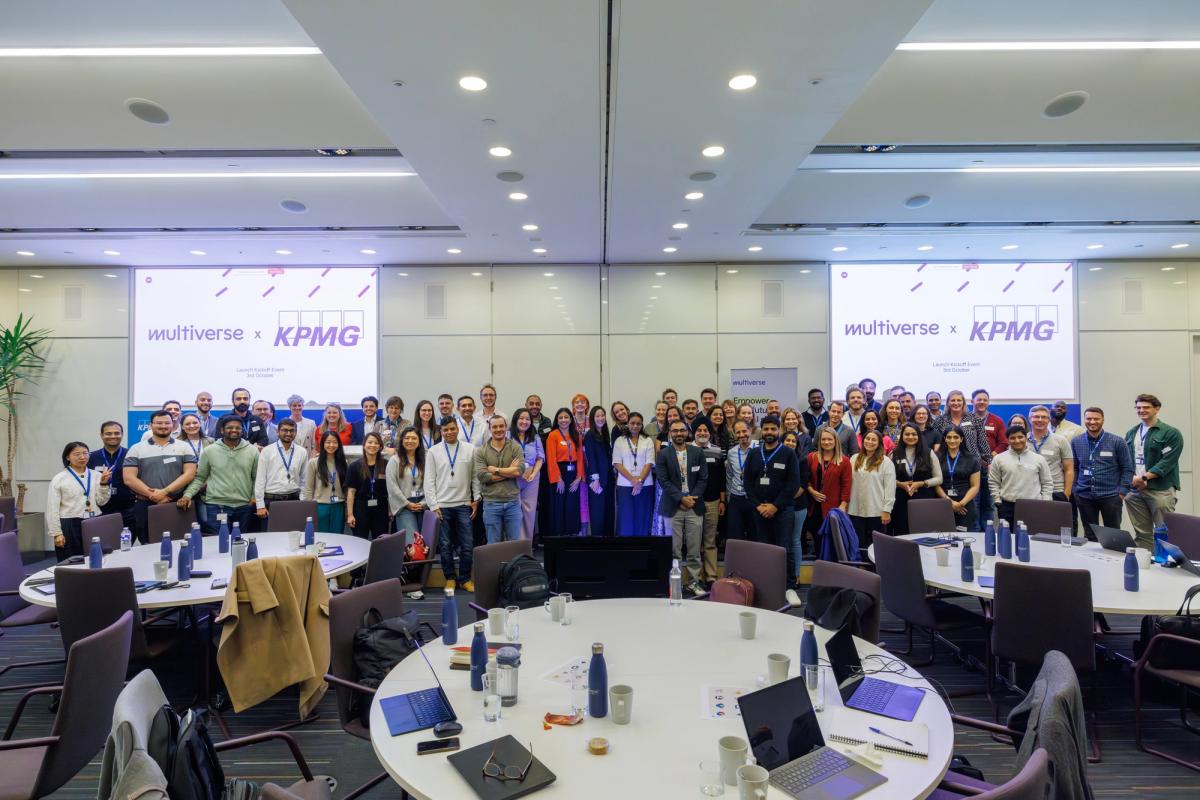
Upskilling platform Multiverse is delivering a specialist AI training programme to KPMG UK, a leading professional services firm, to help build the digital skills needed to service clients in the AI era. The first 134-strong cohort, ranging from early-careers up to partners in the Advisory business, will have the opportunity to build greater AI literacy. This will enable them to better support clients as they navigate their own AI journeys, while also evolving the way services are delivered by harnessing AI tools.
Recognising the increasing opportunity for AI adoption across the public and private sector, and the transformational impact it is having, KPMG UK aims to help clients build responsible implementation roadmaps and enable the organisational change needed to embrace AI.
As part of the new AI Upskilling Programme, learners will be enrolled in Multiverse’s Level 4 AI for Business Value programme, which will provide participants with a formal qualification. They will undertake learning in how to use AI strategically and source new revenue opportunities. By increasing AI literacy, KPMG UK is driving improved client services that deliver the largest business impact and enable strategic data and AI-informed decisions.
Lisa Fernihough, Head of Advisory at KPMG UK said: “The potential for AI to transform our industry is really exciting, both in terms of the way we deliver our services to our clients, and in how we help shape what our clients themselves are thinking and doing. So it’s really important that we continue to upskill our people at all levels, from the most senior to those who are just starting their career.”
“By offering this enhanced training programme with Multiverse, it means that our people have the chance to develop their AI skills and receive a formal qualification that will showcase their skills in the emerging AI space, meaning we remain ahead of the curve for innovation and leading consultancy services.”
Gary Eimerman, Chief Learning Officer at Multiverse, said: “KPMG UK is built on a foundation of strategic business transformation practises for its customers and its own team development. By embracing increased AI capabilities from junior to senior levels of the business, employees are more equipped than ever to provide informed AI-focused services, while the deployment of AI tools internally will save hours of time spent on manual tasks.”
Multiverse is the upskilling platform for AI and tech adoption, which delivers personalised, on-the-job learning. Multiverse has trained more than 20,000 apprentices in AI, data and digital skills since 2016.
Over 1,500 companies work with Multiverse to deliver a new kind of learning that’s transforming the workforce at scale. Programmes are targeted at people of any age or career stage.
Multiverse's playbook for embedding data literacy
Employers
Team Multiverse
As we learned, successful AI implementation doesn't start with models—it starts with data. For any organisation aiming to harness the full power of AI, establishing the right data foundations and culture is paramount. AI is only as intelligent as the data it is trained on.
Here are three core pillars for building a robust data foundation and culture ready for the AI transformation:
The agility vs. scalability challenge
One of the biggest data challenges in an AI transformation is finding the right balance between agility and scalability. Since AI is a rapidly evolving technology, moving fast often means experimenting quickly, even if initial methods aren't scalable.
- Embrace agility for experimentation: A successful AI strategy involves enabling experimentation and allowing teams to try new things without immediately requiring a massive, fully developed data pipeline. This might mean starting with simpler, non-scalable methods to quickly prove a concept.
- Scale for sustainability: Once a concept is proven, the key is to transition to scalable solutions. An effective strategy involves doing both—experimenting quickly and building scalable structures—by knowing when to do one and when to do the other.
Building a data-first culture
Formal training is essential for building data literacy. However, training alone is not enough; success hinges on integrating data into the very DNA of the organisation.
- Consistency is key: A strong data culture means data is part of the day-to-day language and ways of working. Key metrics and definitions must be clear and consistently used across all settings, including meetings and documents.
- Empowering the whole organisation: Effective AI implementation requires giving data access to everyone, not just data scientists, and teaching them how to use it. Upskilling the entire organisation ensures the best possible use is made of the data.
- The consumption shift: As companies embrace AI, the way people and machines consume data changes. While dashboards were once common, organisations now increasingly need data formats that machines can easily read, such as APIs. Consistency in definitions is critical for trusting AI to correctly interpret the data and provide answers in natural language.
- Security and Compliance: The foundation of a trustworthy data strategy is ensuring that data is handled securely and responsibly. We demonstrate this commitment to our clients and apprentices, ensuring their sensitive information is handled with the highest level of care. Multiverse has achieved SOC 2 Type 1 certification, a result of third-party audit from the American Institute of Certified Public Accountants, confirming our internal controls exceed the necessary, rigorous standards.
Data as your competitive advantage
The most advanced AI applications are widely available to virtually everyone. What truly differentiates a company and drives value is its proprietary data, and what they build with it.
- Unlock internal value: Well-structured, proprietary data can unlock powerful AI solutions. For example, taking unstructured data, structuring it into a knowledge graph, and sharing it can provide valuable insights for customers.
- Move ahead of the pack: If a company wants to build something truly differentiated and make a real difference, it must connect AI to its unique internal data. The sooner an organisation commits to structuring and leveraging its data, the sooner it will gain a competitive edge.
By focusing on structuring data, fostering a company-wide data culture, and strategically balancing speed and sustainability, any organisation can build the solid foundations necessary to deliver powerful and effective AI transformation.
Multiverse and Palantir launch a strategic partnership to accelerate tech adoption
News
Team Multiverse
The rapid evolution of AI and data is creating an urgent demand for a digitally skilled workforce. At Multiverse, our commitment is to equip the workforce to succeed in this new era. We achieve this not through solitary effort, but through strategic alliances that unlock transformative value for our clients and drive market acceleration.
Our newly announced partnership with Palantir exemplifies this philosophy in action. Together, we’re building Federated Data Platform (FDP) apprenticeship programmes for the NHS, equipping staff with the skills needed to improve patient care and operational efficiency. It provides a model for how software and skills work together to deliver real-world impact at scale.
The strategy: Aligning to accelerate enterprise adoption
Multiverse deliberately seeks partnerships that solve the critical skills challenges facing British institutions. We focus on becoming the essential enablement layer for major technology platforms.
1. Maximising platform investment
Technology is only as powerful as the people using it. Large-scale digital transformation initiatives often struggle due to a skills gap. Multiverse’s partnerships are designed to close this gap, ensuring clients realise the full potential of their technology investments.
- Solving a critical need: The collaboration with Palantir addresses one of the UK’s most significant tech initiatives: the NHS's digital transformation. It’s a commitment to enhancing staff training to support the implementation of the FDP.
- The full-stack solution: Palantir provides the proprietary Foundry platform and data analytics command, while Multiverse provides the bespoke, FDP-specific apprenticeship programmes tailored to a diverse range of NHS roles, from analysts to clinical staff. This creates a comprehensive, end-to-end solution for workforce transformation and platform adoption.
2. Driving measurable, mission-critical impact
Our partnerships are structured to drive tangible results where they matter most. We believe collaborations must directly impact the client's mission. For the NHS, this means:
- Focus on applied learning: The new programmes focus on practical, applied learning to help NHS organisations implement the FDP directly into their work.
- A proven track record: We leverage Multiverse's proven capabilities in digital skills training, having already upskilled more than 100 NHS trusts. This history gives our partners confidence in our ability to scale impact.
- Real-world outcomes: The ultimate goal is clear: by investing in the workforce, the NHS will reap benefits like improved operational workflows, more efficient resource allocation, and a tangible impact on patient health.
Expanding commercial horizons
For Multiverse, these partnerships are a key component of our commercial growth strategy, significantly expanding our market opportunity and reinforcing our position in the enterprise learning space.
The strategic decision to integrate our training with platforms like Palantir's Foundry positions Multiverse as an essential partner for technology providers seeking to accelerate user skill and adoption. This strategy ensures that as major enterprises continue to invest in core AI and data infrastructure, Multiverse is there to ensure their human capital keeps pace. This is a significant step toward unlocking the full potential of AI.
Sorry, no results found.