










We couldn’t find what you are looking for. Please try another way.
The Multiverse blog
Thank you! Your submission has been received!
Oops! Something went wrong while submitting the form.

King’s College London bolsters digital transformation with new Digital and Data Academy for staff
News
Team Multiverse
King’s College London is upskilling 75 of its staff through a new Digital and Data Academy in partnership with Multiverse. The initiative will support the University’s ongoing digital transformation, which includes the review and automation of time-intensive tasks.
The Digital and Data Academy will enhance skills in key areas such as professional services technology and academia, further strengthening the organisation’s ability to make data-informed decisions to improve service provision to both students and staff. Once accredited, the cohort will have increased capacity to focus on the most impactful and strategic elements of their roles.
Training is funded by the apprenticeship levy and delivered by Multiverse, a tech company that specialises in high-quality training through applied learning. Multiverse has trained more than 20,000 apprentices at over 1,500 organisations in data, AI and digital skills since 2016.
The 75-strong cohort will undertake Multiverse’s Level 4 Data Fellowship for professionals looking to establish or develop core data skills. At the end of the 13-month programme, King’s College London employees will have strengthened skills to support accurate, data-informed decision making while confidently using visualisation tools like Power BI.
According to Multiverse’s Skills Intelligence Report, the education sector is impacted by a lack of data skills, with 38% of employees’ time working with data spent unproductively, compared to the average of 30% across 18 other sectors. King’s College London’s new Digital and Data Academy will seek to proactively address this ahead of current sector concerns.
Kirti Swift, Deputy Director - Organisational Development at King's College London said: “Through this academy, we are strengthening a culture of data literacy and digital capability across the university. This will enable smarter decisions, deeper insights, and more efficient ways of working - freeing us to focus on what truly matters: enhancing the experience and outcomes for our students and staff.”
Isabelle Leung, Senior Research Grants Administrator at Kings College London, who is enrolled in the apprenticeship, said: “My team leverages data from across multiple systems daily, identifying and resolving problems or discrepancies. This training has already allowed us to streamline processes, improve accuracy and drive efficiencies, reducing the turnaround time of our monthly reviews from one week to just two days.”
Multiverse combines work and learning to unlock economic opportunity for everyone. It works with more than 1,500 organisations to close critical skill gaps in the workforce in AI, data and tech, through a new kind of apprenticeship.
Gary Eimerman, Chief Learning Officer at Multiverse said: “King’s College London is a global epicentre of exceptional research and innovation, led by the finest professionals. It has identified an opportunity to strengthen its operations through an enhanced understanding and utilisation of data – our Data Fellowship program is designed to help individuals on their team for exactly this.”
What is DevOps?
Apprentices
Team Multiverse
As the name suggests, DevOps combines development and operations, allowing modern businesses to create and iterate software more efficiently. This hybrid approach helps companies deliver high-quality products faster — and, ideally, beat their competitors to the punch.
What is DevOps?
DevOps is an engineering workflow methodology that brings together development and operations teams for seamless collaboration. These employees work closely together to design, build, and refine software applications.
The traditional software development model mostly separated operations and development teams. Software Developers would create an application, then hand it over to the operations team for deployment and management. If any issues occurred, the operations team would send it back for the Software Developers to correct — a process that could take days or even weeks.
DevOps breaks down these silos by encouraging collaboration and shortening feedback loops. Instead of working independently, all team members review applications at every stage. That way, they can catch issues early and make necessary improvements immediately.
While this approach might sound revolutionary, its core ideas have been around for over two decades. In 2001, a group of tech professionals published the Agile Manifesto, introducing a new methodology for software development. The Manifesto emphasised the importance of frequent feedback, laying the foundation for DevOps.
In 2009, John Allspaw and Paul Hammond presented a paper at the Velocity Conference titled “10+ Deploys Per Day: Dev and Ops Cooperation at Flickr.” Inspired by this paper and Agile practices, Patrick Debois organised the first DevOps Days in Belgium, officially starting a new movement.
Key principles of DevOps
The DevOps methodology is built on several guiding principles that businesses can adapt to their specific projects.
Most obviously, this model revolves around collaboration between cross-functional teams. Professionals work closely throughout the entire development process, sharing expertise and resources. This teamwork can empower them to create more innovative and effective products than they could have separately.
DevOps also encourages teams to automate processes to improve efficiency. For example, professionals might automate testing after every code change to double-check that the application still functions correctly. Many DevOps teams also use Infrastructure as Code (IaC) to automatically configure and manage infrastructure. Automating these routine tasks can save significant time and reduce the risk of costly mistakes.
Building on Agile development principles, continuous feedback and improvement are also core DevOps values. Tools like Datadog and Prometheus help teams monitor performance and identify opportunities for improvement. For example, if you notice glitches recorded in the system logs, you can quickly review the code to find the root cause. DevOps teams also gather feedback from colleagues and users regularly, promoting a culture of transparency and continuous improvement.
Benefits of DevOps
DevOps offers several significant advantages, contributing to its widespread popularity.
Rapid deployment
DevOps speeds up software delivery by streamlining the development process. When projects move smoothly through every stage, time-to-market decreases, reducing project costs. Faster releases also improve customer satisfaction and retention.
Improved software quality
Traditionally, development teams gathered feedback only near the end of the process — often when it was too late to make significant changes. By contrast, DevOps enables continuous feedback throughout the development lifecycle, allowing teams to address issues as they appear. The result? A more polished product, perfectly tailored to the end user.
Improved security
Treating security like an afterthought can leave applications vulnerable to cyber threats and data breaches. Plus, there’s always the risk that last-minute security practices will negatively affect the software’s performance.
Businesses can avoid these issues by adopting DevSecOps. This model works like regular DevOps, but it also integrates the security team into the entire application lifecycle. By designing systems with security in mind from the very beginning, companies can increase compliance and mitigate vulnerabilities.

Understanding the DevOps lifecycle
The DevOps lifecycle consists of five distinct phases:
Plan
The two teams collaborate to create a detailed project plan. This process involves prioritising tasks, setting deadlines, and developing a realistic budget. The collaborators also define their roles and delegate tasks, reducing the risk of future conflict or miscommunication.
Build
This phase involves the nitty-gritty tasks of building an application, such as writing code and designing product features. Developers typically take the lead here, but the operations team is still closely involved throughout the process.
Integrate
Individual team members typically often work on code independently, especially in remote work environments. Continuous integration allows them to frequently merge their code into a central repository. That way, every member can instantly see any changes made, reducing the risk of duplicate code.
This process is also essential for quality assurance, as it enables teams to continually check each other’s work. Catching errors earlier makes them easier and less expensive to fix.
Deliver
DevOps doesn’t stop after a business officially releases an application. Dev and ops teams typically continue to refine the software after the launch, updating features and making improvements. With continuous deployment, they can automatically push new features and other changes to users, allowing them to quickly respond to customer feedback.
Operate
Once an application is live, the DevOps team must also monitor and maintain software performance. Many issues can arise in the blink of an eye, from cyberattacks to unexpected issues. By automatically tracking performance metrics and setting up alerts for potential issues, the team can intervene quickly and resolve incidents.
Core DevOps practices
If you want to contribute to development and operations teams, you’ll need to understand a few essential practices:
- Continuous integration (CI): All code changes made by multiple developers get merged into a single codebase for consistency.
- Continuous delivery (CD): New code is automatically deployed after leaving the production pipeline, allowing users to see updates immediately.
- Infrastructure as Code (IaC): This model deploys the same infrastructure — such as networks and virtual machines — every time, enabling DevOps teams to test applications in consistent development environments.
- Monitoring and logging: Tools automatically track an application’s performance and log interactions, making it easier to identify bugs or anomalies.
There are plenty of resources available to help you learn these practices. For example, Coursera and Udemy offer free online courses on CI and CD. You can also watch tutorials on YouTube and other video platforms.
DevOps tools: The key tech and tools used in DevOps
Tech professionals rely on a wide range of tools to streamline and automate DevOps workflows. While mastering every technology isn’t necessary, especially at the beginning of your career, you should at least be familiar with key tools you might encounter on the job.
Jenkins is an open-source automation software that enables continuous integration and continuous delivery. DevOps professionals use this tool to build and test applications. The platform features hundreds of plugins for easy integration with other services, such as Amazon Web Services and Zoho.
Kubernetes and Docker often go hand-in-hand to develop and deploy software. Docker allows users to build and operate container applications that don’t require their own infrastructure. Developers can then use Kubernetes to manage and scale these containers. These applications save time, allowing DevOps teams to focus on designing unique software instead of creating everything from scratch.

For monitoring and analytics, many DevOps teams turn to two free tools: Prometheus and Grafana. Prometheus is a powerful open-source monitoring tool that continuously tracks your application’s performance. It offers real-time alerting, so you can instantly get notified of any problems.
Meanwhile, Grafana is an open-source analytics tool. It integrates with Prometheus and many other data sources, allowing you to compile all your performance data in one place. You can also transform this information into accessible data visualisations, making it easy to spot trends. For example, if you notice that your software tends to log errors at a specific time, you can investigate more closely to determine the reason.
How to get started with DevOps
As more companies adopt DevOps, it’s become one of the highest-paying tech jobs. According to Glassdoor, DevOps Engineers in the UK earn an average salary of £49K. It’s also a top career choice for introverts who balance a mixture of independent work and energetic collaboration.
Of course, you don’t need to become a DevOps Engineer to embrace this methodology. No matter your role, you can help promote a DevOps culture in your organisation by following these steps.
Start small with pilot projects
Convincing colleagues and managers to try DevOps practices can feel like an uphill battle. If your development and operations teams are firmly siloed, they might resist your invitation to collaborate. Plus, many people get attached to their familiar software delivery process and feel reluctant to overhaul it.
Luckily, you don’t need to jump into the deep end with DevOps right away. Instead, start gradually with low-stakes pilot projects. For example, you might practice monitoring an older project with Prometheus or encourage your team to give each other feedback using a tool like GitHub. These initiatives will help you introduce the DevOps process without the pressure of strict deadlines or major risks.
As your team gains confidence, you can slowly begin integrating more DevOps best practices into your projects. This could involve setting up a continuous integration tool like Jenkins or GitLab or adding continuous delivery for minor features. This gradual approach will allow your team to see the benefits of DevOps for themselves without overwhelming them.
Get stakeholder buy-in
DevOps isn’t the responsibility of one individual or team; it’s an organisational philosophy requiring universal support to implement. Many people, however, are wary about new tech frameworks. Change can be scary, especially for people who are used to working a different way.
Earning stakeholder buy-in is key to DevOps success. Start by gaining the support of leadership by educating them about the benefits of DevOps, such as improved collaboration and faster time-to-market. Consider using case studies and statistics to make your appeal more compelling. You could also develop a pilot project so the stakeholders can see the results of DevOps for themselves.
Once you’ve secured leadership support, it’s time to get the development and operations teams to buy in. This might be trickier, but don’t feel discouraged. Emphasise how DevOps can streamline their workloads by automating repetitive tasks and prioritising continuous feedback. Additionally, be sure to tout the benefits of increased collaboration and efficiency, which can reduce stress and boost productivity.
Focus on continuous improvement
At its core, DevOps is all about striving for continuous improvement. The best DevOps teams are dedicated to perfecting their products, returning to them as often as needed to keep everything working flawlessly.
At first, this process might sound exhausting or frustrating — after all, you don’t want to get stuck in an endless cycle of adjustments and updates. However, prioritising continuous improvement will help you provide the best user experience and maintain customer satisfaction. It can also save time in the long-run by allowing you to develop a strong foundation for your applications. That way, you’re less likely to encounter significant issues like bugs or security vulnerabilities when you deploy the finished product.
Master DevOps principles with Multiverse
DevOps has surged in popularity as organisations search for new ways to increase efficiency and gain a competitive edge. In 2024, approximately 10% of permanent tech job postings in the UK required DevOps skills, underscoring its growing importance.
A Multiverse tech apprenticeship can help you gain hands-on experience with DevOps methodologies and tools. Our 15-month Software Engineering programme teaches you how to develop full-stack applications in agile environments. Our structured modules cover a wide array of topics, from automation to CI/CD. Our knowledgeable coaches can also help you chart a career progression framework in tech to grow on your existing career path and interests.
Take the next step on your DevOps journey by completing our quick application today.

What does a Data Engineer do?
Apprentices
Team Multiverse
A Data Engineer builds data pipelines to collect and process information from multiple sources. These data streaming systems allow businesses to perform in-depth analyses and answer complex questions.
As more businesses embrace data-driven decision-making, the demand for Data Engineers will continue to grow. That means there are plenty of promising opportunities for people looking to upskill core data-based capabilities. In this guide, we’ll explore the role of Data Engineers, their key responsibilities, salaries, and more.
What is a Data Engineer?
A Data Engineer is responsible for building, managing, and fine-tuning an organisation’s data infrastructure. They create data pipelines that gather raw information and transform it into a usable format for data analysis.
As the amount of data grows exponentially, businesses rely on Data Engineers to sift through the noise and collect the most valuable information. Without these professionals, organisations would struggle to make sense of a vast sea of raw data in different formats.
For example, a retailer might want to understand why clients prefer certain products. The business could analyse many types of data, from customer reviews to purchase history and returns. A Data Engineer speeds up this process by collecting the relevant data points, organising them, and delivering them to Data Analysts for further evaluation.
Data engineering is the foundation of data science, which includes several similar but distinct career paths. Data Engineers focus on developing data pipelines to extract and organise information. This processed data is then analysed by Data Analysts to answer questions and detect trends. Some businesses also employ Data Scientists, who perform more complex statistical analyses and develop predictive models. In the above scenario, a Data Scientist could use historical customer data to predict future buying behavior.
Day in the life of a Data Engineer: Core responsibilities
A Data Engineer’s exact responsibilities can vary by role, but here are a few common tasks:
- Build data pipelines to collect and process information from various sources
- Maintain data systems to keep information flowing smoothly
- Evaluate the quality and reliability of collected data
- Store information in accessible data warehouses or data lakes for easy retrieval
- Collaborate with Data Scientists, Analysts, and other team members
Data Engineers use various tools and techniques to accomplish these fundamental tasks. For example, extract, transform, and load (ETL) processes allow them to combine both structured and unstructured data into a centralised location. Many professionals also rely on cloud infrastructure platforms — such as Amazon S3 and Google Cloud Storage — to store vast datasets remotely.
Key skills for Data Engineers
If you’re interested in a career in data engineering, you’ll need these essential technical skills:
- Structured Query Language: Used to build and communicate with relational databases
- Programming languages: Python and Scala are often used to construct pipelines, process data, and automate tasks
- Apache Spark: A powerful computing framework used to process enormous datasets quickly
- Mathematics: Discrete mathematics is used to build algorithms and handle data structures, while statistics helps detect trends and anomalies
- Cloud computing: Familiarity with cloud platforms like AWS and Azure is critical for storing and managing data securely
Of course, hard skills aren’t enough to excel in this field; strong soft skills are just as critical. Many data engineering projects are highly collaborative, requiring close collaboration with people from different departments. For example, a Data Analyst might ask you to aggregate information for business intelligence reports. Effective communication helps you simplify complicated concepts and build positive relationships with all team members.
You’ll inevitably encounter challenges, especially when dealing with complex or messy data, so excellent problem-solving skills are a must. Being adaptable will also enable you to learn new techniques and master the latest technologies.
Certifications can help you gain new skills and demonstrate your expertise to potential employers. Consider pursuing industry-recognised credentials, such as AWS Certified Data Analytics and Google Professional Data Engineer.
The importance of data engineering in modern businesses
In 2025, it’s predicted that users will generate and consume a staggering 182 zettabytes of data. Traditional data processing and analytics methods simply can’t keep up with this exponentially growing flood of information.
That’s where Data Engineers come in. They develop infrastructure to collect the right information and make the data usable for analysis. This process allows leaders to make strategic business decisions based on accurate and relevant data, rather than a random jumble of information.
Many industries rely heavily on data engineering for high-stakes decision-making. For example, finance institutions use fraud detection systems to automatically identify and block suspicious transactions. Similarly, data engineering empowers healthcare organisations to analyse patient data and improve the quality of care. Without this field, businesses would struggle to analyse information and address emerging issues effectively.
Tools and technologies used by Data Engineers
Even the most experienced Data Engineers can’t manually process millions of data points. Instead, they rely on sophisticated tools to automate and streamline data workflows.
Apache Hadoop is one of the most critical technologies, using parallel processing to handle big data efficiently. Many professionals also turn to Snowflake for building batch data pipelines quickly, while Apache Airflow allows users to design and automate workflows. These technologies can save significant time and reduce the risk of errors.
How to become a Data Engineer
There’s no one-size-fits-all approach to becoming a Data Engineer. You can use many strategies to gain the necessary knowledge and skills, giving you the freedom to shape your professional journey.
It all starts with developing foundational programming and database skills. Most Data Engineers rely on SQL to manage databases, while Python is commonly used for routine tasks like data storage and processing. Online courses or coding bootcamps can help you learn these languages quickly.
Beyond these basic skills, a Multiverse apprenticeship is one of the best ways to expand your data engineering knowledge. Our three-year Advanced Data Fellowship teaches you how to analyse information and design innovative data solutions. It covers advanced topics like data governance and predictive analytics. You’ll also gain hands-on experience by applying your newfound skills in your current role.
Once you’ve gained the necessary skills, start looking for entry-level roles like Business Data Analyst or Junior Data Engineer. These positions will allow you to refine your skills further and may lead to more advanced positions as you gain experience.
For example, Daniel Beach began his career in a completely unrelated field — agriculture. In 2013, he decided to pivot to data engineering and taught himself SQL. With this self-taught knowledge, he landed a Data Analyst position at a bank. From there, he quickly climbed the career ladder, moving from Senior Data Analyst to Business Intelligence Engineer, then to Data Engineer, and finally to his current role as Senior Data Engineer.
Career progression for Data Engineers
Data engineering is a vast field with ample opportunities for advancement and specialisation. Here’s one possible career trajectory, with salary data from Glassdoor.
Data Analyst
Average UK salary: £41K
A Data Analyst uses statistical methods and software to gather and study data. They search for meaningful trends in datasets and communicate their insights to stakeholders. For instance, they might create data visualizations or dashboards to present their findings in accessible formats.
Junior Data Engineer
Average UK salary: £31K
A Junior Data Engineer typically works under the guidance of more experienced data professionals. Their responsibilities include fundamental tasks like collecting, cleaning, and storing data. They may also assist with building and optimizing data pipelines and troubleshooting issues.
Data Engineer
Average UK salary: £48k
A Data Engineer handles more advanced tasks, such as designing sophisticated data pipelines and solving business problems autonomously. This mid-level role typically requires two to five years of experience in data engineering.
Big Data Engineer
Average UK salary: £46k
A Big Data Engineer specialises in developing and managing pipelines for big data. These systems must be scalable and capable of handling vast, ever-increasing amounts of information without experiencing performance issues. Big Data Engineers often collaborate with Machine Learning Engineers and other professionals who rely on big data for analysis and decision-making.
Lead Data Engineer
Average UK salary: £72K
As the name suggests, a Lead Data Engineer oversees a team of engineers. They plan complex data architecture, delegate tasks, and manage large-scale projects. They’re also responsible for mentoring junior employees.
Advance your data engineering career with Multiverse
Once a niche field, data engineering has become an integral part of modern business operations. It’s the foundation of advanced analytics and data management, helping businesses get the most out of their data.
Take the next step on your upskilling journey with a Multiverse apprenticeship. Our Data Fellowship programmes teach fundamental technical skills, such as data visualization and machine learning. You’ll strengthen your data engineering knowledge as you complete our online curriculum and collaborate with peers. Plus, you’ll receive personalised career coaching from industry experts. All without having to put your career on hold.
Ready to take the leap? Get started today by completing our quick application.

Multiverse and Skillable launch partnership to enhance hands-on, job-embedded learning at scale
News
Team Multiverse
In today’s fast-changing workplace, traditional training methods no longer suffice. As AI automates routine tasks, employees must develop higher-order skills such as critical thinking, problem-solving, and the ability to apply technical knowledge in context.
Multiverse and Skillable are joining forces to bridge the divide between learning and real-world application. This partnership integrates Skillable’s hands-on virtual labs with Multiverse’s structured coaching model, creating an immersive ecosystem where learners gain both theoretical knowledge and practical, scenario-based experience. By combining strengths, Multiverse and Skillable empower employers with a scalable solution that ensures professionals can confidently apply technical skills in real-world settings—reinforcing their shared philosophy that people learn best by doing.
Gary Eimerman, Chief Learning Officer at Multiverse, added, "Our partnership with Skillable expands our experiential learning approach by providing practice environments that mirror real-world use cases. Coupled with our coaching, Skillable's virtual labs allow us to create experiences where learners can safely practice technical skills before applying them in production environments."
Through this collaboration, apprentices benefit from structured skill-building experiences that provide immediate feedback, with the ability to reset and try again without consequences—creating low-pressure learning opportunities that build confidence. These experiences are further enriched by Multiverse's personalized coaching, which helps learners connect technical skills to broader business contexts.
Frank Gartland, Chief Product and Technology Officer at Skillable, remarked, "Our partnership with Multiverse represents an exciting opportunity to enhance their industry-leading apprenticeship model with our hands-on virtual lab technology. Together, we're creating a learning experience combining the best of human coaching with immersive scenarios that stretch skills and bolster confidence, giving learners both the guidance and practical experience needed for ongoing success in today's digital economy."
The partnership will launch with Multiverse's Applied Data Engineering (ADE) apprenticeship program, the latest addition to its portfolio of data skills products. This program exemplifies how the combined approach elevates learning outcomes: learners gain hands-on experience in data infrastructure management through Skillable's customizable labs, while Multiverse coaches provide strategic guidance on applying these skills to real business challenges.
Learners in the ADE program gain hands-on experience managing complex data infrastructure, developing advanced pipelines, securing databases, implementing rigorous data governance, and even applying machine learning to enhance data solutions—all within Skillable's safe learning environments that protect critical production systems and sensitive data. Throughout their learning journey, Multiverse's expert coaches provide targeted support, helping employees translate these technical skills to their organization's unique environments and technology stacks. This powerful combination bridges the gap between controlled practice and real-world application, ensuring apprentices can confidently implement their new capabilities using their organization's specific tools, processes, and business context.
As the workforce continues to adapt to new technologies and business challenges, Multiverse and Skillable are committed to delivering the hands-on, outcome-driven learning environments needed to thrive. With plans to expand across technical domains, including cloud computing and AI, this partnership marks the start of a new era in applied learning—where talent development is measured not by knowledge alone but by the ability to deliver results.
Reporting our Gender Pay Gap 2024
Life at Multiverse
Paige Rinke, VP People & Talent
Headlines
- Our mean pay gap increased in 2024 to 13%, however, this remains lower than the average gender pay gap in comparable sectors, which is 16%.
- Our mean bonus gap declined slightly compared to 2023, and our median bonus gap was negative for the first time. Only 37% of reporting employers have a negative median bonus gap.
- In 2024, representation of women in our senior leadership roles declined; however, we have made a number of significant appointments since the 2024 snapshot date.
- We continue to see increased representation of women across our Tech team for the second consecutive year, with 39% of our Tech team identifying as women in 2024 (an 8% increase since 2022).
- The median gender pay gap for our Sales team was 0% in 2024. Even considering the varying effect that Sales commissions have on pay gap figures, this is something we are proud of.
The Gender Pay Gap explained
First - some technical bits. The gender pay gap is the difference between the average hourly pay of men and women within an organisation. The UK government requires businesses with 250 or more employees to report on the following metrics each year:
- Hourly pay gap - mean and median
- Bonus pay gap - mean and median
- Proportion of men and women receiving a bonus
- Proportion of men and women in different earnings quarters
The gender pay gap is distinct from unequal pay, which is illegal in the UK and has been since 1970. At Multiverse, we take active steps to ensure there is equal pay for equal work at all levels within our business, for example, regular pay audits and benchmarking. Reporting on our gender pay gap is an important moment for us to reflect on the initiatives we introduce to embed fairness and equality of opportunity in our business, and whether these are successful.
A note - HMRC specifies that Gender Pay Gap data sets should only include people who identify as a man or woman. Multiverse employees can voluntarily complete a series of census questions through our HR Information System, including their gender identity. To align with HMRC’s guidelines, we have excluded any employee who has self-identified as ‘Non-binary’ or ‘Another gender identity’. However, this approach is not in line with our internal pay audit practices or overall approach to gender identity and equality.
Key Figures
As a reminder, this report is retrospective and covers the period between 6th April 2023 - 5th April 2024, with a snapshot date of 05 April 2024.
Pay Gap
In the UK, Multiverse’s mean gender pay gap was 13%. This means that the average hourly pay of a man at Multiverse was 13% higher than the average hourly pay of a woman.
Multiverse’s median pay gap was 11.1%. The median pay gap is the difference between the salary in the middle of the range of all employees who are men, compared to the middle salary among all employees who are women. At Multiverse, the median man earned 11.1% higher than the median woman. The median is an important measure because it reduces the impact of what may be a small number of outlier values.
According to the Office for National Statistics (ONS), the 2024 UK median gender pay gap was 13.1% (source). Research also tells us that the mean gender pay gap in both the Technology and Professional Services sectors is approximately 16% (source), which are the sectors that offer the best comparisons to Multiverse.
Bonus Gap
In the reporting period, 48.8% of Multiverse’s UK employees received a bonus - 49.3% of women, and 48.3% of men.
Our mean gender bonus gap declined from 34% in 2023 to 33.2% in 2024. This means that on average across the 12 months leading up to 05 April 2024, the bonus of a man at Multiverse was 33.2% higher than the bonus of a woman.
Our median gender bonus gap declined from 11% in 2023 to -16.5% in 2024. This means the median man at Multiverse had a bonus 16.5% lower than the median woman. Our median bonus gap differs significantly from the mean gap because the median factors out some of the impact of outlier bonus amounts. We will explore what this means in greater detail later in the report.
Across all reporting employers in 2024, on average, 39% of women and 40% of men received bonuses, and in 63% of reporting employers, median bonus pay was higher for men than for women (source). We are proud of our results and the progress we are making here.
Earnings Quarters
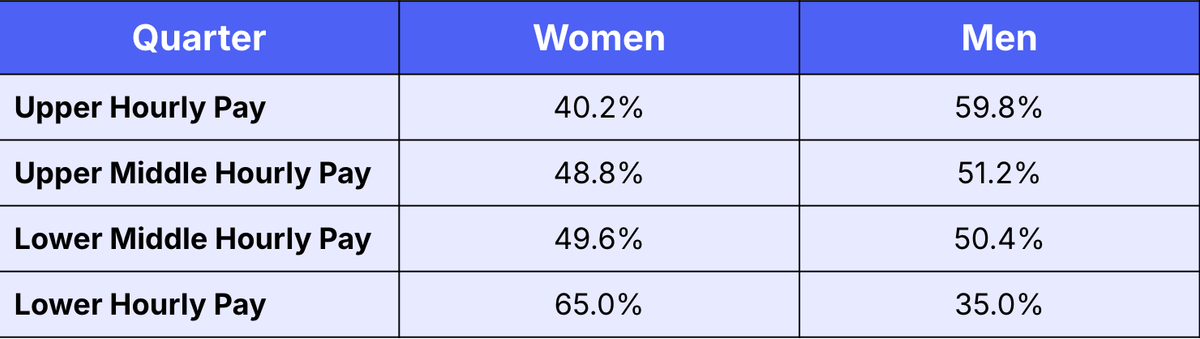
The proportion of men in our UK business increased from 2023 to 2024, leading to a decreased proportion of women at all quarters except for lower hourly pay, meaning that overall we have more men in our highest paid roles and more women in our lowest paid roles. While we are focused on ensuring our organisation is representative of the communities we operate in, at all levels, unfortunately, over-representation of men in high-earning roles is a systemic driver of the gender pay gap; it is at these levels where the most significant pay gaps exist and they have been the slowest to narrow (source).
Explaining our Data
While we are pleased our mean gender pay gap remains lower than the average for the UK Tech and Professional sectors, we acknowledge that our pay gap increased in 2024. While we are beating the average, we strive to be higher performing than the average. In pursuit of this goal, we will continue to work on identifying the causes of our pay gaps and how we can close these. This section sets out some key factors which have influenced our pay gap data this year.
Impacts on Pay
Through intentional steps, we have made progress in many of the focus areas we identified in last year’s report.
Gender Representation in Tech: According to the 2024 'Diversity in Tech' report, women make up 29% of the UK Tech industry. At Multiverse, we have made year-on-year improvements in the representation of women across our Tech team (Engineering, Product, and Data & Insight), which has increased from 31% in 2022, to 35% in 2023, and now 39% in 2024. This highlights how our transparent and consistent hiring framework is enabling us to source brilliant talent and increase our gender representation in critical areas at the same time. Roles in the Tech sector continue to attract more men than women (source) and these roles are often higher paid, so improving gender representation in our Tech team is vital.
Since the snapshot date of 05 April 2024, we have continued to make strides in this area, appointing several women into some of our most senior roles in Tech, including VP Engineering and Director of Product Design & Research. Research shows that women are underrepresented in these fields, making up 20% of Engineering talent (source) and 30% of AI roles (source). Our median Engineering team pay gap for 2024 was -3.8%; however, for Product it was 9.7%, and for Data & Insight 5%.
Sales Commissions: Commissions and other bonuses paid in the month of April are included in our calculation of an employee’s ordinary pay, as required by the UK government. At Multiverse, the only bonuses paid in April are Sales commissions. In previous years, many of our top-performing women in Sales joined our management pathway, which had an accelerating impact on our gender pay gap. We are proud that in 2024, due to several of our highest performing Sales reps being women, the median pay gap for our Sales team was 0%. It is important to note that there is an inherent variability in commission payments, because they are highly dependent on individual in-year performance, and so this picture can change year-on-year. Despite this, we hope our continued focus on bringing a diverse range of talent, including women, into our Sales teams and investing in enablement opportunities for all reps, will help us maintain our strong progress in this area.
However, some key factors have limited our progress:
Senior Representation: A contributing factor to our increased gender pay gap was lower representation of women at our upper pay quarter for 2024, which in real terms, means a decrease in women at “Director” and above levels. Representation at these levels changed from 58% in April 2023, to 42% in April 2024. This was fueled by the departure of our COO and CFO during the 2023-2024 tax year, both of whom were women. As an organisation of less than 1000 employees, we have a small overall population at senior levels and so a small number of key departures can have a significant effect. Since April 2024, we have appointed a new COO and CFO, both of whom are women. This means that our Executive team is currently gender balanced, which is something we are proud of - women occupy 43% of board positions and 35% of Leadership roles at the FTSE 350 level (source).
Lower-Level Representation: The increase in our pay gaps for 2024 is also the result of increased representation of women at our lower pay quarter. While we are always pleased to increase the diversity of our business, having more women in lower-level roles, which are associated with less pay, can particularly impact the mean pay gap. However, several of these lower-level roles held by women were in teams like IT and Finance, which are typically male-dominated, including at lower levels. Having women enter these areas of our business, combined with our aim to provide equitable access to development opportunities, provides a pathway to diversify our future leadership pipeline.
Impacts on Bonuses
Our mean bonus gap decreased in 2024; however, at 33%, it remains higher than we would like. This is closely related to the disproportionate representation of men in our most senior roles at this time, because larger bonus payments are typically granted to employees in these roles.
However, our median bonus gap significantly decreased to -16.5%. As the median figures lessen the impact of outlier figures on each end of the spectrum, this is a useful representation of the picture within Multiverse for the typical employee. The majority of Multiverse employees are on our annual bonus plan, rather than a commission plan. Since our 2023 report, we have made further progress on our approach to data-driven performance reviews, with a rigorous calibration process and structured approach to paying out bonuses based on both company and personal results. Performance ratings have a large impact on bonus payments, and so we believe this is evidence that our new approach is leading to improved outcomes for women at Multiverse.
Our Approach to Closing the Gender Pay Gap
In early 2024, we launched our Career Mobility strategy, which focuses on how we can bring Multiverse’s mission to life for our employees through an equity-first approach to People policies, processes, and practices. We have made a number of strides in our Career Mobility journey so far, which we believe over time will help us close our gender pay gap:
- Pay Philosophy - In late 2022, we started our journey towards pay transparency by creating our first organisation-wide pay philosophy, which is applied to all compensation decisions. Since our last gender pay gap report, we have appointed a dedicated Reward Lead to help us monitor pay equity more closely across the organisation and within departments. Additionally, all employees can now view the pay band for their position in our compensation tool, Pave, and where they sit in the band - a step that only 16% of UK companies have taken (source). We’re continuing to progress with this work and are moving towards even greater transparency, because we believe evidence-based compensation discussions are critical for interrupting bias.
- Equitable Performance Reviews - As discussed earlier in this report, we introduced a structured performance appraisal and calibration process in 2023. Our belief was, and still is, that this would enable us to make more accurate decisions for all employees regarding pay and progression - and we believe this is evidenced by our reduced mean and median bonus gaps. In 2024, we are evolving our approach by taking leaders through a ‘nine-box’ exercise to identify our highest-performing and highest-potential talent. This is the first step in succession planning, which we hope will enable us to take a long-term, business-area agnostic look at our organisation. From this, we will identify opportunities to strengthen and diversify pipelines for key roles, including at senior levels.
- Employee Resource Groups (ERGs) - As well as equitable policies, processes, and practices, building an inclusive culture where everyone can grow and thrive is a key focus for Multiverse. Effective ERGs are shown to increase engagement and reduce attrition for the communities they serve, which means they play a key role in helping us retain high-performing talent from underrepresented backgrounds, including women. In 2024, we launched Women@Multiverse, our fourth ERG. In the nine months since, over 100 employees have joined the ERG and members have held events ranging from ‘Irrational Ways to Influence People’ to ‘Having Challenging Conversations’. Since introducing these networks, employees have reported feeling a greater sense of belonging and community at Multiverse, which is measured by our quarterly employee engagement survey. When combined with the work we are doing to create fairer reward and progression structures, this is likely to increase retention for women across the organisation - something we will monitor across the next 12 months.
- Inclusive Leadership - We want to ensure all People Managers have the tools they need to lead high-performing teams, while supporting individuals to grow and thrive at Multiverse. In early 2024, we launched a 9-month training programme called M-Powering Managers, in partnership with an external training provider. The programme covered key leadership skills from Giving Feedback, to Coaching, and Managing Change. There was also a dedicated session on Diversity, Equity, and Inclusion, specifically focused on practical ways managers can create a sense of belonging within their teams. In 2025, we are planning to introduce a Manager Onboarding programme for all new people managers; inclusive leadership skills and interrupting bias will act as a thread underpinning all three modules.
Conclusion
While reporting our gender pay gap for the 2023-2024 tax year provides an important moment for us to reflect, the work to build a fairer and more equitable Multiverse for every employee does not pause between reports! We are committed to providing equitable access to opportunities internally, as well as in the wider workplace, and will continue to strive to make this a reality at Multiverse.
The AI skills gap in financial services
Employers
Claire Williams
But while financial institutions are making significant investments in AI technology, many are still developing the workforce capabilities needed to maximise its potential. This presents a timely opportunity for organisations to gain competitive advantage through strategic upskilling.
Our recent research reveals an industry at an inflection point: enthusiastically adopting new technology while simultaneously working to develop the human skills that drive AI success.
"The future of financial services isn't written by algorithms, but by the people who understand how to make those algorithms work for humanity." Anna Wang, Head of AI, AI Advisory Board Member - Multiverse
Based on our comprehensive survey of senior leaders in UK financial institutions,* here are the critical insights defining the state of AI in financial services today:
AI adoption surges, while results lag behind
67% of financial organisations are using AI for process automation, yet only 37% report transformative business results.
Financial institutions are enthusiastically embracing AI across multiple functions:
- 67% for process automation and operational efficiency
- 64% for customer service enhancement
- 57% for strengthening cybersecurity
- 52% for risk management and fraud detection
But despite widespread implementation, the majority (47%) experience only moderate benefits, while 9% admit they aren't measuring AI's impact at all.
The workforce readiness gap
Only 46% of financial institutions are heavily investing in AI upskilling, while 11% have no formal AI training initiatives whatsoever.
Organisations face critical skills gaps in:
- Building AI features (40%)
- Identifying AI use cases (37%)
- Implementing AI projects (33%)
- Risk management (32%)
- Ethical AI practices (30%)
The competitive landscape: An industry of explorers
Only 37% of financial institutions rate their AI maturity ahead of competitors.
The research reveals most organisations remain in early maturity stages:
- 52% classify themselves as "AI Explorers"
- 55% view their AI maturity as comparable to peers
This relatively level playing field creates a significant opportunity for ambitious organisations to gain competitive advantage through strategic skills development.
The future of AI in financial services
Our research shows financial leaders expect AI to transform:
- Cybersecurity (64%)
- Customer service & engagement (55%)
- Regulatory compliance & reporting (48%)
- Process automation & operational efficiency (57%)
Yet this transformation depends entirely on workforce readiness. While 36% of leaders believe AI will transform their roles and create new opportunities, 12% fear their roles may become redundant without proper adaptation.
"The biggest risk is being left behind and seen as uncompetitive because the organisation cannot deliver the service levels that others will have developed." Senior Financial Services Leader
The path forward
Organisations that successfully bridge the AI skills gap will lead the industry through:
- Enhanced cybersecurity capabilities
- Hyper-personalised customer experiences
- Automated compliance through regulatory technology
- Operational efficiencies with AI co-pilots
- Strategic decision-making powered by predictive insights
But this future is only possible with strategic investment in people alongside technology.
Methodology
*The survey, conducted by Radish on behalf of Multiverse between February and March 2025, targeted 157 leaders within financial services organisations. An online survey was used, with all respondents based in the UK. Phone interviews with leaders within the financial services sector were also conducted.
First comprehensive analysis of FTSE100 annual reports reveals substantial skills gap
News
Team Multiverse
Most of the UK’s largest listed companies are underprioritising skills development in relation to technology, according to new Multiverse analysis of a sample of FTSE 100 annual reports spanning the last 10 years.

Despite seven in ten FTSE 100 companies mentioning a strategic priority relating to technology, only 7% describe skills and training as a strategic priority in their latest annual reports. This proportion has not improved since 2013 (6%), while technology has shot up, suggesting that boardrooms are not yet recognising the sweeping impact of technology on workforce skills and people requirements.
With Goldman Sachs predicting that AI investment will rocket to $200bn this year, companies who do not act are potentially putting record levels of investment at risk.
To uncover this data, Multiverse’s data science team worked with expert data analyst David Abelman (ex-Meta, Bain & Company), to build a Large Language Model (LLM) system to analyse structured information from over 100,000 pages of publicly available annual reports. The resulting Boardroom Skills Agenda report provides empirical evidence on how people and skills are missing from the boardroom’s top priority list.
The missing skills piece
Where companies do proactively reference skills strategies, they are often not undertaking reviews of the existing skills capabilities of their workforce. Only 17% describe running skills reviews of their workforces in the latest reports, while 78% of companies reference reviewing their Board of Directors’ skills.
According to the report, companies are also not targeting skills development relating to the most consequential technologies that will shape the future of work. For example, while 97% of companies mention critical compliance and DEI training, only 34% of companies referenced Artificial Intelligence (AI) training.
These findings follow Institute for Fiscal Studies (IFS) reporting, which confirms that the average number of days of workplace training received each year has fallen over the last decade. Employer spending on training has decreased over the same period, and there has been a fall in both public and private investment in training.
Meanwhile, growth is top of the UK’s political and economic agenda, with the Government promising to break down the current barriers to equipping the workforce with the right skills to maximise new technologies.
Euan Blair, CEO of Multiverse, said:
“Annual reports are a weathervane for the issues that are capturing the boardroom’s attention. What we can see in the data is that investment in technology is skyrocketing but skills and training has stagnated. It’s telling that at the same time, so has UK productivity.
“Technology tools are only as powerful as the people who use them. Without prioritising people, companies will be left with tech strategies that are missing a key piece of the puzzle. The tech revolution will not arrive until companies connect the dots between tools and talent.”
Further headline findings from the Boardroom Skills Agenda report include:
Technology is impacting workforce skills, despite absence from boardroom top priority list
The growing impact of technology on the workforce is starting to be signalled in some reports, with discussion of “reskilling” and technical “upskilling” on the rise. Yet overall the incidence and prioritisation of technical skills initiatives is notably still low.
- The proportion of companies mentioning reskilling has nearly tripled in the last 10 years from 7% to 20%, while technical upskilling has more than doubled (23% to 51%).
- Yet in the most recent set of annual reports, only 10% of companies provided a sum for how much they were investing in training.
- When referenced, the average (median) spend was £600 per employee. A median of just 0.16% of company revenue was spent on training, and only 1% of working hours.

Apprenticeships overtake graduate schemes
The AI analysis also found that companies are delivering training via a number of different schemes, and referencing these schemes more than they were 10 years ago:
- 59% of companies referenced an apprenticeship scheme (vs 48% 10 years ago), while 48% have a graduate scheme (vs 39% 10 years ago).
- Meanwhile, 32% said they had an internship scheme (vs 19% 10 years ago).

David Abelman, Data Science Consultant, added:
“When implemented carefully, LLMs provide a fantastic way to extract quantitative information from textual documents at scale. We were able to craft a workflow to make sense of over 100,000 pages of annual reports, giving us a unique understanding of how companies discuss their people development in relation to their increasingly strategic prioritisation of technology.
“It was clear that whilst technological focus has ramped up, strategic skill development is generally lagging behind. But it’s also promising to see signals of change in the tactical implementation of learning and development initiatives. It will be fascinating to see how this plays out in the coming years as the increasing impact of AI is felt.”
Download the full report.

New Data Academy to boost student success and staff satisfaction at Buckinghamshire New University
News
Team Multiverse
Buckinghamshire New University is launching a Data Academy for 35 of its staff members in a bid to enhance employee experience, maintain student satisfaction and grow student numbers.
By building a data-driven culture in areas such as admissions and academic registry, upskilled employees will support in achieving some of the university’s strategic milestones, including retaining its place as a top 10 university in National Student Survey student satisfaction rankings.
Training is being delivered by Multiverse, a tech company that identifies, closes and prevents skills gaps, through personalised, on-the-job learning. Multiverse has trained more than 20,000 apprentices in AI, data and digital skills since 2016.
According to Multiverse’s Skills Intelligence Report, the education sector has the highest rate of time lost to unproductive data tasks. For Buckinghamshire New University, time-consuming manual processes previously impacted staff’s ability to spend time on more value-added tasks, while data silos led to inconsistent ways of working. By upskilling its employees in data, the university will be able to optimise processes and significantly increase productivity.
Employees will be enrolled on two Multiverse programmes. The Level 3 ‘Data & Insights for Business Decisions’ course will give staff the skills to understand data quality, apply automation to reduce silos and save time, while also managing organisational change and influencing behaviour across the organisation. The more advanced Level 4 ‘Data Fellowship’ will upskill university staff in computer programming, data modelling, integration and analysis techniques, with an introduction to machine learning and predictive analytics.
Jon Lees, Academic Registrar at Buckinghamshire New University, said: “At BNU, we are committed to investing in our staff talent. Our collaboration with Multiverse will help deliver on this, as we build our staff’s expertise and professional practice, and continuously improve our organisational effectiveness. As we launch our first cohort, we look forward to seeing positive change take place, led by data skills for the modern workplace.”
Multiverse combines work and learning to unlock economic opportunity for everyone. It works with more than 1,500 organisations to close critical skill gaps in the workforce in AI, data and tech, through a new kind of apprenticeship.
Gary Eimerman, Chief Learning Officer at Multiverse said: “Buckinghamshire New University has a rich heritage in transforming student lives and has recognised how more effective data management has the potential to contribute to this. By investing in the development of its staff, Buckinghamshire will be able to accelerate progress in meeting its strategic objectives.”
How Multiverse coaches drive impact for learners and leaders
Learning Science
Team Multiverse
At Multiverse, we focus on four key competencies that drive learner success and business impact: our coaches are industry experts, data-driven, connectors, and guides. Together, these competencies form our Compass Framework, which we use to hire, train, and evaluate our coaches.
The four competencies of the Multiverse Compass Framework
According to apprentices and apprentice managers, their coach is the most influential part of the learning experience. Here’s what makes them exceptional:
- Industry experts: Multiverse coaches have the expertise to deliver effective, enjoyable, and relevant learning experiences. Most join following years of working in industry, adding insight and experience to their teaching. With an average of 60 hours of technical upskilling per year, our coaches stay updated on the latest tools, techniques, and trends.
- Data-driven: Our coaches meticulously plan sessions by integrating data to understand learner progress and client needs. This preparation ensures purposeful, personalised interactions. We help coaches collect, monitor, and act on this data with proprietary tools like Coach World and weekly coach enablement workshops.
- Connector: Multiverse coaches foster personal and professional growth by building trust and creating safe environments for taking risks and asking questions. Our Coach Academy equips coaches with these essential skills, which they refine through ongoing observations, workshops, and feedback.
- Guide: Our coaches help learners identify and complete impactful projects by asking relevant questions, encouraging idea sharing, and providing constructive, actionable feedback, usually within 24 hours. Customer Success Managers collaborate with each client to create joint success plans, ensuring our coaches understand their strategies and priorities. We provide training and toolkits to help them put this into action. At Multiverse, coach roles are specialized, so learners are always talking to a subject matter expert with the coaching skills to support their needs.
These competencies work in unison. Industry expertise forms the foundation; our ability to transfer knowledge and skills attracts many clients to Multiverse, but it’s just the beginning.
Data-driven preparation makes sessions engaging and relevant, while connection allows coaches to help learners thrive – whether they are practising new skills, finding opportunities to apply them, or overcoming challenges.
Finally, guidance ensures that individual learners’ actions align with clients’ strategic objectives.
How apprentices lead cost transformation
In 2023, a new customer approached Multiverse with financial challenges. They were launching a major cost-saving initiative and needed support.
They placed 50 apprentices in data-focused programmes, with each apprentice tasked to bring their new skills back to their teams. This goal was outlined in the Joint Action Plan created by the customer and the account executive, serving as a key reference for the coach throughout the apprenticeships.
Each month, apprentices honed their data skills – analysis, visualisation, and automation – during workshops and individual sessions. In group coaching, the coach aligned apprentices on their organisation’s strategic challenge, and used it to frame the content of the sessions.
For instance, during the data quality unit, the coach prompted apprentices to discuss the data challenges they faced within their organisation and connected these challenges to tools and techniques learned in the program.
When poor data quality emerged as a significant issue, the coach guided the conversation toward problem-solving:
- How might apprentices apply their data cleaning skills?
- What approaches would be most effective?
- Which additional skills, like engaging relevant stakeholders, could ensure their projects receive the necessary support?
Throughout their apprenticeship, the coach provided tailored support for each apprentice, from tutoring sessions to stretch content to assistance with workplace challenges.
By any measure, the apprenticeships were transformative. Cost assessments that took weeks became instant. A new spend management system, developed by one apprentice, was implemented by every category lead in the organisation. And over £50 million in savings were identified.
In summary
This is just one of thousands of examples from our employer partners across the US and UK. We take pride in being a strategic partner for transformations in areas like AI and data, and it's our coaches, and our coaching model, that drive exceptional outcomes like these every day.
From chaos to competence: 4 lessons on AI adoption challenges
Employers
Gabriela Wasilewska
The reality is that AI is here to stay. But with mounting questions around risk, governance and making a return on investment (ROI), how can leaders move from chaos to competence with AI? And how can they overcome AI adoption challenges?
We spoke to Rudy Lai, CEO at Tactic, and Jason Smith, AI Strategy Lead at Publicis Media, to tackle these questions and to share guidance on how best to get started.
Lesson 1: Prioritise people and processes
What’s their best advice for starting AI transformation?
“The technology is the least of your worries,” says Jason. “People and process are two of the most difficult things to get right.”
Jason recommends assessing the ‘day in the life’ of your workers to understand how generative AI (GenAI) can help, while also encouraging people to be hands-on with the technology. He adds:
<block-starlight>“Because GenAI has democratised access to AI and machine learning, people need to roll their sleeves up, try things, and get grace to make mistakes.”</block-starlight>
“Everybody understands that AI is the next big thing, the next business opportunity, the next tool to create impact,” says Rudy, agreeing on the need to focus on people and processes.
He argues many businesses struggle to find the right place to start, and suggests a three-tiered approach when thinking about AI adoption:
- Tier one: empowering employees with GenAI tools such as Microsoft Copilot, helping people be more productive.
- Tier two: transforming your product or services with AI features.
- Tier three: using AI to create entirely new business models.
As you move through each tier, you’ll shift from internally focused AI use cases to external ones. How far you’ve progressed depends on a range of factors, including your level of data skills maturity.
However, Rudy argues: “No matter how you slice and dice the use cases of AI in your organisation, you always need to go back to the business impact.”
Upskilling should be treated as a priority – giving your people the foundational data skills to unleash the potential of AI.
Lesson 2: Identify champions to support AI implementation
When asked which teams are most receptive to AI, Rudy notes that it depends on task suitability, digital maturity, and staff readiness:
“One of the first signs of a department being AI-ready is you can imagine putting the work they do into a large language model (LLM) and automating it.”
He adds that “well-defined problems” such as repeating tasks and processes are good candidates for automation. And not to forget: teams with an existing strong data culture will be better targets for initial AI adoption.
AI champions – people who are curious, proactive, and willing to experiment with new tools – is one way to encourage adoption.
So what else makes a great AI champion?
“[They have] the right mindset, a willingness to give it a go,” says Jason. AI optimism goes a long way – and these people may already be building rough and ready prototypes to show what can be achieved – even if these prototypes aren’t perfect.
After getting AI champions on a consistent skill level, they can act as mentors to others around them – as well as being focal points for spotting new use cases.
“Those use cases are when you can start to get some traction with the help of these champions, who can then hopefully bring other team members along,” he adds.
One initial step you can take to identify your AI champions is reviewing your skills inventory – helping you spot AI capability and strengths that may already exist in your workforce.
Lesson 3: Watch out for ‘shadow AI’ to manage risk and AI governance
Significant risks are emerging from unmanaged AI use – also known as ‘shadow AI’.
Without proper AI tool oversight, risks can include data leakage, compliance issues, and misinformation. It’s a challenge that adds to the barriers to AI adoption.
Given the availability of free-to-access tools, as well as new players entering the market such as DeepSeek, businesses can run into difficulty when they have no rules or protections in place around tool use.
“There's not a huge amount of visibility on how and what people are using, and it’s fairly challenging to detect,” says Rudy.
“People can be almost too excited about what AI can do, and being too reliant on what AI is producing without verification.”
As well as the need to have solid AI governance frameworks in place, Jason argues responsible AI usage should also be considered, with people asking the questions:
“Should I do this? Is it ethically correct? That's much more difficult to get right, but you have to factor in both [governance and responsible use]. It's important to recognise what might be the unintended consequences of deployment and adoption,” he says.
So how can these risks be contained?
Creating a ‘sandbox’ environment where your people can experiment with AI tools safely is one way to protect leaders from risk, data security and compliance challenges.
For it to work, Jason suggests: “It’s a combination of leadership setting the tone and the policies. Make sure agreements are in place so you can use the tools in the sandbox. And then training so that people are aware of the risks.”
Lesson 4: ‘Find the baseline’ to measure the ROI of AI
As AI projects shift from proof-of-concepts to full adoption, showing the ROI of AI is a recurring theme for leaders making a business case for AI.
And while there is no one-size-fits-all approach or a ‘magic measurement tool’ to share all the answers, the panel recommends going back to basics on measurement.
Rudy advises against using vanity metrics, and instead for people to look at the 'business as usual' KPIs they're already tracking.
“Vanity metrics don't deliver real business impacts because you have shifted the focus from what you need – such as time efficiency, cost efficiency, or more revenue.”
It’s a sentiment echoed by Jason, who says how you measure can vary between use cases. He recommends establishing ‘baselines’ that you measure in the business:
“If you've got that in place it's going to make it much easier for you to measure your return on investment.”
What next with your AI adoption challenges?
With agentic AI influencing trends in 2025, you are likely looking closely at how to overcome your AI adoption challenges.
Rudy and Jason share three principles to help get you started:
- Start with clear business goals, not just AI hype
- Empower internal AI champions to drive change
- Balance innovation with governance to scale AI safely
Sorry, no results found.