







We couldn’t find what you are looking for. Please try another way.
Employers
Thank you! Your submission has been received!
Oops! Something went wrong while submitting the form.
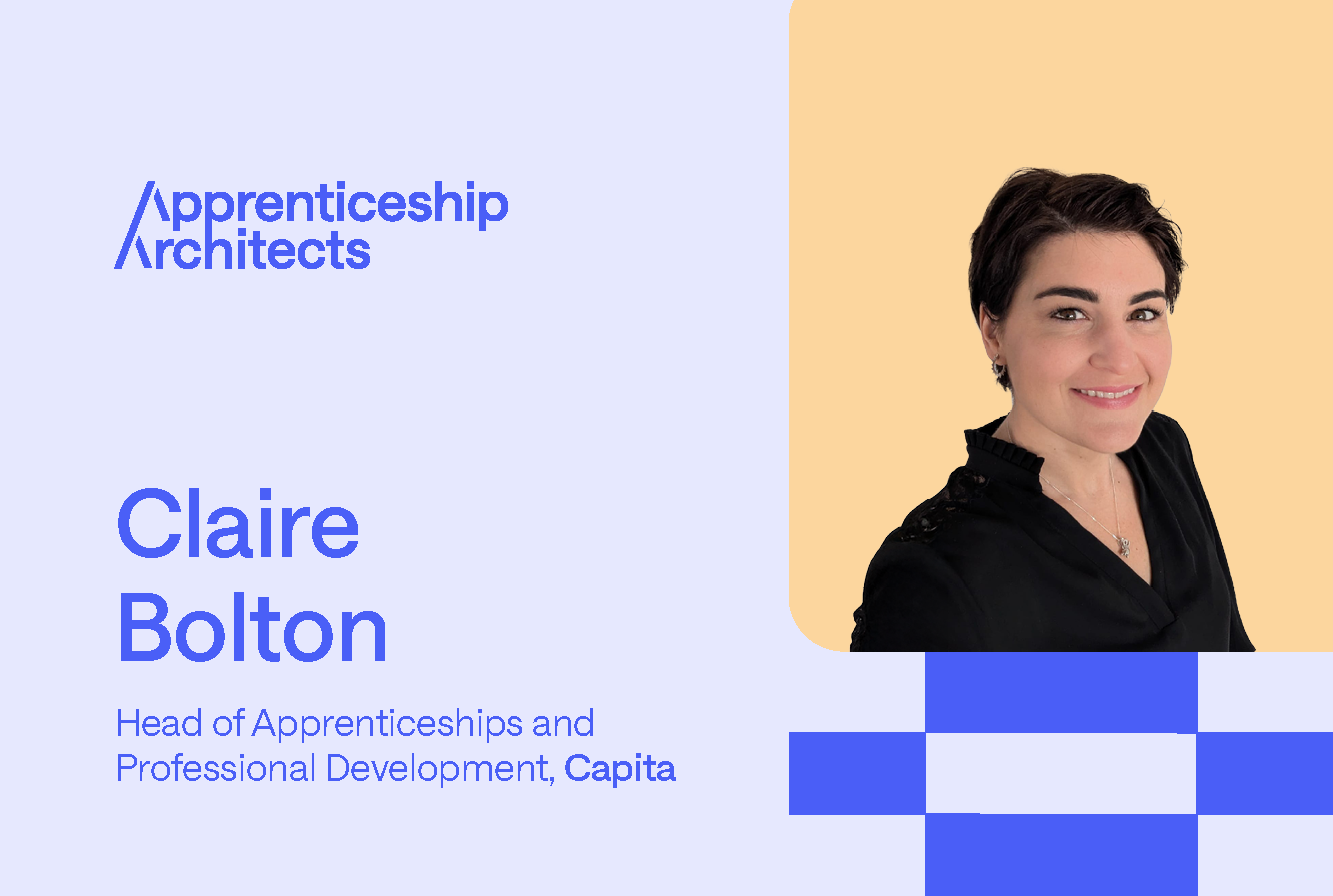
“The biggest impact is confidence” Apprenticeship Architects: Claire Bolton, Capita
Employers
Claire Williams
We spoke to Claire Bolton from Capita, about the steps for launching a new upskilling programme and how to align apprenticeships with AI adoption.
Welcome to Apprenticeship Architects, Claire. Can you tell us about your role and the apprenticeship programme you launched with Multiverse?
I'm Claire Bolton, Head of Apprenticeships and Professional Development at Capita. I work with Multiverse and other providers to promote apprenticeship programmes for Capita across the business.
I ensure programmes are of good quality and are fit for purpose, for the individuals and the organisation. I work with senior leaders at Capita to align the apprenticeships with Capita’s strategy. I’ve been working with Multiverse for some time on the AI for Business Value apprenticeship.
You’re now on your fourth intake of employees to the apprenticeship programme. Can you walk us through how it’s evolved?
At first, it was a big bang – we had so much interest across the business. It's evolved quite significantly over the four cohorts.
Initially, we started with a ‘transformation accelerator’ group. We held in-depth stakeholder interviews to understand:
- Where they sit in the business and what they’re involved in
- Who they work with and who works for them
- How could this programme add value to them?
- What are the problem statements this programme could potentially support?
We gave that information to the coaches working on the programme.
This is how you know, while building this knowledge, you're going to make a difference. And then we can use the projects they're working on, like a full cycle, and feed it back to those senior leaders.
What’s the biggest impact you’ve seen from the Multiverse apprenticeship programme?
The biggest thing is confidence. The [AI for Business Value] apprenticeship gives everybody the opportunity to start at the same level and build confidence.
For those in client-facing roles, they can go into a client meeting, take that new knowledge, and share the journey they've been on. That will be hugely powerful in our organisation to ensure our clients have confidence in us as their trusted advisor.
Can you explain the steps you took so learners knew what to expect?
In any apprenticeship at Capita, we're keen to make sure we have the right people, on the right programme, at the right time. No one wants to start a course and then drop out.
With Multiverse, we built out a comprehensive insight session. Following the first two cohorts, we took it one step further and it grew into a taster session.
It transformed from a factual session about the course, goals, and eligibility criteria into a preview of what sessions are like and how they're delivered. That way, learners get an idea of whether it would work for them. Having that exposure before they've committed has been really successful.
How do learners on AI for Business Value actually implement their new projects
We're very lucky to have Tiina Stevens, Director of Digital at Capita, who leads our AI engagement internally. She's been really involved in the programme, hosting sessions for apprentices to provide insight into her role, highlighting how they can have an impact on the business and its direction.
Tiina has introduced our AI Catalyst Lab, [which houses] all of the identified opportunities where AI could be applied as part of a solution. Apprentices have full access to align their projects to this Lab and have the opportunity to work with Tiina and her team to see it to fruition, which is really exciting.
How are you sharing success with the rest of the business?
Seeing the projects - and the impact individuals are creating - brings it to life.
This isn't just sitting in a classroom and learning the theory. They genuinely are changing the way our organisation is performing, developing and serving our clients and their customers, because they understand AI and how it can benefit them.
We share [learner] outputs in a variety of ways. We might do a session with a senior leader who previously identified the challenge. It might be that we'll have an internal community where we'll post various case studies of the projects. It varies, but it's important to complete that circle and show the successes of individuals and the impact on the business.
In National Apprenticeship Week, we had a panel session which we live-streamed across the organisation. We had six learners on the programme at the time who were able to speak about their experience.
That was incredible. Not only did it touch so many different people, it managed to get a huge audience watching virtually. It spotlighted the individuals as well as the programme overall.
We've talked about lots of positives, were there any challenges, and how did we overcome them?
One that sticks out for me – which was probably a good challenge – is we had to be careful about who we put on the programme. There was so much excitement and so much appetite. Understandably, everyone wanted to go on it. So we had to be strategic and selective as to who we could invite to join.
We did that by ensuring we had really good relationships with senior stakeholders who understood the needs of their divisions. They could work with us to identify who’s top of the list that needs to go on this immediately, who can afford to wait until the next cohort, and so on.
Without that strategic partnership with the wider business, the leaders, and their knowledge, we wouldn't have that clarity.
What’s your top advice for HR teams at the start of this journey?
I've got two. One would be to not underestimate the power of real stories. We've four cohorts in, and our first isn't far off graduating. We've got tangible impact statements, reports, projects and outcomes that we can share with our business and with our clients. It's real, it's not theory. The more we can promote those, the better.
My second bit of advice is to work with the business, layer by layer. The real success has been understanding each area of our business and how this can help individual teams, before tailoring the nominations and the offering.
We've spoken lots about the wider impact, do you have any individual success stories you want to share?
Many learners [have created] significant impact since being on the programme, but one in particular stands out from our first cohort. They had no exposure to AI and joined full of enthusiasm and excitement, like everyone does.
There was a moment when she wasn't sure if she was going to stay on the programme. And she'll tell you that she's delighted she did, because she turned that corner, and started to see the change in her thinking and doors opening internally. She's doing some brilliant work in leading AI change in her area of the business.
It’s a lovely, good news story, about achieving something that you might not have thought you could and going through all of the challenges to get there, but actually seeing the benefits afterwards.
What's your long-term vision for the AI for Business Value programme at Capita?
I’d love to create a sense of communal learning in Capita. AI is changing all the time, and it's important our colleagues are continuously developing their learning in this space.
So even once they've completed the programme, it would be lovely to create a space for them to share their learning regularly. That might be a regular spotlight ‘lunch and learn’ where we invite apprentices to share the projects they're working on.
That would be a way to spread the knowledge, excitement, and confidence across the business as well as keep momentum. We can't stand still, because we'll get left behind.

Why reskilling and flexible training are vital: Breaking down the Skills England report
Employers
Ellie Daniel
At Multiverse, we’ve been keenly following the establishment of Skills England, a new government agency sponsored by the Department for Education, which brings together partners from inside and outside government to drive improvements to England’s skills landscape, to power economic growth and opportunity.
What is Skills England’s role in assessing skills?
As the country’s authoritative voice on current and future skills needs, one of Skills England’s primary responsibilities is identifying skills gaps across the economy through comprehensive skills assessments.
The goal is to create a skills system ‘fit for the future’, and to ensure that the government’s skills strategy and policies are informed by a data-driven approach.
Introducing the Skills for Growth and Opportunity Report
Skills England published its Skills for Growth and Opportunity Report in June 2025, following a period of data analysis and engagement with employers and other stakeholders about the country’s growth and skills offer.
The report brings together a wealth of evidence including analysis of Government data and insights from 743 stakeholders, including employers.
It identifies the challenges faced by employers in developing skills pipelines and the critical importance of the skills system in delivering the Government’s missions and wider priorities, including its Industrial Strategy.
Crucially, it highlights long-standing skills shortages across the eight Industrial Strategy Growth-Driving Sectors:
- Advanced Manufacturing
- Clean Energy Industries
- Creative Industries
- Defence
- Digital and Technologies
- Financial Services
- Life Sciences
- Professional and Business Services
And in two additional ‘critical’ sectors:
- Construction - essential for achieving the government’s wider house building aims)
- Health and Adult Social Care - facing pressures as a result of demographic shifts
Skills England report: Three takeaways from Multiverse
Skills England offers an overarching perspective on themes pervasive across these sectors.
These include the escalating demand for highly qualified workers, the prevalence of gender inequality in various priority sectors, and the importance of the wider education system, including careers advice, in addressing skills challenges.
Three themes particularly caught our attention:
1) The digital and AI revolution is transforming workforce skills
According to Skills England, the unprecedented pace of technological change is a ‘major driver of changing skills needs across sectors’ with AI in particular reshaping the future of the workforce.
For example, in the creative industries, 69% of employers say their staff need urgent retraining due to new technologies. The report demonstrates that both advanced digital skills and digital literacy are in critical demand - with basic digital skills set to become the UK’s largest skills gap by 2030.
2) Reskilling is essential to combat the widening digital gap
Employers highlighted the importance of both reskilling the existing workforce alongside upskilling new entrants, with apprenticeships identified as an important tool in enabling this, particularly in relation to the adoption of AI and data science.
Despite this technological revolution, Multiverse research has shown that more than half of workers have received fewer than five hours of training on AI, and just one third (34%) of FTSE 100 companies reference AI training in their latest annual reports.
That’s why we’ve recently launched a commitment to train 15,000 new AI apprentices over the next two years.
3) Flexible apprenticeships and training options are key
Employers see the value in apprenticeships but are calling for more flexible, responsive models such as shorter, flexible courses or ‘bolt-on’ training in AI, to meet business needs as they evolve.
Multiverse has long been calling for increased flexibility in the apprenticeship system so as to widen access to learning and ensure the apprenticeship system truly serves the immediate and evolving needs of businesses.
The path forward
The Department for Education is currently developing a Post-16 Education and Skills Strategy, which will articulate its long-term vision for skills.
While we don’t expect major changes any time soon, decisions also lie ahead regarding the future of the Growth and Skills Levy, and how much increased flexibility this might offer for employers in the future.
Skills England’s assessment is a critical first step in closing the nation’s skills gaps and designing a system that will unlock economic growth. The message is clear - investing in workforce skills is instrumental to driving productivity and economic growth.
Beyond the buzzwords: Realising tangible ROI from digital, data and AI upskilling
Employers
Lindsey Purpura
Add AI into the mix and the opportunity grows even larger. But a complex ecosystem of legacy technology and workforce skills gaps makes transformation a challenge.
The NHS is investing in updated IT systems, including a £1.5 billion NHS framework to support the analogue to digital switch, but enduring change goes beyond new hardware.
To achieve tangible benefits and ROI, the NHS workforce needs the critical skills to implement digital systems and AI effectively.
The role of digital skills in the NHS
Today, all NHS employees – clinical, administrative, or otherwise – are expected to be data consumers, whether using dashboards, filing electronic patient records, or communicating using a patchwork of online systems. As a result, all roles now need a baseline level of digital literacy.
Yet, when some hear words like digital, AI and upskilling, all they hear are buzzwords.
Upskilling in critical digital, data and AI skills translates into greater productivity, which in turn, results in a better standard of patient care.
Let's explore stories of tangible, employee-led change happening at NHS trusts across the country.
Improving data visibility at Barts Health NHS Trust
Apprentice role: Data Analyst, Transfer of Care Hub
Barts Health NHS Trust launched a data and digital academy with Multiverse to help drive efficiency gains and improve patient experience.
A Data Analyst on the apprenticeship programme used her skills to build a central dashboard that monitors compliance levels and key performance indicators in the Transfer of Care Hub.
The dashboard streamlines access to critical data for the entire team, saving two hours per week in the creation of data packs and ad-hoc reports. By identifying and resolving data quality issues, the learner has also enabled more reliable reporting and the development of targeted interventions.
Today, the hub enjoys streamlined access to data that helps them understand performance and areas for improvement. New automations save each team member between 30 minutes and one hour per day, freeing their time to focus on patient care.
Minimising waiting times at Royal Free London NHS Foundation Trust
Apprentice role: Administrator, Adult Assessment Unit
The Royal Free London NHS Foundation Trust partnered with Multiverse to improve data literacy within data teams, supporting the Trust’s strategy to become a data-driven organisation.
One learner was an administrator in the Adult Assessment Unit at Barnet Hospital’s emergency department. He felt the unit could be made more efficient by migrating paper-based patient management processes to a digital Electronic Health Record (EHR).
The learner used skills acquired from his apprenticeship to map the patient journey and demonstrate how it could be improved.
He consulted with small focus groups comprising employees across the unit to iterate and ensure the new solution delivered value to every user.
Today, the digital tool enables efficient, end-to-end patient management for the unit.
For instance, patient sign-ins automatically trigger arrival notifications for the relevant clinicians, and test results are sent digitally instead of being printed and physically distributed.
Digitalisation has helped double the daily department caseload from 30 to 60 patients and reduce waiting times from over 30 minutes to 10 minutes.
For his efforts, the learner has earned a well-deserved promotion to Data Coordinator.
Improving theatre audits at Medway NHS Foundation Trust
Apprentice role: Band 5 Endoscopy Nurse
The Endoscopy Unit at Medway NHS Foundation Trust faced inefficiencies and delays in decision-making due to time-consuming, paper-based processes.
An Endoscopy Nurse, Joy Onuoha, applied the data skills she learnt on the Multiverse apprenticeship programme to develop a Power Business Intelligence (BI) dashboard that automated the theatre audit processes.
Joy integrated multiple data sources and designed interactive visualisations to track critical metrics, delivering real-time insights to inform the unit’s decision-making.
Automating the process has led to reducing delays and minimising errors, and enhanced resource allocation for clinical sisters so they can focus on what they do best – delivering high-quality care to patients.
In acknowledgement of her work to streamline data collection, Joy recently received a Chief Nursing Officer’s Award for Most Innovative Nurse.
Joy said: “This achievement wouldn’t have been possible without the skills, knowledge, and confidence I gained through the Multiverse fellowship. Learning about data analytics, visualisation, and automation has empowered me to identify clinical inefficiencies and implement data-driven solutions."
Since completing the apprenticeship, Joy has been promoted to the role of Clinical Practice Facilitator.
Upskilling initiatives empower the NHS
Across trusts, hospitals, and all other healthcare organisations, upskilling is delivering tangible value to the NHS. Employees aren’t just building digital, data and AI skills for the future, they’re applying them within their roles to deliver real benefits operationally and, importantly, the patients in their care.
Multiverse is empowering every NHS employee to unlock innovation and improve patient care through our applied learning programmes. Discover more
Article originally featured in HSJ Online

“Start with the right learner, on the right programme” Apprenticeship Architects: Gareth Kenward, Babcock
Employers
Gabriela Wasilewska
We spoke to Gareth Kenward, Head of Early Careers and Skills Development at Babcock, a leading defence company, about the steps they’ve made in data upskilling and the crucial role of line managers.
Welcome to Apprenticeship Architects, Gareth. First off, can you tell us about yourself and your role at Babcock?
I’m an early careers manager at Babcock, looking after apprentices, graduates, STEM, and external engagement at a specific site, while working closely with Multiverse on our data apprenticeship programmes.
Why did Babcock decide to launch the Data Academy?
Our large workforce relies heavily on data in day-to-day operations. Over the years, I’ve worked with the business to introduce a range of apprenticeship programmes – mainly at levels three and four, with some at level six – focused on upskilling our existing teams.
The goal is to ensure we’re making the most of our data, driving both efficiency and effectiveness. And partnering with Multiverse has been a big part of making that happen.
The programme grew quickly, which has been fantastic. We’ve got a significant number of learners enrolled, and the feedback from both apprentices and their line managers has been really positive. It’s been a real success so far, and we’re already seeing a tangible impact.
What were the key goals and business challenges you wanted to address with the programme?
Automation is revolutionising the maritime industry, enabling organisations to save considerable time and money, freeing up the workforce to focus on higher-value tasks and boosting overall productivity.
Beyond that, we also wanted the Data Academy to drive broader business efficiency and strengthen our position with clients and investors.
How did you set managers up to support apprentices from the programme’s launch?
For any apprenticeship programme to succeed, all three parties – apprentices, the business (represented by line managers), and the training provider – need to align on expectations.
For line managers, it's about helping them balance providing support for apprentices without becoming a burden or impacting their daily duties. To set them up for success, we worked with Multiverse to run dedicated sessions outlining expectations from both sides – what we needed from managers and what they could expect from Multiverse.
The sessions also helped clear up common misconceptions about apprenticeships and ensured managers were going in with their eyes open.
Feedback from these sessions was overwhelmingly positive. Apprentices felt reassured that their managers understood the significance and demands of the programme, which in turn made them more confident when asking for time to focus on their development.
More people completed the programme and brought their new skills back into the business.
What tools did you give line managers for guiding and mentoring apprentices?
On top of setting clear expectations, line managers knew where to go for additional support or resources. We built a mentorship network giving apprentices access to additional mentors – beyond their direct line managers – to give extra layers of help.
Multiverse coaches in the Data Academy – while primarily focused on apprentices – gave line managers advice and guidance on how to provide effective support.
And Multiverse’s ability to collate feedback from line managers has been incredibly useful. By establishing clear feedback loops we drilled into the challenges managers were facing to adapt the programme accordingly.
With such a large workforce, how do you strike the balance between learners hitting their goals while making a positive learning experience?
My mantra – which my team is probably tired of hearing – is that you have to start with the right learner on the right programme. And that applies at both the individual and team level.
For example, if you have five people from the same team of six in the Data Academy all at once, you’ll undoubtedly run into some operational challenges. The business’ needs always have to be balanced against the requirements of the programme.
The second part is about regular feedback and check-ins. We continuously monitor workloads to ensure they’re manageable. Proactive support is key – once a learner starts falling behind, it can be difficult to catch up.
It’s a multifaceted challenge, so it requires a layered approach.
What else have you done to stop learners from feeling overwhelmed?
Our mentoring network has been one of the most impactful. Sometimes, learners simply need help with their programme. But often, it’s guidance around how to manage their workload or balance their day job with their studies that apprentices need.
Time management is a critical challenge, so giving apprentices access to mentors outside their direct line management structure offers that additional layer of support.
We also make sure they’re aware of the broader wellbeing resources available at Babcock, including mental health first aiders, financial advice and medical support. It’s important people know they can always access help – not just for their studies but for anything affecting their ability to perform at work.
When we get feedback on learners' challenges, we work to resolve them.
Because we use a response mechanism to receive feedback, it’s an inherently reactive process. We try to act as fast as possible, as we know the sooner we do, the more likely we are to keep learners engaged and on track.
You successfully maximised Babcock’s Apprenticeship Levy spend. How do you measure and show the ROI of the Data Academy?
For us, it all comes back to impact. While we’re pleased to make full use of the Levy, it's more important that we invest in apprenticeships that deliver real business value.
We frame the Data Academy as a tool for making the company more operationally and financially successful. By tying learner success to the business, we show the value of the programme more clearly.
We also track ROI carefully, with Multiverse helping us measure the programme’s impact – particularly in terms of time savings.
For instance, if a task that previously took a week can now be completed in three days through better data handling, that’s an immediate efficiency gain. In some cases, apprentices have identified new ways to streamline processes they’re close to, saving money and improving service delivery.
We want to ensure learners complete the programme and use their new skills to help the business achieve its objectives.
You’ve been a key advocate for expanding the Data Academy. What’s your vision for the future of apprenticeships at Babcock?
We’ve scaled quickly and are now seeing real ROI, which is fantastic – but there’s still plenty of room to grow.
Data is everywhere in our business, and nearly every role interacts with data in some way.
Our goal is to identify areas where data skills will have the biggest impact, so we can achieve the quickest and most significant wins.
By expanding strategically into these areas, we can continue to demonstrate the Academy’s value across the organisation.
What’s one final piece of advice you'd give to other organisations looking to create a successful apprenticeship programme at scale?
It comes down to building strong, open partnerships. Having the right people in the room at the right time is essential – whether that’s during setup, scaling, or refinement.
Clear, honest communication makes all the difference. It allows you to celebrate what’s working and quickly adapt to what isn’t.
Finally, learn from others. Speaking to organisations already running large-scale programmes – especially those working with Multiverse – offers invaluable insights.
Sharing experiences with peers has helped us refine and strengthen our approach.
Ultimately, the key is to stay flexible and collaborative. Building a successful apprenticeship programme at scale is never a one-and-done effort, but an ongoing journey of learning and improvement.

“Secure buy-in from the top down” Apprenticeship Architects: Melissa Hope, Oxford City Council
Employers
Gabriela Wasilewska
This week, we’re speaking to Melissa Hope, Organisational Development Manager at Oxford City Council, about how their apprenticeship programme has managed to foster a new culture of collaboration across the organisation.
Welcome to Apprenticeship Architects, Melissa. First off, tell us about your role at Oxford City Council and the apprenticeship programme you launched with Multiverse.
I’m responsible for organisational learning and development (L&D) and providing support across the council. So, I work with managers and our leadership team to help deliver on our corporate strategy.
We’re currently working with Multiverse on four apprenticeships: AI for Business Value, AI-Powered Productivity, Business Transformation Fellowship and Data and Insights for Business Decisions. Across these four areas, 42 people started their apprenticeships in December last year.
What were the key goals for the programme, and how did it support the broader goals of the City Council?
We launched the apprenticeship programme to help our employees make better use of AI tools such as ChatGPT and Microsoft Copilot. Many were already experimenting with it, but didn’t fully understand how to best use the technology in their day-to-day roles.
Our goal was to reduce the time spent on repetitive, manual tasks by equipping our people with the skills to use these tools more effectively. This aligned with our broader efforts to streamline data use, improve processes and grow collaboration.
The programme also supported the rollout of our AI policy, which offers guidance on how to deal with AI and data safely, effectively, and ethically. Alongside this, we introduced a Microsoft Copilot strategy, giving all employees access to free licences.
Apprentices have been working with our ‘change agents’ – employees who drive internal innovation alongside their usual roles – to compare the free and business versions of Copilot.
They’ve created how-to guides, tested use cases, and shared findings to identify where advanced tools may drive the most impact. The collaboration has helped shape how we use AI across the council, really driving efficiency and change.
How did you structure the partnership with Multiverse in line with other L&D initiatives?
First, we integrated it into our people plan and held a ‘Let’s Talk’ session, open to everyone. These sessions focused on L&D, giving people insight into upcoming opportunities and helping them make informed decisions about which route would best suit them.
Alongside Multiverse, we also offered a range of other L&D opportunities so everyone understood the full spectrum of options available, allowing them to choose what worked best for them.
Could you tell us about the process of securing internal buy-in for the apprenticeship programme?
Before launch, we spent six to seven months building the foundation with Multiverse. We started with a data and AI skills scan across the whole organisation to identify gaps.
Multiverse then helped us present the findings alongside the business value of an upskilling programme to our corporate leadership team – showing how data-driven skills could save time and improve processes.
With leadership buy-in, we were then allocated an executive sponsor: Tom Hook, Deputy Chief Executive of city and citizen services. His support has really helped us keep on top of the programme and drive the initiative from the top-down.
Tom and I met with all the service directors individually to talk about the programme – the benefits, impact, and any concerns they might have – and this information was then disseminated down to managers.
We also ran sessions where employees could learn about the programme’s content, commitments and benefits, after which they could submit an expression of interest. We then worked with managers to confirm that the programme aligned with participants’ roles and career stages.
Your initial cohort was a big undertaking, involving 5% of the council workforce. Can you tell us about what it takes to successfully launch an apprenticeship at scale?
We needed to make sure that the programme was manageable for the organisation. So, we took a phased approach with employees given the choice to join either Cohort One or Two, depending on their schedules.
We also gave Multiverse data on the service areas and how many people worked in each, so we could make sure we had good coverage across the organisation.
Staggering the rollout kept it manageable, and we worked with directors to plan for the time commitments. Planning this way gave us a clear view of the cohorts' scope, helping us set them up for success.
What other steps did you take to ensure employees were set up for success on the programme?
To prepare participants, we ran detailed information sessions so they understood the weekly commitment: six hours, with three spent applying their skills in real work scenarios.
Once the programme was underway, we ran a quick survey to get early feedback, helping us pick up on any teething issues. Multiverse also checked in regularly, ensuring everyone knew what they needed to do and where to go for support.
And what results have you observed so far from the programme?
We’re now around three months into the programme, and while we haven’t formally measured the impact yet, we’re already hearing some fantastic feedback from colleagues.
One standout example comes from a colleague on the Data Insight for Business Decisions apprenticeship. Within 10 minutes of her first module, she’d already picked up something she could immediately apply to her role.
As she’s part of my team, I’ve been fortunate to see the impact first-hand. During a recent people team away day, she demonstrated her new Power BI skills to 22 colleagues, showing how she streamlined the reporting process for large volumes of internal data. What once took hours of manual input is now faster, clearer, and far more user-friendly.
Best of all, she quickly shared her learnings with others, spreading best practices across the council – a great example of the apprenticeships delivering value early on.
What about the general initial response from employees on the programme?
People are enjoying it – and they’re learning from day one!
There was a short adjustment period as people found the balance between the apprenticeship and their day jobs, but they seem to be coping well. The quality of the learning and the coaches have all been called out as standout strengths.
It's been especially exciting to see how the learnings are extending beyond the formal sessions. Colleagues have set up their own groups to meet, collaborate on assignments and share project ideas.
The cross-council collaboration is an example of the culture shift that’s taking shape: employees are taking new skills and using them to work together, solve problems and drive real change.
How do you plan to measure and demonstrate the ongoing impact of the apprenticeship programme?
From the outset, we worked with Multiverse to map out a clear business value plan. We identified key areas to measure, including improved productivity and time savings, as well as shared best practices.
We’ve also partnered with Multiverse’s customer service team to create a joint success plan. That’s been a really thoughtful touch – the team took the time to share their insights on the potential successes they saw for us based on what they’d learned about our organisation.
We’ve since added our own priorities to that list and are in the middle of finalising that plan. We meet regularly to review it, combining feedback from both Multiverse with our own teams’ to make sure the programme’s impact is clear and shows measurable results.
And what’s Oxford City Council’s long-term vision for the Multiverse Apprenticeship Programme?
Cohort Two is officially in motion and it’s exciting to see the growing interest from people who didn’t initially consider the programme. Managers are asking when the next cohort will start because they have team members eager to take part since seeing the impact of Cohort One.
We’re now working to map out the plan and timeline so that we have plenty of time to do it properly. That means running the same thorough process: giving people clear, detailed information so they can make informed decisions and ensuring we have the right people on the right programmes at the right time.
What was your biggest challenge in the process of launching the programme, and how did you overcome it?
Shifting the perception of apprenticeships. When we started, many still associated them with new starters or younger employees, when in reality, they’re for all ages and levels.
Luckily, I have experience in the apprenticeship field, which helped me passionately advocate for the programme. It was important to communicate that apprenticeships range from entry level to the equivalent of a master’s degree, making them a valuable tool for not only upskilling existing employees but also attracting new talent.
Information sessions helped us overcome many of these misconceptions. We had plenty of one-on-one conversations and made sure to demonstrate the value apprenticeships bring at all levels.
The other big challenge was time commitment concerns. Initially, many employees and managers assumed six hours a week would be unmanageable. But once employees settled in and it became part of their routine, they started seeing rewards in the form of time saved and increased productivity.
What’s one piece of advice you’d give to other HR leaders looking to launch an apprenticeship programme?
Don’t be scared of apprenticeships.
Many already know the value they can bring, which is great. But if you’re not sure, Multiverse will guide you every step of the way. But you have to put in the groundwork upfront – there’s no point rushing the process.
So, take your time, speak with the right people across your organisation and secure buy-in from the top down.
The learning opportunity: Making data and AI skills attainable for the NHS
Employers
Rhys Westall
Meaning, there’s a missed opportunity for trusts to streamline operations and transform care. Only one in five NHS organisations are considered “digitally mature”. And despite lots of progress in the last decade, there are still areas of the NHS relying on paper and non-digital processes.
It makes embracing new technologies, such as AI, feel like an unattainable goal – one that goes beyond moving the health service from analogue to digital.
As we enter this new era for the NHS, data and digital skills across the workforce will be fundamental to improving patient care, streamlining processes, and making cost savings.
The case for upskilling in the NHS
Why should a consultant anaesthetist care about data skills? You might not immediately think it’s important.
But when we show how understanding patient data supports positive patient outcomes, the story changes.
Data and AI skills can support better decision-making, automate routine tasks and even enable innovation from within teams – outcomes that are relevant for roles across each trust.
Being data-driven moves the health service away from a reliance on “gut feeling” when making decisions. So, the information NHS staff work with becomes more meaningful – with the opportunity to save millions in costs.
With more than 1,500 learners across 95 NHS trusts and arm’s-length bodies, Multiverse’s digital, data and AI training programmes have so far unlocked £10m in savings over six months. And that’s just the tip of the iceberg.
Building on a skills foundation to boost productivity
Data and AI skills have to be embedded into every layer of trusts in order to deliver the lasting impact the health service needs.
Looking at skills holistically will improve data maturity and, in turn, AI readiness.
Assessing the levels of data maturity in the workforce will help NHS trust leaders understand their current skill gaps and opportunities for growth. Tailored learning programmes can then align with the goals and objectives of the transformation strategy.
Aligning skills requirements with strategic workforce planning processes creates a solid foundation – making skill gaps easier to spot and solve.
Importantly, providing upskilling through the levy, combined with applied learning, means people can learn on the job – making a stronger link between the training and how it impacts their day-to-day. After all, what’s the point of learning new skills if they can’t be applied directly into your role?
North London Foundation Trust (NLFT), for example, needed to reset its company culture around technology. To make this happen, the trust provided an upskilling programme, delivered by Multiverse, to improve data literacy across its workforce and improve productivity.
One learner used the analytical skills gained in the Digital Academy to pinpoint bottlenecks in one department’s discharge process. By employing data visualisation techniques using Power BI, he could effectively illustrate the issues, reducing the number of active patients awaiting assessments from 25 to one within nine months.
Engaging staff for a future-fit NHS
Improving the data and AI skills of NHS staff can create opportunities across the service. From improving patient outcomes to automating routine tasks, freeing up time and even enabling innovation from the inside.
The results from our digital, data and AI programmes show what’s possible. We see NHS workers saving on average seven hours a week – just from improving their data skills.
Today, the NHS can take advantage of the levy – a strategic funding pot for trusts to deliver applied learning that upskills the workforce at scale and at no extra commercial cost.
Levy-funded training is an ideal way to harness the talents of NHS workers to effect positive change – helping every employee gain the skills and confidence to support the digital evolution of the NHS.
Multiverse is empowering every NHS employee to unlock innovation and improve patient care through our applied learning programmes. Discover more
Article originally featured in HSJ Online
Implementing AI in the public sector: Four tips to enhance adoption
Employers
Gabriela Wasilewska
The AI Opportunities Action Plan highlights the potential the technology has to enhance efficiency, improve service delivery and support better decision-making.
The big question is: what does it mean for public services?
Howard Lewis, the managing director of Modern Workplace at Microsoft, shares some thoughts on how to take advantage of AI in local government and strengthen public sector services. Here’s a snapshot of what he has to say.
Applying AI in the public sector
In practice, implementing AI in the public sector could look like:
- Predictive insights to notify when potholes could need maintenance, social care services that might require urgent intervention, and where emergency services could need to be deployed based on data trends.
- Automating back-office processes to free up staff time for higher value or community-facing work.
- Improving citizen engagement with AI-powered chatbots that handle common questions, reducing response times and improving accessibility.
But the challenge is implementation. AI is only as effective as the strategy and the people behind it. And that's why we're seeing a shift from exploring AI to developing real-life use cases which benefit the public.
An AI-ready culture comes from the top
Successful AI adoption starts with strong leadership. Whether it’s breaking down silos or driving data strategies, public sector leaders need to be champions of change – creating a culture of collaboration and innovation.
"Encouraging the right culture comes from the top-down – no matter what you’re looking to achieve. When implementing AI, business leaders need to be active, visible and demonstrate consistent participation."
Howard Lewis, Managing director of Modern Workplace at Microsoft
To make this possible, building a coalition with executive peers and the wider management community will help to engage the rest of the organisation – enabling a culture that’s ready for change.
Establish ethical frameworks for AI usage
There are several pillars of an AI ethics framework, including fairness, accountability, transparency, reliability and safety, inclusivity, and privacy and security.
Yet, a framework alone won’t do the job – you also need strong internal communications.
“Communication is key. You have to demonstrate the importance of the framework, why shortcuts shouldn't be taken, and the impact on fair, secure and accurate AI usage,” Howard explains. “Never has this been more necessary than in the public sector, where employees work with sometimes confidential and sensitive data.”
Having an ethical framework for how you will use AI can also help reduce data constraints. That means no waiting to sort your data quality to get started. Instead, your data strategy works alongside the implementation of AI – all shaped by your ethical framework.
“Starting with small-scale pilots helps to get the ball rolling and see those early wins, but it also means cleaning up your data in manageable chunks so it’s ready to use for specific applications,” Howard shares.
Empower your people
Today, the topic of AI adoption coincides with concerns about how the technology could be used to replace workers.
“Establishing clearly how AI will be applied can help to assuage worries. But, you can empower your workforce too if you’re able to show how their involvement is critical,” Howard explains. “We call this: keeping humans in the loop. And it’s a vital part of ensuring compliance is maintained too.”
The key to getting this right, Howard says, is upskilling and reskilling employees on AI. By ensuring staff can understand and apply the technology, you can create an environment where people feel empowered.
“Having the right skills in your workforce means employees can start to think of creative, responsible ways to leverage AI to improve legacy processes and deliver real, long-term impact.”
Howard Lewis, Managing director of Modern Workplace at Microsoft
When people feel empowered to use AI – with the appropriate guardrails in place – public services will benefit from more available time for human contact and support.
Collaborate with partners to develop best practice
“Whether it’s demonstrating real-world use cases or how to address your specific AI applications, technology partners can help you identify and prioritise high-impact areas for implementation,” Howard mentions.
By partnering with trusted AI advisors, the public sector can focus on driving the most meaningful change. “There’s a feedback loop to partnerships that means you can benefit from the technology now and as it evolves to better meet their needs,” Howard concludes
At Multiverse, we’re partnering with Microsoft to equip 1 million people with the skills needed to thrive in an AI-enabled economy by 2025. By collaborating, we can work together to share expertise and create opportunities to prioritise best practice.
Get started today
It’s important to remember the public sector is only two years into working with AI on a large scale.
While there could be a tendency to feel left behind or out of the loop, public services adoption is just getting started. As long as those in the sector take initial steps to begin AI implementation today, no one will be left behind.
See how Essex County Council and the NHS are embarking on their digital transformation journey with incremental changes.
10 benefits of AI in the workplace: Key statistics
Employers
Claire Williams
Nearly three in four (72%) businesses are using AI, which is up from 50% in previous years, according to McKinsey.
Here are 10 key benefits of AI in the workplace – and four ways you can unlock them within your business:
10 benefits of AI in the workplace
- New career opportunities: The World Economic Forum (WEF) predicts that by 2027 we’ll see 2.6 million jobs added by AI.
- Revenue increases: Four in five leaders say implementing AI has led to an increase in revenue generation (Multiverse ROI of AI report). About 75% of the value that generative AI (GenAI) could deliver falls across four areas: customer operations, marketing and sales, software engineering and R&D (McKinsey).
- A productivity boost: Businesses using AI to sort vast amounts of customer and market data are seeing as much as an 80% reduction in data processing time – supporting a 40% improvement in speed to market for new products and services (Accenture).
- Increased GDP: PwC and McKinsey report that global GDP will be 14% higher in 2030 as a direct result of AI – the equivalent of a staggering $15.7 trillion of new value.
- Creating efficiencies: More than 80% of workers surveyed – who use generative AI (GenAI) daily – expect it to make their time at work more efficient in the next 12 months (PwC).
- Business value: 83% of workers think AI skills will help them to drive more value for their employer in the next 12 months (ROI of AI report).
- Greater employee satisfaction: Deloitte reports that, on average, more than half of Millennials (55%) and Gen Z (58%) employees believe GenAI will free up time and improve work/life balance. And half (49%) of all daily GenAI users expect the technology to lead to higher salaries (PwC).
- Increased demand for AI specialists: The WEF expects to see a 40% jump in the number of AI and machine learning specialists. And a 30%-35% rise in demand for roles such as data analysts and scientists or big data specialists.
- Heightened competitive advantage: 68% of senior leaders in financial services and telcos believe that competitive advantage in their industry will depend on who can make the best use of AI (Experian).
- Transforming industries: According to cross-industry research from Accenture, 90% of C-level executives expect GenAI to revolutionise their industry and customer interactions. However, separate insight from the company found that the banking (54%) and insurance (48%) industries hold the highest potential for AI impact through automation.
4 ways to unlock the benefits of AI in your workforce
1. Create a future-ready AI skills strategy
Tech investments need to be combined with an AI-enabled workforce to get the most from the technology. But there are several barriers holding businesses back from reaching AI maturity – and technical skills are a big one.
In fact, our ROI of AI: Unlocking AI maturity through workforce skills report found that leaders currently name AI as their most significant skill gap (45%).
That’s because AI and data literacy is an ongoing challenge in the workplace. Half of workers have received less than five hours of AI training. And employees struggle with the basic data sksills needed to achieve the full benefits of AI, such as making data more efficient (53%) or analysing data to make informed data-driven decisions (46%).
Fixing these skills gaps starts with a targeted upskilling strategy. One which equips your teams the most needed AI skills for your business.
These skills may be different across sectors, job titles, roles and functions, and your crafting an effective AI skills strategy needs to first begin with identifying your business opportunities to generate Return On Investment (ROI) from AI.
2. Define measurable goals
Measurement should sit at the heart of your strategy.
Setting a benchmark for measuring success with AI also helps to ensure all training ladders up to your business’s wider picture. Do your customer service executives need training in how to automate manual processes? If one of your goals is to improve the speed of customer responses, then the answer could be yes.
However, measurement is only as successful as the strength of the strategy and goals set in the first place. Only then can results truly be measured to anticipate hurdles and uncover opportunities.
3. Give teams the tools and training they need to succeed
Once you’ve got a solid skills strategy in place, implementing tools and training is the next step.
When we think of tools, it’s easy to go straight to technology. But, when it comes to unlocking the benefits of AI in your workforce, providing safe guardrails to innovate is vital. That means creating clear policies, guidelines or even Centres of Excellence with best practice examples.
Today, just 45% of employees have received formal AI training provided by their employer. So, it’s likely workers will struggle to assess whether their actions are aligned with the company without policies or broader best practice – creating potential risks for the business.
It’s about ensuring policies are being adhered to, with people not only accountable for how they’re using AI, but also proud of it. That means fostering a positive culture around AI in the workplace, with the integration of technologies into operations, processes, and employee interactions.
4. Enable new career opportunities for employees through AI skills
Businesses need to build expertise in AI, fast, but formal AI training opportunities remain in short supply.
Our data shows that most workers learn AI skills informally by experimenting with ChatGPT (61%) or learning on the job (59%). And half (51%) have received fewer than five hours of training on AI.
This presents challenges for both the worker and the business, from struggling to assess knowledge gaps to unlocking efficient processes.
According to our ROI of AI report, businesses are aware of the gaps and leaders are looking to invest in data upskilling in 2025. Half of the organisations that have identified skills gaps as a key barrier to full implementation of AI plan on upskilling employees through long-term external AI training programmes (56%) and ad-hoc/short-term external AI training programmes (50%).
There’s a clear opportunity for businesses to upskill employees in AI – unleashing productivity benefits, opening up new career pathways, and delivering measurable impact.
The AI skills gap in financial services
Employers
Claire Williams
But while financial institutions are making significant investments in AI technology, many are still developing the workforce capabilities needed to maximise its potential. This presents a timely opportunity for organisations to gain competitive advantage through strategic upskilling.
Our recent research reveals an industry at an inflection point: enthusiastically adopting new technology while simultaneously working to develop the human skills that drive AI success.
"The future of financial services isn't written by algorithms, but by the people who understand how to make those algorithms work for humanity." Anna Wang, Head of AI, AI Advisory Board Member - Multiverse
Based on our comprehensive survey of senior leaders in UK financial institutions,* here are the critical insights defining the state of AI in financial services today:
AI adoption surges, while results lag behind
67% of financial organisations are using AI for process automation, yet only 37% report transformative business results.
Financial institutions are enthusiastically embracing AI across multiple functions:
- 67% for process automation and operational efficiency
- 64% for customer service enhancement
- 57% for strengthening cybersecurity
- 52% for risk management and fraud detection
But despite widespread implementation, the majority (47%) experience only moderate benefits, while 9% admit they aren't measuring AI's impact at all.
The workforce readiness gap
Only 46% of financial institutions are heavily investing in AI upskilling, while 11% have no formal AI training initiatives whatsoever.
Organisations face critical skills gaps in:
- Building AI features (40%)
- Identifying AI use cases (37%)
- Implementing AI projects (33%)
- Risk management (32%)
- Ethical AI practices (30%)
The competitive landscape: An industry of explorers
Only 37% of financial institutions rate their AI maturity ahead of competitors.
The research reveals most organisations remain in early maturity stages:
- 52% classify themselves as "AI Explorers"
- 55% view their AI maturity as comparable to peers
This relatively level playing field creates a significant opportunity for ambitious organisations to gain competitive advantage through strategic skills development.
The future of AI in financial services
Our research shows financial leaders expect AI to transform:
- Cybersecurity (64%)
- Customer service & engagement (55%)
- Regulatory compliance & reporting (48%)
- Process automation & operational efficiency (57%)
Yet this transformation depends entirely on workforce readiness. While 36% of leaders believe AI will transform their roles and create new opportunities, 12% fear their roles may become redundant without proper adaptation.
"The biggest risk is being left behind and seen as uncompetitive because the organisation cannot deliver the service levels that others will have developed." Senior Financial Services Leader
The path forward
Organisations that successfully bridge the AI skills gap will lead the industry through:
- Enhanced cybersecurity capabilities
- Hyper-personalised customer experiences
- Automated compliance through regulatory technology
- Operational efficiencies with AI co-pilots
- Strategic decision-making powered by predictive insights
But this future is only possible with strategic investment in people alongside technology.
Methodology
*The survey, conducted by Radish on behalf of Multiverse between February and March 2025, targeted 157 leaders within financial services organisations. An online survey was used, with all respondents based in the UK. Phone interviews with leaders within the financial services sector were also conducted.
From chaos to competence: 4 lessons on AI adoption challenges
Employers
Gabriela Wasilewska
The reality is that AI is here to stay. But with mounting questions around risk, governance and making a return on investment (ROI), how can leaders move from chaos to competence with AI? And how can they overcome AI adoption challenges?
We spoke to Rudy Lai, CEO at Tactic, and Jason Smith, AI Strategy Lead at Publicis Media, to tackle these questions and to share guidance on how best to get started.
Lesson 1: Prioritise people and processes
What’s their best advice for starting AI transformation?
“The technology is the least of your worries,” says Jason. “People and process are two of the most difficult things to get right.”
Jason recommends assessing the ‘day in the life’ of your workers to understand how generative AI (GenAI) can help, while also encouraging people to be hands-on with the technology. He adds:
<block-starlight>“Because GenAI has democratised access to AI and machine learning, people need to roll their sleeves up, try things, and get grace to make mistakes.”</block-starlight>
“Everybody understands that AI is the next big thing, the next business opportunity, the next tool to create impact,” says Rudy, agreeing on the need to focus on people and processes.
He argues many businesses struggle to find the right place to start, and suggests a three-tiered approach when thinking about AI adoption:
- Tier one: empowering employees with GenAI tools such as Microsoft Copilot, helping people be more productive.
- Tier two: transforming your product or services with AI features.
- Tier three: using AI to create entirely new business models.
As you move through each tier, you’ll shift from internally focused AI use cases to external ones. How far you’ve progressed depends on a range of factors, including your level of data skills maturity.
However, Rudy argues: “No matter how you slice and dice the use cases of AI in your organisation, you always need to go back to the business impact.”
Upskilling should be treated as a priority – giving your people the foundational data skills to unleash the potential of AI.
Lesson 2: Identify champions to support AI implementation
When asked which teams are most receptive to AI, Rudy notes that it depends on task suitability, digital maturity, and staff readiness:
“One of the first signs of a department being AI-ready is you can imagine putting the work they do into a large language model (LLM) and automating it.”
He adds that “well-defined problems” such as repeating tasks and processes are good candidates for automation. And not to forget: teams with an existing strong data culture will be better targets for initial AI adoption.
AI champions – people who are curious, proactive, and willing to experiment with new tools – is one way to encourage adoption.
So what else makes a great AI champion?
“[They have] the right mindset, a willingness to give it a go,” says Jason. AI optimism goes a long way – and these people may already be building rough and ready prototypes to show what can be achieved – even if these prototypes aren’t perfect.
After getting AI champions on a consistent skill level, they can act as mentors to others around them – as well as being focal points for spotting new use cases.
“Those use cases are when you can start to get some traction with the help of these champions, who can then hopefully bring other team members along,” he adds.
One initial step you can take to identify your AI champions is reviewing your skills inventory – helping you spot AI capability and strengths that may already exist in your workforce.
Lesson 3: Watch out for ‘shadow AI’ to manage risk and AI governance
Significant risks are emerging from unmanaged AI use – also known as ‘shadow AI’.
Without proper AI tool oversight, risks can include data leakage, compliance issues, and misinformation. It’s a challenge that adds to the barriers to AI adoption.
Given the availability of free-to-access tools, as well as new players entering the market such as DeepSeek, businesses can run into difficulty when they have no rules or protections in place around tool use.
“There's not a huge amount of visibility on how and what people are using, and it’s fairly challenging to detect,” says Rudy.
“People can be almost too excited about what AI can do, and being too reliant on what AI is producing without verification.”
As well as the need to have solid AI governance frameworks in place, Jason argues responsible AI usage should also be considered, with people asking the questions:
“Should I do this? Is it ethically correct? That's much more difficult to get right, but you have to factor in both [governance and responsible use]. It's important to recognise what might be the unintended consequences of deployment and adoption,” he says.
So how can these risks be contained?
Creating a ‘sandbox’ environment where your people can experiment with AI tools safely is one way to protect leaders from risk, data security and compliance challenges.
For it to work, Jason suggests: “It’s a combination of leadership setting the tone and the policies. Make sure agreements are in place so you can use the tools in the sandbox. And then training so that people are aware of the risks.”
Lesson 4: ‘Find the baseline’ to measure the ROI of AI
As AI projects shift from proof-of-concepts to full adoption, showing the ROI of AI is a recurring theme for leaders making a business case for AI.
And while there is no one-size-fits-all approach or a ‘magic measurement tool’ to share all the answers, the panel recommends going back to basics on measurement.
Rudy advises against using vanity metrics, and instead for people to look at the 'business as usual' KPIs they're already tracking.
“Vanity metrics don't deliver real business impacts because you have shifted the focus from what you need – such as time efficiency, cost efficiency, or more revenue.”
It’s a sentiment echoed by Jason, who says how you measure can vary between use cases. He recommends establishing ‘baselines’ that you measure in the business:
“If you've got that in place it's going to make it much easier for you to measure your return on investment.”
What next with your AI adoption challenges?
With agentic AI influencing trends in 2025, you are likely looking closely at how to overcome your AI adoption challenges.
Rudy and Jason share three principles to help get you started:
- Start with clear business goals, not just AI hype
- Empower internal AI champions to drive change
- Balance innovation with governance to scale AI safely
Sorry, no results found.