








We couldn’t find what you are looking for. Please try another way.
Apprentices
Thank you! Your submission has been received!
Oops! Something went wrong while submitting the form.
My apprenticeship expectations vs reality: Laura's story
Apprentices
Team Multiverse
No one told me how competitive it would be to find a decent apprenticeship program. After months of interviewing and numerous rounds, I felt defeated. Jobs that seemed too good to be true ended up being too good to be true. Companies posted descriptions with ‘entry level’ requirements, but were looking for ‘experts’ with multiple years of experience in the field.
My Multiverse Experience
After months of job searching at various apprenticeship providers and job boards with no luck, I came across Multiverse. Multiverse had a specific platform for people like me to apply to roles and did not require any prior work experience: just a GCSE at 4/C in English and Maths.
I put in my application and landed a role pursuing a business apprenticeship. Now nearly half way through my Digital Business Accelerator apprenticeship program, I truly did not expect this level of nurturing for my ideal role, which I could not be happier in!
While my journey has not been easy, I strongly believe everything happens for a reason. The admission’s team were helpful with the application process, transparent about my options and true to their word from the start. Now in my working role, I’m not afraid to ask seemingly simple questions or ask for help with more in-depth tools that I don’t know how to use - I’m confident my manager will walk me through it and go over it again if I don’t understand.
Starting the new job
Prior to starting in my new role, I had a different perception of what my apprenticeship course as a whole would look like. Everything I am taught here intertwines. My new Excel skills help me complete my other work faster, and I also have access to the Multiverse community hub with all sorts of information, events to attend and articles to read to help me throughout my career. Apprentices need to spend 80% of their time at work and 20% completing ‘Off the job’ learning. At first I thought my ‘Off the job’ learning time would be away from my job and unrelated to my work, but I quickly discovered that the majority of my ‘Off the job’ time is decided by me, so I can choose tasks and activities that I feel relate to my role.
Growing beyond imposter syndrome
Despite the initial excitement of starting a new job, transitioning into a new role was nerve wracking! Prior to my apprenticeship, I studied business at college and had two years of sales experience. When I received the apprenticeship offer from Multiverse, I was worried that after so many rejections I wouldn't have the skills needed to do the job.
Perhaps you’ll see yourself in my previous position. It’s a competitive and difficult market to land a quality apprenticeship, and you may feel like an imposter once you finally find a good one. Just because you’ve been knocked down before, please know you are not alone: you have earned your position! Continuous growth during an enriching learning experience is something to be proud of. If you look back at where you are now in comparison to five years ago, you’ll see just how far you’ve come.
Data Analyst salary in the UK: How much can you make?
Apprentices
Team Multiverse
To answer "How much do Data Analysts make?" and help you decide whether data analytics is the right path for you, we'll cover:
- Data Analyst salary in the UK
- Types of Data Analysts
- Data Analyst salary by job title
- What does a Data Analyst do?
- Are Data Analysts in demand?
- How to get a Data Analyst job in the UK
Data Analyst salary in the UK
A Data Analyst career can be rewarding because it's in high demand. You can also earn a higher than average salary. According to Indeed, Data Scientists make around £35,500 annually.
Salary in the UK is broad and fluctuates by city, industry and experience. For example, in cities like London and Edinburgh where the cost of living is higher, salaries are higher.
Your specialism and seniority level also impact what you earn. You might start your career path as a Junior Data Analyst, then specialise in data science.
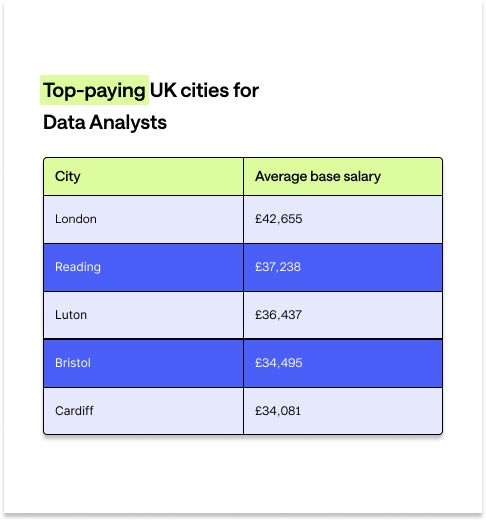
Highest-paying cities for Data Analysts in the UK
Aside from experience, role and employer, your location can affect what you make as a Data Analyst. In London, Data Analysts make around £42,000 on average, while in Reading, they earn around £37,000.
According to Indeed, the five highest-paying cities for Data Analysts in the UK are:
- London
- Reading
- Luton
- Bristol
- Cardiff
Types of Data Analysts
Data Analysts sometimes specialise in an industry or area of expertise. With Data Analytics training, you might pursue one of these careers:
- Media Planner
- Data Scientist
- Data Modeller
- Business Analyst
- Financial Data Analyst
There are many ways to progress through a career in data analytics. One way is with a Data Analyst apprenticeship from Multiverse. This programme allows junior and new Data Analysts to broaden the depth of their data analytics knowledge and prepare for lucrative mid to senior-level positions in the field. You’ll develop durable, future-proof data skills without having to put your career on pause — and get support from your manager, coach and the Multiverse community. The best part? When Multiverse partners with your employer, your on-the-job training is free to you and all learners on your team.

Data Analyst salary by job title
Data analytics is broad, so there are many types of jobs you can pursue. All industries need data experts to assist them in organising their data. Since data analytics skills are in high demand, there are many well-paying roles.
Let’s look at Data Analyst salary by job title, including the average base, entry and senior-level wages for each.
Data Analyst
Data Analysts collect, clean and interpret company data. They also collaborate with other colleagues and leadership to find data-led solutions. If you enjoy technology, mathematics and solving problems, a career in data analysis could be a fit for you.
Here average Data Analyst salaries in the UK according to Glassdoor, using London as a frame of reference:
- Entry-level salary: £32k
- Average base salary: £41k
- Senior-level salary: £54k+
Let’s look at the salary for other roles that need data analytics skills.
Business Analyst
Business Analysts find data-led solutions to business problems and create growth opportunities.
To become an entry-level Business Analyst, you'll need a grade of 4/C GCSE (or equivalent) in Maths and English. Relevant A Levels (Business Studies or IT/ Computing), and prior work experience with translatable soft skills will also help strengthen your application.
Business Analyst salaries in the UK:
- Entry-level salary: £35k
- Average base salary: £42k
- Senior-level salary: £52k+
Media Planner
Media Planners analyse marketing data and create advertising strategies connecting brands with their target audience. To become an entry-level Media Planner, you'll typically need a higher qualification in a relevant subject. That could be advertising, marketing or a data-focused programme.
Media Planner salaries in the UK:
- Entry-level salary: £23k
- Average base salary: £30k
- Senior-level salary: £38k+
HR Analyst
Human Resource (HR) Analysts collect, organise and review employee data. They may focus on hiring, onboarding and compliance. Their data-informed insights help to solve recruitment, retention and compliance problems for companies.
HR Analyst salaries in the UK:
- Entry-level salary: £33k
- Average base salary: £39k
- Senior-level salary: £46k+
Data Modeller
Data Modellers are engineers and system analysts. They design database management systems that help companies manage data. You'll typically need a higher qualification in a relevant field to become a Data Modeller.
Data Modeller salaries in the UK:
- Entry-level salary: £37k
- Average base salary: £49k
- Senior-level salary: £67k+

Financial Data Analyst
Financial Data Analysts work with financial institutions. They collate and review data from financial records to help institutions make better business decisions. You’ll need an interest in mathematics or economics to become an entry-level Financial Data Analyst.
Financial Data Analyst salaries in the UK:
- Entry-level salary: £31k
- Average base salary: £36k
- Senior-level salary: £43k+
What does a Data Analyst do?
Data Analysts collate, clean and review raw data. They spot trends and help make data-led decisions. Data Analysts also make company data more accessible to leadership.
Job responsibilities include:
- Using specialist tools to gather, clean and organise data
- Finding patterns and anomalies in data
- Reporting and presenting data insights to non-specialists
- Collaborating with Business Analysts to create data-informed systems and processes
- Sourcing new ways to use company data
- Keeping up with training needs and best practices
To become a Data Analyst, you should be interested in developing these skills:
- Knowledge of mathematics: Linear algebra, statistics and probability play a significant role in data analysis.
- Problem-solving: You identify starting points for overcoming project and technical problems.
- Technical skills: You use (or you’re willing to learn) SQL and data visualisation techniques to gather, clean and segment data.
- Database fundamentals: You know how to manage and navigate databases.
- Commercial mindset: You understand the data analytics lifecycle and how to meet business requirements.
- Communication: You communicate data insights to non-specialists.
Aside from demonstrating relevant skills (or a commitment to learning them), employers may require specific qualifications:
- At least a grade of 4/C GCSE (or equivalent) in Maths and English
- A relevant higher qualification like L4 Data Analytics or a BSc (Hons) Digital and Technology Solutions. If you don’t already have a higher qualification in data, you’ll need to demonstrate the willingness to work toward one
To strengthen your application for a data role, the following could also increase your chances of landing one:
- A Levels in a relevant subject like Computing, Mathematics or Business Studies
- Prior work experience that includes transferable interpersonal skills
Are Data Analysts in demand?
The job outlook for data analytics in the UK is healthy. A quick search for "Data Analyst" jobs on LinkedIn brings up over 2,600+ results across multiple sectors.
The Department for Culture, Media and Sport (DCMS) anticipates data analysis demand will grow 33% by 2026. DCMS also predicts data analysis will become one of the fastest-growing digital skills in the UK.
Accelerate your career as a Data Analyst
A Data Fellowship apprenticeship with Multiverse is the fastest way for junior Data Analysts to accelerate their careers. The free programme helps apprentices build in-demand data skills that can ultimately help them unlock promotions, increase productivity, and future-proof their careers.
We make it easy for you to get started — it takes less than 15 minutes to create a profile. Our team can then double-check your eligibility and discuss apprenticeship options with your current employer. Apply today.

Beginner's guide to data analysis methods
Apprentices
Team Multiverse
Not sure what data analysis is or how it works? Keep reading for everything you need to know about analytics and data analysis methods. We’ll cover:
- What is data analysis?
- Qualitative vs. quantitative data analytics
- The data analysis process
- Quantitative data analysis methods
What is data analysis?
Data analysis turns raw data into actionable insights. Data Analysts collect and make sense of information so companies can improve efficiency, profit and more. Ultimately, data analysis helps companies make better decisions that contribute to success.
Qualitative vs. quantitative data analytics
The two main forms of data analysis are qualitative and quantitative.
Quantitative analytics
Quantitative analytics focuses on data that you can measure or quantify with numbers. Some examples of quantitative data include:
- Costs and revenue numbers
- Weight and measurements
- Projections and forecasts
- Anything you can count or quantify
You usually use quantitative data analytics to answer questions about how much, how often or how many.
For example, Google Analytics is a rich source of quantitative data, especially for your website. Analysing web traffic shows how your customers find your website and what they engage with when they’re there.
Qualitative analytics
Qualitative analytics looks at those harder-to-define areas, such as customer satisfaction levels or user experience.
Qualitative analysis can answer questions about how customers interact with a company. For example, qualitative analysis might provide insights into how to attract loyal customers or convert new leads. It also reveals the ‘why’ behind behaviours. You could use it to understand why:
- Customers buy from you
- People chose a competitor over your brand
- Some products are more popular than others
- Your sales increase or decrease
The data analysis process
Data analytics is an interactive process that, when done correctly, requires multiple steps to go from raw data to conclusion. The basic steps of the data analysis process are:
1. Define the question
Data analysis aims to answer questions. The more narrowly you can define your question, the better. These are a few questions effective data analytics can answer:
- How much time do users spend on your app?
- What’s driving your website traffic?
- How often do customers recommend your products?
- Which products do your customers prefer?
- How much does the average consumer spend per visit?
To get the most out of your data, you’ll need to formulate your questions clearly beforehand. Defining your questions gives you a roadmap to follow when you begin your data analysis.
2. Collect data
Once you know the goal or question you want to answer, you must collect accurate and relevant data to analyse. You can collect it from a variety of sources, but most Data Analysts start with internal or first-party sources. Companies collect this type of data directly from customers and other tools.
These include:
- Customer relationship management (CRM)
- Website heatmaps
- Customer and user surveys
- Google analytics and other tracking tools
- Marketing and sales data
You can also supplement data with external sources depending on your goal. Examples include:
- Review websites
- Public and government sources
- World health data
3. Clean and organise data
Raw data, on its own, is difficult to organise. Before you can analyse data, you’ll need to clean it and put it into a format that you can use. Check for duplicates and delete any unnecessary information. Make sure that you haven’t left any fields blank, as this can throw off your data.
4. Analyse data and pull insights
Analysing data typically means looking for patterns, drawing connections and then, understanding what it all means. To make sense of data, you can use various data analysis methods. As you spot trends and connections, you’ll be better able to answer your initial question.
5. Visualise the data
You can visualise data by putting it in charts, graphs, tables and other visuals that help someone quickly interpret it. Data visualisation is an ideal way to share and explore insights with the rest of your team.
Once you’ve visualised and shared your analysis, you and your team can build an action plan or make decisions from the insights.
This is also the stage where you’ll become aware of any limitations in your data analysis. Visualising data can reveal holes or missing data in the process. Are you missing data points? Do the answers to your questions seem incomplete?
If so, go back and complete your analysis.
Quantitative data analysis methods
As previously mentioned, there are qualitative and quantitative data analysis methods. Qualitative data helps you understand why people make certain actions. It deals with words and feelings and you gather data through observation and interviews. Quantitative data focuses on information that you can measure. It puts insights in terms of quantifiable percentages and numbers that reveal how much, many or often.
In this post, we’ll focus on quantitative data analysis methods. But, both qualitative and quantitative analysis have important roles to play in data analytics.
Four of the most common quantitative data analysis methods are:
- Regression analysis
- Cohort analysis
- Cluster analysis
- Time series analysis
Depending on your goals and the specifics of your analysis, you may use one of these approaches, all of them or a blend.
Regression analysis
Regression analysis leverages historical data to reveal which variables have the most impact on your present outcome.
To carry out an effective regression analysis, you’ll need access to relevant data. In many cases, this means sales data. But, it can also include product quality, marketing, retail design and other relevant information.
Regression analysis is a useful way to make sense of changes in a business over time. For example, suppose you’ve noticed that your sales took a dip in the past year. You might want to do a regression analysis to try and understand which variables are driving the downward trend. Other questions it can help answer include:
- Are consumers spending less across the board?
- What’s changed over the past year— in your business and the overall economy?
Looking at a range of factors can help you pinpoint which variables drove the change that you’re seeing. Then, you can make educated decisions about how to address the change.
Cohort analysis
Cohort analysis looks at the behaviour of a particular set of people or “cohort.” To do a cohort analysis, you group cohorts based on similar behaviour or categories. Grouping cohorts together helps you more easily look at patterns and trends.
If you want to better understand how and why a group behaves a certain way, use cohort analysis. For example, you can do a cohort analysis to understand when users churn, or stop using your product.
To begin, you’d group users based on when they began using your product. Then, look at what points that group dropped off. You can further analyse cohorts to identify why users churn, form a hypothesis and an action plan to keep users.
Overall, cohort analysis can help you understand your customers better. You can use it to decide which product features to prioritise or craft more effective marketing campaigns.
Cluster analysis
Cluster analysis groups data points together according to their similarities. The goal behind cluster analysis is to seek out patterns that you may not have noticed before.
As we have seen, cohort analysis and regression analysis are both focused on answering a particular question. In contrast, cluster analysis is a way of looking for patterns and insights that you may not have been aware of otherwise.
Cluster analysis is a great place to start when you really aren’t sure what’s driving a particular trend. It can often push you to explore new areas and to re-analyse your existing data.
Time series analysis
A time series analysis lets you zero in on changes in a particular variable over a period of time.
The beauty of time series analysis is that it isolates the variable. So, you get a broad picture of how it operates throughout the time period. You can also understand how the variable interacts with other variables.
Time series analysis allows you to make successful predictions about the future, based on past behaviour. For example, let’s say you notice that consumers buy more leather boots in the autumn. You’ll be able to predict when demand for those boots will increase and alter your inventory ahead of time. In general, the more accurately you can track past patterns, the more effectively you can predict the future.
Data analysis tools
The right tools can make beginning your data analysis career much easier. Here are some of the most useful data analysis tools that apprentices learn in Multiverse’s analytics programmes.
- Excel: With Excel knowledge, you can clean and organise data. You can also create pivot tables to quantify data and more.
- Business intelligence (BI): The best BI tools help you analyse and create reports to share with decision makers. Tableau is a data visualisation tool, but Multiverse apprentices also it to prepare data and build dashboards.
- SQL: SQL is important for Data Analysts and Scientists to learn. You’ll use it to organise and extract data.
- Data visualisation: In Multiverse’s data analytics apprenticeship training, apprentices learn how to visualise data in Power BI.
Learning data analytics with Multiverse
Data analytics jobs are in-demand and often come with higher salaries and better benefits. One of the best ways to grow your data analytics career is through an apprenticeship.
Unlike university or other continuing education programmes, Multiverse apprenticeships are tuition-free for learners —and you get paid your regular salary while you learn.
Multiverse partners with top companies to provide on-the-job training for a broad range of tech roles. Participants gain real-world knowledge and experience, all while building relationships with successful people in the field.
Multiverse provides training in data analytics, software engineering and more. To become an apprentice, check eligibility requirements and complete an application in minutes today.
Starting your career again at 30 on an apprenticeship
Apprentices
Ayla Kelly
While this is true for lots of people, apprenticeships are a valuable resource to older groups as well. In fact, for this current academic year, over 25s make up 41.5% of new apprenticeship starts in the UK.
One of many in their 30s doing an apprenticeship
I am among this group of over 25s and I have just started my Level 3 apprenticeship. While attending university and gaining a degree in my early twenties had its merits, completing an apprenticeship in my thirties will be much more beneficial to my career in the long run.
Here are a few reasons why I’m benefitting from doing an apprenticeship in my thirties.
You don’t always know what career route to take at 18
Asking an 18 year old to know what direction they want their life to go in is a pretty big ask. When you leave school at 18 you don’t know a lot about the working world and you can’t always be completely sure what route to take. There are a few lucky people that know exactly what they want to do from a young age, but for most, it takes a lot longer.
You’ve got to try out different jobs until you find the right one
To me, it made more sense to venture out into the world with the skills and interests I did have. I tried out a few jobs, and found out what I liked and what I absolutely didn’t like.
I worked in the service industry for nearly a decade and it taught me a lot. It’s a perfectly valid career choice but it didn’t motivate me. Finding out what I didn’t like has been just as important as discovering what I do want from my career.
After ten years I hit a career crossroad
After ten years in the service industry, I was in a rut. I’d gotten everything out of it that I possibly could, yet I was still working every hour under the sun to make ends meet. I knew I wanted to do something different, but I didn’t know where to start.
The apprenticeship opportunity at Timpson came at just the right time. I was ready to learn something new. I jumped at the chance. Not only was I embarking on an exciting new career path, but I would receive several qualifications in the process.
Learning new skills at work invigorated me
It’s easy to forget what a privilege it is to have the opportunity to learn something new. I didn’t realise how rewarding learning could be until I found the path that was right for me.
A second chance to reach my full potential
One of my biggest regrets in life is not utilising my time at university to the fullest. I was young and foolish and didn’t take advantage of the opportunities I was given, ending up with a much lower grade than I knew I was capable of. Now that I’ve got the chance for a sort of do-over, I don’t plan on wasting it.
I’m so grateful to my employers for giving me the chance to better myself and finally reach my potential. That’s the main thing I take away from starting this apprenticeship in my thirties – gratitude.
Doing an apprenticeship in your 40s
Apprentices
Libby Adams
I was at a key transitional point at work, thinking about my next steps. I was torn between leaving my admin role within the NHS or starting a Master’s in Spanish Translation. The pandemic threw a metaphorical spanner in the works and I reluctantly decided against pursuing the Spanish course.
That was when I stumbled upon a one-liner in the hospital bulletin. Something about a data apprenticeship. My interest was piqued. Clicking on the link, I realised it was exactly what I needed to flourish in my current job. At that moment I decided I had to do it. Just a few weeks later I was starting my apprenticeship and I haven’t looked back since.
Now I could tell you all about Excel formulas, programming languages, off-the-job training and assignments, but I want to tell you about the more unexpected benefits of what I now call my ‘Multiverse makeover’.
An apprenticeship has given me self belief
This apprenticeship is helping me remember my value. For a long time, I felt that I was lucky to have a job. Ten years ago, due to personal issues, I was redeployed from my role as a children’s nurse to a more administrative role. This meant a massive pay cut and a massive loss of self-esteem, but I have been able to turn things around and now I’ve realised what an asset I am to the team.
My apprenticeship has made me more confident at work
Everyone has noticed. First, it was one of the secretaries, then the nurses, and consultants. Now even one of the business managers has noticed: I am much happier and much more confident since starting my data apprenticeship. No doubt about it. I’ve found the leader in me I didn’t know was there.
Having a growth mindset is a phrase I’d not heard of until recently, but I am now developing mine. I no longer think I am powerless to make changes to things that affect me. What I used to think were stumbling blocks are now my climbing frame. Whatever role I'm in, my opinion counts and I can take the initiative.
I’ve found my people on an apprenticeship
My apprenticeship at the NHS has been a great opportunity to meet so many fabulous people. My coach, my cohort, the wonderful community team and my mentor have all been a big part of the journey so far. I feel blessed to have met them all. I am thriving in such a positive, upbeat community. There is power in creating a culture of encouragement and letting people know when they have done a good job.
I really get on with my cohort. I love the team I work with, but they aren’t data people and don’t always understand the data challenges I face. My cohort gets me. They know what I am talking about, and help me when I can’t remember which set of brackets to use in python code. They have my back and I have theirs. I would never have met them without the apprenticeship, even though some of them work at the same hospital as me.
A few people in my cohort even speak Spanish, which was a fabulous surprise. I made it my mission to try and insert some Spanish into our bootcamp chats. Even though I was unable to continue my Master's in translation, I still had fun setting the language to Spanish in PowerBI and when we recently covered Natural Language Processing I was excited to discover that it didn’t just apply to English. Thanks to my coach, I also realised learning Python code is not that far removed from learning Spanish.
I feel invested in on an apprenticeship
I had no idea that the Multiverse experience was so immersive. I thought I would just be learning data content. Nerdy stuff to help me at work, but that is not the case at all. I have such a wide range of resources at my fingertips aimed at the whole person.
The amazing resources that are available have challenged and inspired me. I’ve learned so much that has nothing to do with data. I have been soaking up everything about group facilitation, change management, leadership, feedback strategies, and public speaking as well as content on working through menopause, and overcoming procrastination.
My apprenticeship has been life changing
Since the beginning of my programme in September, I no longer feel old, past my best, or stuck in a rut. I have years ahead of me and I am convinced they will be the best years of my life. The impact of my ‘Multiverse makeover’ is propelling me towards a better future full of possibilities.
Multiverse helped me reevaluate what I needed to do and take the next step in my career, later than I expected. My life is fuller. I’ve made best friends, I’m smarter, and healthier. Oh, and by the way, I have even learned some stuff about data, I am doing a data apprenticeship after all.
A guide to apprenticeship levels and how to choose the right one for you
Apprentices
Team Multiverse
Different apprenticeship levels are available to suit your goals, whether you're entering the workforce, upskilling in your current role, or developing expertise in your field.
Making an informed choice about your future can set you on the right career path. To help you choose the best option for you, we'll guide you through the following:
- What is an apprenticeship?
- 4 types of apprenticeships
- Apprenticeship levels (Levels 2-7)
- Who can do an apprenticeship?
- Which apprenticeship is right for you?
- How to get an apprenticeship with Multiverse
What is an apprenticeship?
An apprenticeship is a nationally recognised qualification that allows you to earn a wage while you study. With an apprenticeship, you'll upskill, get hands-on industry experience and gain a relevant qualification as part of your paid job.
While completing your apprenticeship, you'll dedicate 80% of your working hours to on-the-job training and 20% to learning—your employer will pay you for both. You'll also receive employee benefits like paid holiday leave.
You can find relevant apprenticeships for most industries. However, the entry requirements and course structure will vary depending on the apprenticeship level and these factors:
- The profession you want to pursue or master
- How long you want to study
- Where you are in you’re career
4 types of apprenticeships
Whether you’re entering the workforce for the first time or you’re an existing employee hoping to upskill, there's an apprenticeship for you.
There are four different categories or types of apprenticeships in England:
- Intermediate (Level 2)
- Advanced (Level 3)
- Higher (Levels 4-7)
- Degree* (Levels 6 and 7)
Apprenticeship types are also sometimes called levels, because they each correspond to a numerical apprenticeship level (Levels 2-7).

Also, the exact apprenticeship terms may differ in other parts of the UK. In Scotland, you'll find Foundation, Graduate, and Modern apprenticeships. Northern Ireland offers Level 2, Level 3 and Higher Level apprenticeships. Wales has similar apprenticeship types to England—the difference is Degree apprenticeships stop at Level 6.
*Degree apprenticeships are only available in England and Wales, but you can apply from across the UK.
Intermediate apprenticeships (Level 2)

Intermediate apprenticeships are a Level 2 qualification which is the equivalent of five GCSE passes. There are usually no qualification-specific entry criteria for Level 2 apprenticeships. However, employers might set job-specific entry requirements.
You'll also need to demonstrate to the education provider that you have what it takes to complete the course. You can show this through your enthusiasm for the subject or industry, relevant career goals or previous qualifications.
Level 2 apprenticeships are helpful if you need a 4 Standard Pass (previously grade C) or equivalent in English, Maths or both at GCSE. (You'll be able to gain Functional Skill equivalents as part of your apprenticeship, opening up more progression routes.)
They're also helpful if you've been out of the education system for a few years and want to build confidence before progressing.
Depending on your industry, job role and other factors, you can finish an Intermediate apprenticeship in 12 to 18 months.
Advanced apprenticeships (Level 3)

Advanced apprenticeships are equivalent to two passes at A Level and they’re classed as a Level 3 qualification.
You'll generally need a minimum of five passes at GCSE (including English and Maths) or a Level 2 apprenticeship qualification to be eligible. You can also use Functional Skill passes instead of English and Maths GCSEs.
If you live in England, you must stay in education until age 18. Advanced apprenticeships are a good route for those who prefer a work-based alternative to Sixth Form or college.
Level 3 could be a natural continuation after completing a Level 2 apprenticeship. Progressing from Intermediate to Advanced can demonstrate your commitment to professional development and improve your potential career growth.
You can generally finish an Advanced apprenticeship in just over a year to two years. If you’re doing it part-time, it may stretch into three years, but it’s not the norm. For example, Multiverse’s Advanced apprenticeships for business and data literacy only take 13 months to complete.

Higher apprenticeships (Levels 4-7)

Higher apprenticeships cover Level 4, 5, 6 and 7 qualifications. You can achieve anything from a Foundation degree to a Master’s degree.
- Level 4 - Higher National Certificate (HNC), Level 4 NVQ, or the first year of an Undergraduate degree
- Level 5 - Higher National Diploma (HND) or Foundation degree
- Level 6 - Bachelor's degree
- Level 7 - Master's degree
You'll usually need five GCSE passes, including English and Maths or Functional Skill equivalents, to qualify for a Higher apprenticeship. Providers and employers may also consider your Level 3 qualifications (BTECs, Apprenticeships, A Levels or NVQs).
Employers sometimes set their own entry requirements specific to the Higher apprenticeship job role. They might ask for industry-relevant experience or qualifications. You don’t need industry experience to do any of our advanced apprenticeships.
Higher apprenticeships are work-related, vocational alternatives to theory-based study. They're ideal if you'd like a nationally recognised qualification, but becoming a full-time student or starting university doesn't appeal to you.
Higher apprenticeships can take anywhere from two to five years to complete.
Degree apprenticeships (Levels 6 and 7)

Degree apprenticeships cover Levels 6 and 7. Level 6 is equivalent to a Bachelor's degree, and Level 7 is equivalent to a Master's degree. Criteria for Degree apprenticeships vary, but as they're higher level qualifications, employers have specific requirements.
An employer might require you to have a Higher apprenticeship, five GCSE passes with English and Maths, or Level 3 qualifications. You might also need industry-relevant experience, including voluntary work.
When it comes to Multiverse degree apprenticeships, you’ll need the following minimum qualifications:
- A grade of 4/C GCSE (or equivalent) in Maths and English
- Be able to work in the UK
- Lived in the UK for at least three years
Currently, there are two Multiverse programmes—Technology Consulting and Advanced Data Fellowship—that offer a degree. It’s an Applied Degree, so you learn through personalised coaching and on-the-job experience rather than traditional classroom study.
Degree apprenticeships can offer a more affordable alternative to the full-time university route. You'll earn a wage while studying, and apprenticeships are employer-funded, so you avoid student debt.
They're also viable if you'd like a degree but would prefer to start your career and learn real-world skills immediately. Or you don't want to leave the workforce and would like to improve your career trajectory by upskilling.
Degree apprenticeships take anywhere from three to six years to complete.
Apprenticeship levels
The six apprenticeship levels go from two to seven. Some apprenticeships combine several levels in one programme. For example, Multiverse’s Advanced Data Fellowship covers Level 4, but you can complete a second part for Levels 5 and 6.
The higher the level, the more challenging the qualification. Across all levels, you'll earn a wage, enjoy employee benefits like holidays and get paid for time spent learning. To top it off, there's usually a permanent job waiting for you at the end of your apprenticeship.
Level 2
You can find Level 2 apprenticeships for most industries and job roles. Level 2 apprenticeships (Intermediate) are usually linked to entry-level roles, You don't usually need formal qualifications to be eligible as they're a lower level. However, having relevant industry experience or an interest in the sector helps.
If you don't have GCSE English and Maths (or equivalent), a Level 2 apprenticeship could be right for you. You'll be able to gain GCSE equivalents (without the intensity of a Level 3 or higher) as part of your apprenticeship.
Level 3
A Level 3 apprenticeship (Advanced) is the next step up. It’s usually a good fit for those starting out in their careers. You can find Level 3 apprenticeships for Data Technicians, Software Engineers, Veterinary Nurses, Personal Trainers and more.
If you passed GCSE English and Maths and show you're working at Level 2 or above, you can usually skip straight to Level 3. Many Level 2 and 3 apprenticeships require Functional Skills qualifications. These show that you have developed your knowledge of English and maths enough for the role. To gain the qualification, you study and take an assessment.
When relevant to the job role or industry, some Level 3 apprenticeships require you to complete Functional Skills in Information and Communication Technology (ICT). This can be helpful if you'd like to progress to Higher apprenticeships in digital and tech sectors.
Level 4
Level 4 (Higher) apprenticeships are helpful for those who've completed a Level 3 apprenticeship and are looking for a natural progression. You might also pursue a Level 4 apprenticeship if you fall into one of these categories:
- Career starter - someone who’s entered the workforce in the last few years and may be deciding what path they want to pursue (usually age 16-24)
- Builders - someone who wants to take the next step in their career, upskill, or future-proof their role
Remember, progression looks different for everyone. Level 4 apprenticeships can set you up for a new career or help you upskill and hone your expertise.
Level 5
Where Level 2 and even Level 3 apprenticeships can be broad, Level 5 apprenticeships tend to be more specialised. Level 5 apprenticeships are more challenging than lower levels as well, so employers will set more specific entry requirements. They’ll look for relevant qualifications and a problem-solving attitude to indicate applicants are committed to completing the course.
At Multiverse, we offer Level 4-6 apprenticeships to people who have recently done their A Levels. However, they need to prove their commitment to learning and becoming a master in their field. Industry experience isn’t a requirement, but it doesn’t hurt to have it.
Although you can start a Level 5 apprenticeship with Multiverse, most people that do them are further on in their career. They’ve typically worked in their field for eight to 15 years into and want to upskill or change careers.
For example, you might pursue a Level 5 apprenticeship if you’re in a data-heavy role (data science) and you need to upskill and learn how to code to automate. If you currently work in finance but want to become a Software Engineer, you could also do a Level 5 apprenticeship to transition.

Level 6
A Level 6 apprenticeship is equivalent to a full Bachelor's degree. There’s a broad range of Level 6 apprenticeships across industries. They're also more common for those that want to upskill, change careers, or further advance in their current field.
Level 6 apprenticeships are sometimes a progression from lower levels. If you start a Higher apprenticeship, you could progress to a Degree level. For example, an Advanced Data Fellowship programme takes you from Level 4 (Higher) to Level 6 (Degree).
Similar to a Level 5, you could do a Level 6 apprenticeship to upskill in your current role. If so, it could be worth raising this with your Line Manager in your next 1:1 meeting. Sometimes employers offer an educational stipend, fund Continuing Professional Development (CPD) or have an Apprenticeship Levy allowance available.
Level 7
There are Level 7 apprenticeships for Doctors, Game Programmers, Senior People Professionals, Creative Industries Production Managers and more.
Since Level 7 apprenticeships are the equivalent of a Master's degree, the entry requirements are strict. Expect training providers and employers to ask for more hours of relevant experience or an Undergraduate degree or equivalent.
Apprenticeship levels recapped

Who can do an apprenticeship?
You can do an apprenticeship in an existing or new role, provided the course is relevant to your job. Apprenticeship entry requirements vary depending on the level, industry, learning provider and employer. You can generally apply for an apprenticeship in England if you're:
- 16 or over
- Not in full-time education
- Currently living in England
- Have the right to work in England
The criteria may differ if you live in Scotland, Wales and Northern Ireland.
Apprenticeship providers have varying requirements. The requirements for Multiverse apprenticeships depend on the specific programme. At minimum, the requirements for eligibility are that you must:
- Be 16-24 years of age
- Have the right to work in the UK and lived there for the last three years
- Be able to provide GCSE English & Maths 4-9 (C-A*) or equivalent
- Not have completed a university degree
Which apprenticeship is right for you?
Choosing the right apprenticeship for you depends on a few factors—your interests, career goals, qualifications and experience.
Interests
If you prefer to start working over staying in full-time education, consider your interests first. Let's say you're fascinated by technology. You may have done well at GCSE ICT and started to learn to code in your spare time.
You're legally required to stay in education, but a hands-on approach suits your learning style. Plus, the end goal of completing a Computer Science degree at university doesn't appeal to you.
A tech apprenticeship programme could be a great way to develop your practical skills and kick-start your career in tech.
Career goals
Let's take this idea further, using the tech industry as an example. Say you're already working in a Junior Data Analyst role, but your ultimate career goal is to become a specialist in your field.
Completing an Advanced Data Fellowship programme (covering Levels 4-6) can give you the tools to become a trusted specialist.
Previous qualifications and experience
An apprenticeship provider should work with you to help you determine the best apprenticeship level for your needs. You can get a rough idea by looking at where you are in your career and where you want to go.
Anyone can do an apprenticeship, but are here are some examples to help you choose an apprenticeship level.
For those starting their careers, we usually recommend Level 3 apprenticeships. As mentioned, we have some career starters that do Level 4-6, but they provide additional proof of their qualifications or experience.
Those that have been working for years and want to upskill or change careers, consider Level 4-6 apprenticeships.
How to get an apprenticeship with Multiverse
As a Multiverse apprentice, you earn a competitive salary while you learn on the job. We provide business, digital and tech apprenticeship programmes that give hands-on practical learning experiences. Unlike university, our apprenticeships are fully funded and come at no expense to you.
The first step is to apply for a paid Multiverse apprenticeship. To be eligible, you must be at least 16 with the right to work in the UK. You'll also need at least a grade of 4/C GCSE (or equivalent) in Maths and English.
You'll then create a profile of your skills, traits, and experiences during the application process. Next, we'll get to know you and your goals for your future. Then, we'll help you land a paid apprenticeship at a top company.
Apply for an apprenticeship today and join the 93% of Multiverse apprentices who completed their programme and landed a job in their field within 90 days.

Sorry, no results found.