
How much you earn as a Data Analyst depends on your experience level, location and expertise. But the typical Data Analyst salary is above average for full-time employees in the UK. To top it off, you could earn upwards of £65,000 as you advance through your career.
To answer "How much do Data Analysts make?" and help you decide whether data analytics is the right path for you, we'll cover:
- Data Analyst salary in the UK
- Types of Data Analysts
- Data Analyst salary by job title
- What does a Data Analyst do?
- Are Data Analysts in demand?
- How to get a Data Analyst job in the UK
Data Analyst salary in the UK
A Data Analyst career can be rewarding because it's in high demand. You can also earn a higher than average salary. According to Indeed, Data Scientists make around £35,500 annually.
Salary in the UK is broad and fluctuates by city, industry and experience. For example, in cities like London and Edinburgh where the cost of living is higher, salaries are higher.
Your specialism and seniority level also impact what you earn. You might start your career path as a Junior Data Analyst, then specialise in data science.
Highest-paying cities for Data Analysts in the UK
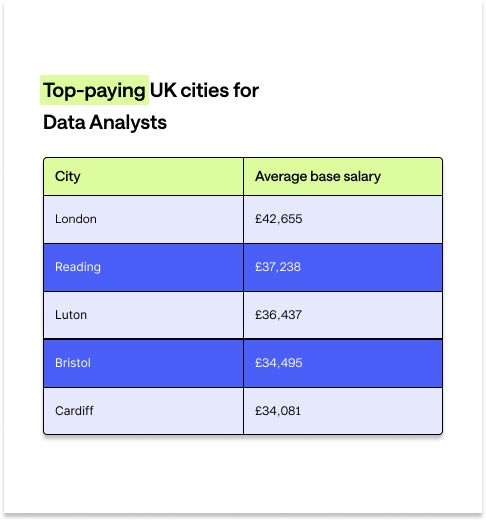
Aside from experience, role and employer, your location can affect what you make as a Data Analyst. In London, Data Analysts make around £42,000 on average, while in Reading, they earn around £37,000.
According to Indeed, the five highest-paying cities for Data Analysts in the UK are:
- London
- Reading
- Luton
- Bristol
- Cardiff
Types of Data Analysts
Data Analysts sometimes specialise in an industry or area of expertise. With Data Analytics training, you might pursue one of these careers:
- Media Planner
- Data Scientist
- Data Modeller
- Business Analyst
- Financial Data Analyst
There are many ways to progress through a career in data analytics. One way is with a Data Analyst apprenticeship from Multiverse. This programme allows junior and new Data Analysts to broaden the depth of their data analytics knowledge and prepare for lucrative mid to senior-level positions in the field. You’ll develop durable, future-proof data skills without having to put your career on pause — and get support from your manager, coach and the Multiverse community. The best part? When Multiverse partners with your employer, your on-the-job training is free to you and all learners on your team.

Data Analyst salary by job title
Data analytics is broad, so there are many types of jobs you can pursue. All industries need data experts to assist them in organising their data. Since data analytics skills are in high demand, there are many well-paying roles.
Let’s look at Data Analyst salary by job title, including the average base, entry and senior-level wages for each.
Data Analyst
Data Analysts collect, clean and interpret company data. They also collaborate with other colleagues and leadership to find data-led solutions. If you enjoy technology, mathematics and solving problems, a career in data analysis could be a fit for you.
Here average Data Analyst salaries in the UK according to Glassdoor, using London as a frame of reference:
- Entry-level salary: £32k
- Average base salary: £41k
- Senior-level salary: £54k+
Let’s look at the salary for other roles that need data analytics skills.
Business Analyst
Business Analysts find data-led solutions to business problems and create growth opportunities.
To become an entry-level Business Analyst, you'll need a grade of 4/C GCSE (or equivalent) in Maths and English. Relevant A Levels (Business Studies or IT/ Computing), and prior work experience with translatable soft skills will also help strengthen your application.
Business Analyst salaries in the UK:
- Entry-level salary: £35k
- Average base salary: £42k
- Senior-level salary: £52k+
Media Planner
Media Planners analyse marketing data and create advertising strategies connecting brands with their target audience. To become an entry-level Media Planner, you'll typically need a higher qualification in a relevant subject. That could be advertising, marketing or a data-focused programme.
Media Planner salaries in the UK:
- Entry-level salary: £23k
- Average base salary: £30k
- Senior-level salary: £38k+
HR Analyst
Human Resource (HR) Analysts collect, organise and review employee data. They may focus on hiring, onboarding and compliance. Their data-informed insights help to solve recruitment, retention and compliance problems for companies.
HR Analyst salaries in the UK:
- Entry-level salary: £33k
- Average base salary: £39k
- Senior-level salary: £46k+
Data Modeller
Data Modellers are engineers and system analysts. They design database management systems that help companies manage data. You'll typically need a higher qualification in a relevant field to become a Data Modeller.
Data Modeller salaries in the UK:
- Entry-level salary: £37k
- Average base salary: £49k
- Senior-level salary: £67k+

Financial Data Analyst
Financial Data Analysts work with financial institutions. They collate and review data from financial records to help institutions make better business decisions. You’ll need an interest in mathematics or economics to become an entry-level Financial Data Analyst.
Financial Data Analyst salaries in the UK:
- Entry-level salary: £31k
- Average base salary: £36k
- Senior-level salary: £43k+
What does a Data Analyst do?
Data Analysts collate, clean and review raw data. They spot trends and help make data-led decisions. Data Analysts also make company data more accessible to leadership.
Job responsibilities include:
- Using specialist tools to gather, clean and organise data
- Finding patterns and anomalies in data
- Reporting and presenting data insights to non-specialists
- Collaborating with Business Analysts to create data-informed systems and processes
- Sourcing new ways to use company data
- Keeping up with training needs and best practices
To become a Data Analyst, you should be interested in developing these skills:
- Knowledge of mathematics: Linear algebra, statistics and probability play a significant role in data analysis.
- Problem-solving: You identify starting points for overcoming project and technical problems.
- Technical skills: You use (or you’re willing to learn) SQL and data visualisation techniques to gather, clean and segment data.
- Database fundamentals: You know how to manage and navigate databases.
- Commercial mindset: You understand the data analytics lifecycle and how to meet business requirements.
- Communication: You communicate data insights to non-specialists.
Aside from demonstrating relevant skills (or a commitment to learning them), employers may require specific qualifications:
- At least a grade of 4/C GCSE (or equivalent) in Maths and English
- A relevant higher qualification like L4 Data Analytics or a BSc (Hons) Digital and Technology Solutions. If you don’t already have a higher qualification in data, you’ll need to demonstrate the willingness to work toward one
To strengthen your application for a data role, the following could also increase your chances of landing one:
- A Levels in a relevant subject like Computing, Mathematics or Business Studies
- Prior work experience that includes transferable interpersonal skills
Are Data Analysts in demand?
The job outlook for data analytics in the UK is healthy. A quick search for "Data Analyst" jobs on LinkedIn brings up over 2,600+ results across multiple sectors.
The Department for Culture, Media and Sport (DCMS) anticipates data analysis demand will grow 33% by 2026. DCMS also predicts data analysis will become one of the fastest-growing digital skills in the UK.
Accelerate your career as a Data Analyst
A Data Fellowship apprenticeship with Multiverse is the fastest way for junior Data Analysts to accelerate their careers. The free programme helps apprentices build in-demand data skills that can ultimately help them unlock promotions, increase productivity, and future-proof their careers.
We make it easy for you to get started — it takes less than 15 minutes to create a profile. Our team can then double-check your eligibility and discuss apprenticeship options with your current employer. Apply today.