











We couldn’t find what you are looking for. Please try another way.
The Multiverse blog
Thank you! Your submission has been received!
Oops! Something went wrong while submitting the form.
Announcing our new Chief Revenue Officer: Alex Varel
News
Team Multiverse
He will be responsible for leading, developing, and growing Multiverse’s go-to-market team, who have successfully launched apprenticeship programs at 1,000 companies worldwide. Through their efforts, they have built strong partnerships with the world’s top employers, helping companies address skill gaps, diversify their early talent strategies, and prepare their workforces for the future of work.
In Alex’s own words: “The rapid pace of technological change requires relevant, up-to-date human skills. This requirement has never been more important. With AI, our workforce faces opportunities like augmentation and productivity gains, but we also face huge risks around the potential displacement of human talent. At Multiverse, we’re positioning our customers and their employees to succeed in the face of so much change.
Joining Multiverse is a unique opportunity to partner with a very talented team, grow our company together and drive forward a solution that has been tested again and again by the most demanding, high-expectation employers.
I’ve been fortunate to learn, on the job, from some of the most elite go-to-market teams out there. I’m excited to bring that experience to Multiverse. Our continued excellence in go-to-market will ensure a powerful customer experience for companies and apprentices.”
Alex’s experiences have made him one of the most in-demand leaders in tech. He has led sales teams across markets, regions, and segments at some of the most exciting growth companies in the world including: Udacity, MongoDB, and Zscaler.
Alex has a strong track record within EdTech and human capital. He ran enterprise sales at CareerBuilder and founded the enterprise sales business while at Udacity. His experience spans the start-up and scale-up ends of the tech company journey — spanning pre and post-IPO experiences.
At the start of 2023, Multiverse reached 10,000 apprentices, and continues to partner with a growing number of the Forbes Global 2000. We’re actively hiring in this team in both the US & UK. To learn more about life in Multiverse’s go-to-market team read Peppa Wise’s journey from Account Executive to VP in just 4 years.
What is OTJ and how do I complete it during my apprenticeship?
Apprentices
Team Multiverse
What counts as OTJ?
‘OTJ’ counts as any time you’ve spent learning during your apprenticeship outside of the recurring tasks in your working role. There’s two types of OTJ activities you’ll need to complete in order to meet the UK government standard for apprenticeship.
Protected learning: Protected learning refers to dedicated periods within a work schedule that are set aside for learning and professional development.
Applied learning: Applied learning is defined as the hands on application of skills in the workplace
If you work 30 hours a week, 6 out of 30 hours need to be spent on OTJ related activities.
What can I do to complete my OTJ?
There’s lots of ways to fulfil your OTJ time and a portion of these will already be scheduled in your calendar by your coach during your apprenticeship. Other activities you will need to seek out yourself. Think about how the OTJ activities you choose relate to your apprenticeship before you complete them. Below are some areas you could focus on to collect OTJ hours and learn on your apprenticeship.
1. Apprenticeship bootcamps
During your apprenticeship, you’ll attend online bootcamps led by coaches who are experts in your apprenticeship field. The coaches will deliver your course curriculum, assign tasks to help you apply your learning and help you prepare for any exams you need to complete on your apprenticeship. Apprentice bootcamps will count as a big portion of your OTJ time, as they’ll be delivered in block sessions of 3 hours up to 1 day at a time.
OTJ time earned: 3 hours - 8 hours at a time (depending on session length)
2. Coach sessions
In-between bootcamp sessions, you’ll have a 1:1 monthly catch-up call with your coach to assess your progress and work on your personal and professional development.
OTJ time earned: 1 hour monthly
3. Applied learning
As well as professional learning that will be scheduled in by your coach, you’ll also need to seek out opportunities for ‘Applied learning’ which covers a broad range of activities you could complete. For an OTJ activity to qualify as ‘applied learning’ it needs to relate to the hands on application of skills in the workplace. For instance, using your recently learnt skills outside of your apprenticeship bootcamp. For example:
- Completing a coding project based on skills learnt during a software engineering bootcamp
- Completing an online course linked to your apprenticeship topic
- Organising a team building activity at work as a result of a related apprenticeship module
You’ll work with your coach on areas for personal and professional development and these areas could include development of key soft skills needed in the workplace. The following would count as applied learning for soft skills:
- Building on active listening skills by carrying out regular note taking during meetings or creating an organised note template and system for you to lookover
- Practising reviewing documentation in detail using examples and methods to retain information
- Researching tools and methods to help organise time effectively and then implementing them in your day to day schedule
OTJ time earned: 30 minutes - 8 hours plus
4. Community
The Multiverse community provides a wide range of opportunities to take part in in order for you to earn OTJ hours for your apprenticeship.
You could attend events. For example:
- Multiverse meet-ups which are social events organised by apprentices
- Lunch and Learn sessions with special guests
- Online seminar in a topic of your choice
- In-person workshops
The community hub also offers a great range of articles to read and video content to watch, all of which adds to OTJ time. To generate regular OTJ time, you could aim to attend 1 community event per week. Please note, not every community activity will count towards your OTJ time. Check with your coach if you're unsure.
OTJ time earned: 20 minutes - 6 hours
5. Exam completion
Exam revision and completion during your apprenticeship also counts as OTJ time.
You can log:
- Time spent revising for upcoming exams
- Practise papers, questions or quizzes
- Actual time spent completing the exam
- Study sessions with other apprentices
OTJ time earned: 30 minutes - 4 hours plus
Where do I log OTJ time?
After you’ve completed an OTJ related activity for your apprenticeship, you’ll need to formally log it with evidence.
Multiverse apprentices have access to a specialised platform in order to do this, where they can log OTJ activities with categories, dates and times. The platform also helps apprentices organise their apprenticeship, track their progress and keep track of key upcoming dates like exams.
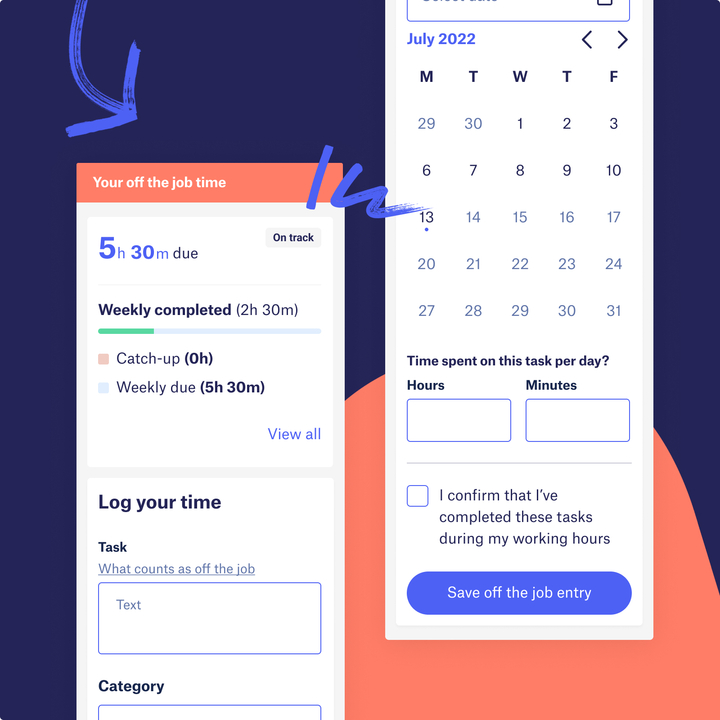
Multiverse apprentices also have access to a 1:1 coach they can reach out to for support. If you’re stuck for what to do for OTJ time or you’re falling behind, you could send an email to your coach asking for advice, ask peers on the community hub or reach out to your apprentice manager.
If you're looking for an apprenticeship, Multiverse offers apprenticeships in tech, data and digital skills all year round.
Start your application here.

Presenting Peppa Wise: from Account Executive to VP of Go-To-Market in 4 years
Life at Multiverse
Team Multiverse
Previously you’ve held roles including Commercial Director at Darktrace & Head of Sales at SenseOn - why did you make the move to Multiverse as an Enterprise Account Executive?
Taking a ‘step back’ into an individual contributor role at Multiverse was a strategic and conscious decision, made with the confidence that I would progress more quickly and be a better leader in the future by following this path.
My goal was to be recognised as the go-to Sales Leader for high-growth scale-ups and I knew that to achieve this I needed to reinvest in my own development and learn a proven playbook for success. It’s really hard to lead a high-performing team without a winning formula, so in order to become a better leader, I wanted to learn and execute the playbook on the ground myself.
I was comfortable with taking the risk of moving to Multiverse back in 2019 because I had done my research and spoken to top-tier VCs in my network who backed Multiverse as the next big thing. When you look at our Series D funding and recent strategic hires and investment in technology, including our new Chief Product & Tech Officer Ujjwal Singh, ex-CTO of GoFundMe and Head of Product at Meta, it’s clear that it was the right decision!
What advice can you share about successfully advancing your career at pace?
I truly believe that the best way to progress your career is to be 100% committed to your own development. It may look like I’ve been chasing promotions throughout my time here but I really haven’t! I’ve been chasing feedback and owning my professional development, and Multiverse is a meritocracy that recognises and rewards that.
For example, before I even joined the team as an Account Executive (AE) in 2019, I asked for my territory and access to resources and materials so that I could hit the ground running. And from day one, I totally embraced learning and executing the playbook at the highest standard. Now as a leader, I’ve seen that our most successful rampers do this too - if you truly commit to learning and living the playbook, and to hitting our Leading Indicators with quality, you will be successful.
Throughout my career, I’ve always asked my leaders for feedback and development. Building strong relationships with leadership and understanding what they want to see from you and what you need to improve is critical for progression.
And finally, I am committed to excellence and I have very high standards. I hold the whole team to a high standard because I do the same for myself!
What drives you as a leader?
My main motivation as a leader is to create a supportive and high-performance culture. I feel a big responsibility to the brilliant people we hire and I am totally committed to giving them the development that they join Multiverse for.
In the early stages of a hyper-growth company, it’s not always easy to get this right, but now in my role as VP, I am committed to doing just that. I want to be remembered as a leader who is focused on creating an inclusive, high-performance and development-centric environment, and I hold myself personally accountable for this.
Additionally, I’m driven by my belief in Multiverse - what we sell, what we do and who we are. I believe in every single AE, leader, and myself, and I know that we can continue to achieve incredible things together. This belief sustains me when things are challenging and motivates me further when things are going well.
Has Multiverse delivered on your expectations?
Oh, it’s delivered far more than I expected - in every way!
From a development perspective, since I joined Multiverse, our Average Selling Price (ASP) has increased exponentially. We achieved this enormous increase by pivoting from selling tactically to selling strategically. Today, we leverage value-based selling and work directly with the C-Suite at some of the biggest companies in the world. This shift towards strategic enterprise selling has naturally delivered increased earnings too.
It has also been more intense and challenging at times - but I think that is the reality of working for one of the fastest-growing companies in the world!
One of the unexpected bonuses of joining Multiverse was the life-long relationships I’ve made. There are people I’ve met here who will be in my life forever because we've been on this crazy journey together - through the highs and the lows, which is when you need those relationships the most!
At Multiverse, we pride ourselves on offering an exceptional learning and development environment. Our structured sales playbook and world-class leadership team are designed to support your growth and development. We believe in promoting from within and operate a meritocracy, so you know that your progress will be unrivalled. Join Multiverse and transform your career, because your development is our priority. Apply here
NHS Data Academies launched in training push
Employers
Team Multiverse
Royal Free, Manchester University NHS Foundation Trust (MFT), Croydon Health Services NHS Trust & Bart Health NHS Trust, some of the largest NHS organisations in the UK, will enrol more than 40 of their staff on data apprenticeships.
The National Institute for Health and Care Excellence (NICE) has committed to training 40 of its staff in data skills through apprenticeships.
The training will be delivered by Multiverse, a startup tech company focused on high-quality education and training through a unique professional apprenticeship model. Multiverse delivers apprenticeships in areas such as software engineering and data analytics.
The use of data has the potential to free up clinician’s time, improve patient outcomes and ultimately save lives. The BMA reports that 27% of doctors lose more than 4 hours a week because of inefficient hardware or systems. A shortage of skills in this area means many systems remain outdated - across the UK more than 100,000 data positions remain unfilled.
The launch of Data Academies across the NHS will improve efficiencies, create learning pathways for staff and, crucially, improve patient outcomes.
During the programmes, apprentices will learn through work - applying their skills in real-time to projects across the NHS.
Roxanne Moran, at National Institute of Health Care Excellence, said: “Our aim at NICE is to help practitioners and commissioners get the best care to patients fast. We have partnered with Multiverse to develop our staff with data skills, with a first cohort of 40 colleagues. Our increased capability in data skills will enable us to provide useful and useable advice for our users, and create a future-ready workforce, whilst providing a valuable personal development opportunity for colleagues.”
At Manchester Foundation Trust, 20 employees across Finance and Procurement will be enrolled on training programmes.
Edd Berry, Director of Finance Innovation at Manchester Foundation Trust, said: “In Finance, data is at the heart of much of what we do. Having the skills to validate, analyse, and forecast with data are essential. We want our staff to feel supported and confident in using the right tools to help them do their jobs as effectively as possible. We are really excited to be developing our staff with digital training from Multiverse”
Sean Hession, Deputy Director of Information Analytics at Royal Free London Trust, said: “Improving data literacy and upskilling our existing data teams is key to making the most of the information that we produce as a trust and is a key component of the Royal Free’s data strategy and trust strategy of becoming a data driven organisation. We recognise the potential that can be unlocked by giving analysts or those that work with data opportunities to develop their skills and understanding of data and how working with Multiverse can help us achieve that.”
The rollouts follow the success of the Data and Analytics Apprenticeship Pilot — launched by NHS England last year, in partnership with Multiverse. Multiverse also began a partnership with Leeds Health and Care Academy (LHCA), in a unique collaboration between health and care partners including Inspire North, Leeds County Council, Leeds Community Healthcare NHS Trust, Leeds Student Medical Practice and many more — to improve data skills within the sector.
Multiverse has worked with more than 200 NHS employees, in a wide-ranging partnership that helps the vital organisation grow its in-house data, tech and engineering skills.
My apprenticeship expectations vs reality: Laura's story
Apprentices
Team Multiverse
No one told me how competitive it would be to find a decent apprenticeship program. After months of interviewing and numerous rounds, I felt defeated. Jobs that seemed too good to be true ended up being too good to be true. Companies posted descriptions with ‘entry level’ requirements, but were looking for ‘experts’ with multiple years of experience in the field.
My Multiverse Experience
After months of job searching at various apprenticeship providers and job boards with no luck, I came across Multiverse. Multiverse had a specific platform for people like me to apply to roles and did not require any prior work experience: just a GCSE at 4/C in English and Maths.
I put in my application and landed a role pursuing a business apprenticeship. Now nearly half way through my Digital Business Accelerator apprenticeship program, I truly did not expect this level of nurturing for my ideal role, which I could not be happier in!
While my journey has not been easy, I strongly believe everything happens for a reason. The admission’s team were helpful with the application process, transparent about my options and true to their word from the start. Now in my working role, I’m not afraid to ask seemingly simple questions or ask for help with more in-depth tools that I don’t know how to use - I’m confident my manager will walk me through it and go over it again if I don’t understand.
Starting the new job
Prior to starting in my new role, I had a different perception of what my apprenticeship course as a whole would look like. Everything I am taught here intertwines. My new Excel skills help me complete my other work faster, and I also have access to the Multiverse community hub with all sorts of information, events to attend and articles to read to help me throughout my career. Apprentices need to spend 80% of their time at work and 20% completing ‘Off the job’ learning. At first I thought my ‘Off the job’ learning time would be away from my job and unrelated to my work, but I quickly discovered that the majority of my ‘Off the job’ time is decided by me, so I can choose tasks and activities that I feel relate to my role.
Growing beyond imposter syndrome
Despite the initial excitement of starting a new job, transitioning into a new role was nerve wracking! Prior to my apprenticeship, I studied business at college and had two years of sales experience. When I received the apprenticeship offer from Multiverse, I was worried that after so many rejections I wouldn't have the skills needed to do the job.
Perhaps you’ll see yourself in my previous position. It’s a competitive and difficult market to land a quality apprenticeship, and you may feel like an imposter once you finally find a good one. Just because you’ve been knocked down before, please know you are not alone: you have earned your position! Continuous growth during an enriching learning experience is something to be proud of. If you look back at where you are now in comparison to five years ago, you’ll see just how far you’ve come.
Multiverse Tech: Multiverse joined by EduFlow and hires CPTO
News
Team Multiverse
When our apprenticeship model works, it’s because it uses the transformational power of working and learning combined. Our apprentices learn in a meaningful way: developing skills on-the-job, and applying those skills straight away to drive business success.
But we aspire to truly world-class apprenticeships, available to everyone: and that depends on enhancing and building the technology that powers apprenticeships.
Our provision, which was ranked Outstanding by Ofsted, already uses technology platforms to personalize the learning experience, connect apprentices to the best opportunities and the most relevant content, and help our coaches have impactful connections with apprentices.
And now, we’re accelerating our investment into this part of our business.
Today, we’re delighted to be joining forces with Eduflow, one of Europe’s most dynamic education start-ups. The team at Eduflow have built a world-class education platform, used by thousands of learners.
The move represents our first acquisition and will mean we can give greater levels of personalization to apprentices, ensuring the skills that they learn are relevant and delivered more effectively.
Eduflow CEO David Kofoed Wind said: “When it comes to learning the skills needed to navigate the workplace, it’s clear that the future of learning isn’t lectures and textbooks, it’s delivered through the transformational power of working and learning combined.
“By integrating Eduflow's technology and team into Multiverse's existing stack, apprentices will benefit from more specialization to ensure their skills are directly applicable to their careers, and a greater level of peer-learning, to help build the connections, communication skills and teamwork necessary to thrive.”
This week, we’re also welcoming Ujjwal Singh to Multiverse as our first Chief Product and Technology Officer. Ujjwal joins us from Meta, where he led the development of Facebook’s suite of workplace tools, and has driven product innovation at Google and GoFundMe.
With our first acquisition and the appointment of our first CPTO, this marks our largest single investment into our technology stack to date, and one that we are confident will accelerate the learning for our apprentices, and the results that businesses see from their programs.
Ujjwal said: “Even after all the studying I’ve done, my best lessons came from the workplace, not the classroom. That’s why I was so driven by the mission of Multiverse, and the opportunity to build the future of applied learning.”
Technology has always been at the heart of how we deliver a brilliant experience to both apprentices and their employers. That’s how we scaled to reach 10,000 apprentices earlier this year.
Now, our ability to continue scaling applied learning relies on our ability to build the tools and technology that can underpin the future of apprenticeships.
This is an investment in our apprentices’ success - because we know that when we accelerate learning for our apprentices we accelerate results for employers.
Data Analyst salary in the UK: How much can you make?
Apprentices
Team Multiverse
To answer "How much do Data Analysts make?" and help you decide whether data analytics is the right path for you, we'll cover:
- Data Analyst salary in the UK
- Types of Data Analysts
- Data Analyst salary by job title
- What does a Data Analyst do?
- Are Data Analysts in demand?
- How to get a Data Analyst job in the UK
Data Analyst salary in the UK
A Data Analyst career can be rewarding because it's in high demand. You can also earn a higher than average salary. According to Indeed, Data Scientists make around £35,500 annually.
Salary in the UK is broad and fluctuates by city, industry and experience. For example, in cities like London and Edinburgh where the cost of living is higher, salaries are higher.
Your specialism and seniority level also impact what you earn. You might start your career path as a Junior Data Analyst, then specialise in data science.
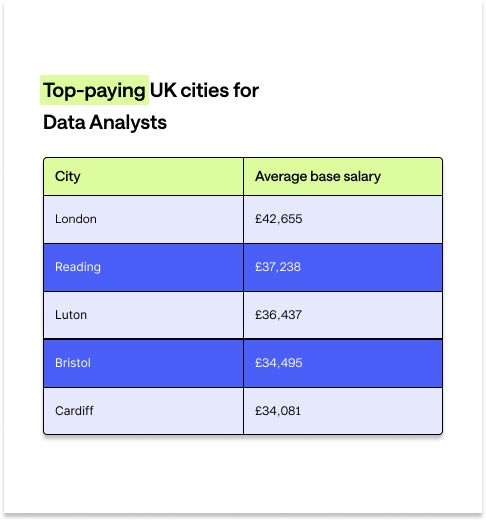
Highest-paying cities for Data Analysts in the UK
Aside from experience, role and employer, your location can affect what you make as a Data Analyst. In London, Data Analysts make around £42,000 on average, while in Reading, they earn around £37,000.
According to Indeed, the five highest-paying cities for Data Analysts in the UK are:
- London
- Reading
- Luton
- Bristol
- Cardiff
Types of Data Analysts
Data Analysts sometimes specialise in an industry or area of expertise. With Data Analytics training, you might pursue one of these careers:
- Media Planner
- Data Scientist
- Data Modeller
- Business Analyst
- Financial Data Analyst
There are many ways to progress through a career in data analytics. One way is with a Data Analyst apprenticeship from Multiverse. This programme allows junior and new Data Analysts to broaden the depth of their data analytics knowledge and prepare for lucrative mid to senior-level positions in the field. You’ll develop durable, future-proof data skills without having to put your career on pause — and get support from your manager, coach and the Multiverse community. The best part? When Multiverse partners with your employer, your on-the-job training is free to you and all learners on your team.

Data Analyst salary by job title
Data analytics is broad, so there are many types of jobs you can pursue. All industries need data experts to assist them in organising their data. Since data analytics skills are in high demand, there are many well-paying roles.
Let’s look at Data Analyst salary by job title, including the average base, entry and senior-level wages for each.
Data Analyst
Data Analysts collect, clean and interpret company data. They also collaborate with other colleagues and leadership to find data-led solutions. If you enjoy technology, mathematics and solving problems, a career in data analysis could be a fit for you.
Here average Data Analyst salaries in the UK according to Glassdoor, using London as a frame of reference:
- Entry-level salary: £32k
- Average base salary: £41k
- Senior-level salary: £54k+
Let’s look at the salary for other roles that need data analytics skills.
Business Analyst
Business Analysts find data-led solutions to business problems and create growth opportunities.
To become an entry-level Business Analyst, you'll need a grade of 4/C GCSE (or equivalent) in Maths and English. Relevant A Levels (Business Studies or IT/ Computing), and prior work experience with translatable soft skills will also help strengthen your application.
Business Analyst salaries in the UK:
- Entry-level salary: £35k
- Average base salary: £42k
- Senior-level salary: £52k+
Media Planner
Media Planners analyse marketing data and create advertising strategies connecting brands with their target audience. To become an entry-level Media Planner, you'll typically need a higher qualification in a relevant subject. That could be advertising, marketing or a data-focused programme.
Media Planner salaries in the UK:
- Entry-level salary: £23k
- Average base salary: £30k
- Senior-level salary: £38k+
HR Analyst
Human Resource (HR) Analysts collect, organise and review employee data. They may focus on hiring, onboarding and compliance. Their data-informed insights help to solve recruitment, retention and compliance problems for companies.
HR Analyst salaries in the UK:
- Entry-level salary: £33k
- Average base salary: £39k
- Senior-level salary: £46k+
Data Modeller
Data Modellers are engineers and system analysts. They design database management systems that help companies manage data. You'll typically need a higher qualification in a relevant field to become a Data Modeller.
Data Modeller salaries in the UK:
- Entry-level salary: £37k
- Average base salary: £49k
- Senior-level salary: £67k+

Financial Data Analyst
Financial Data Analysts work with financial institutions. They collate and review data from financial records to help institutions make better business decisions. You’ll need an interest in mathematics or economics to become an entry-level Financial Data Analyst.
Financial Data Analyst salaries in the UK:
- Entry-level salary: £31k
- Average base salary: £36k
- Senior-level salary: £43k+
What does a Data Analyst do?
Data Analysts collate, clean and review raw data. They spot trends and help make data-led decisions. Data Analysts also make company data more accessible to leadership.
Job responsibilities include:
- Using specialist tools to gather, clean and organise data
- Finding patterns and anomalies in data
- Reporting and presenting data insights to non-specialists
- Collaborating with Business Analysts to create data-informed systems and processes
- Sourcing new ways to use company data
- Keeping up with training needs and best practices
To become a Data Analyst, you should be interested in developing these skills:
- Knowledge of mathematics: Linear algebra, statistics and probability play a significant role in data analysis.
- Problem-solving: You identify starting points for overcoming project and technical problems.
- Technical skills: You use (or you’re willing to learn) SQL and data visualisation techniques to gather, clean and segment data.
- Database fundamentals: You know how to manage and navigate databases.
- Commercial mindset: You understand the data analytics lifecycle and how to meet business requirements.
- Communication: You communicate data insights to non-specialists.
Aside from demonstrating relevant skills (or a commitment to learning them), employers may require specific qualifications:
- At least a grade of 4/C GCSE (or equivalent) in Maths and English
- A relevant higher qualification like L4 Data Analytics or a BSc (Hons) Digital and Technology Solutions. If you don’t already have a higher qualification in data, you’ll need to demonstrate the willingness to work toward one
To strengthen your application for a data role, the following could also increase your chances of landing one:
- A Levels in a relevant subject like Computing, Mathematics or Business Studies
- Prior work experience that includes transferable interpersonal skills
Are Data Analysts in demand?
The job outlook for data analytics in the UK is healthy. A quick search for "Data Analyst" jobs on LinkedIn brings up over 2,600+ results across multiple sectors.
The Department for Culture, Media and Sport (DCMS) anticipates data analysis demand will grow 33% by 2026. DCMS also predicts data analysis will become one of the fastest-growing digital skills in the UK.
Accelerate your career as a Data Analyst
A Data Fellowship apprenticeship with Multiverse is the fastest way for junior Data Analysts to accelerate their careers. The free programme helps apprentices build in-demand data skills that can ultimately help them unlock promotions, increase productivity, and future-proof their careers.
We make it easy for you to get started — it takes less than 15 minutes to create a profile. Our team can then double-check your eligibility and discuss apprenticeship options with your current employer. Apply today.

Unleashing the power of data through upskilling at Jaguar Land Rover
Employers
Team Multiverse
The identification and improvement of data skills involve a huge shift in the way employees work with data, across the entire organisation. Through collaborating with a strategic partner, organisations can begin to make changes at a large scale.
In August 2022, Jaguar Land Rover teamed up with Multiverse to take steps toward their data transformation.
The goal
Jaguar Land Rover had three main objectives for their upskilling efforts:
- Equipping employees with the knowledge and skills needed to identify opportunities to reduce costs and increase revenue.
- Building a data-driven culture that knows how to apply and leverage data in various scenarios – with the ultimate goal of increasing productivity and efficiency across the business.
- Increasing employee satisfaction and engagement by investing in skills development.
The solution
Jaguar Land Rover launched the Multiverse Data Fellowship programme to equip employees with the skills needed to become experts in data analysis, modelling and machine learning.
There are currently 600 Jaguar Land Rover employees on a Multiverse Data Fellowship programme across every department in the organisation, including Manufacturing, Product Engineering, Finance, Transformation, Supply Chain and many more.
"The Multiverse Data Fellowship programme has transformed our company's ability to harness the power of data, enabling us to make better decisions, innovate faster, and stay ahead of the competition. Our workforce is now equipped with the skills and knowledge to unlock valuable insights and drive real-world impact across our entire organisation.
"Multiverse has been an essential partner on this journey, and we look forward to continuing to work together to realise the full potential of our data-driven future." Martin Houghton, Chief Data Officer at Jaguar Land Rover
The results
Identifying opportunities to increase efficiency
After six months on the programme, Data Fellowship apprentice Kamil Poreda was able to identify production inefficiencies by creating a Tableau dashboard for Production Leads. These insights into the efficiency of the manufacturing lines have resulted in the production of 600 extra cars per week.
Increased productivity and efficiencies
Another apprentice, Huijie Ma, utilised Tableau to create dashboards reporting on the electrical diverts from manufacturing. This solution helped save Huijie and her team four hours a day, which equates to 85 hours saved per month.
The reports revealed the root causes of the divert, allowing ownership to be traced back to the specific functions, production lines and work groups, which created an opportunity for an efficient process of divert reduction.
Increased employee satisfaction
The Data Fellowship programme has also supported driving employee engagement - an incredible 100% of apprentices agree the apprenticeship aligns with their professional and personal goals.
“The apprenticeship has given me so much confidence. I am now far more structured in how I approach my work, taking the time to scope out projects with relevant stakeholders to understand their needs fully.” Kamil Poreda, Manufacturing, FACMON Controller at Jaguar Land Rover
Beginner's guide to data analysis methods
Apprentices
Team Multiverse
Not sure what data analysis is or how it works? Keep reading for everything you need to know about analytics and data analysis methods. We’ll cover:
- What is data analysis?
- Qualitative vs. quantitative data analytics
- The data analysis process
- Quantitative data analysis methods
What is data analysis?
Data analysis turns raw data into actionable insights. Data Analysts collect and make sense of information so companies can improve efficiency, profit and more. Ultimately, data analysis helps companies make better decisions that contribute to success.
Qualitative vs. quantitative data analytics
The two main forms of data analysis are qualitative and quantitative.
Quantitative analytics
Quantitative analytics focuses on data that you can measure or quantify with numbers. Some examples of quantitative data include:
- Costs and revenue numbers
- Weight and measurements
- Projections and forecasts
- Anything you can count or quantify
You usually use quantitative data analytics to answer questions about how much, how often or how many.
For example, Google Analytics is a rich source of quantitative data, especially for your website. Analysing web traffic shows how your customers find your website and what they engage with when they’re there.
Qualitative analytics
Qualitative analytics looks at those harder-to-define areas, such as customer satisfaction levels or user experience.
Qualitative analysis can answer questions about how customers interact with a company. For example, qualitative analysis might provide insights into how to attract loyal customers or convert new leads. It also reveals the ‘why’ behind behaviours. You could use it to understand why:
- Customers buy from you
- People chose a competitor over your brand
- Some products are more popular than others
- Your sales increase or decrease
The data analysis process
Data analytics is an interactive process that, when done correctly, requires multiple steps to go from raw data to conclusion. The basic steps of the data analysis process are:
1. Define the question
Data analysis aims to answer questions. The more narrowly you can define your question, the better. These are a few questions effective data analytics can answer:
- How much time do users spend on your app?
- What’s driving your website traffic?
- How often do customers recommend your products?
- Which products do your customers prefer?
- How much does the average consumer spend per visit?
To get the most out of your data, you’ll need to formulate your questions clearly beforehand. Defining your questions gives you a roadmap to follow when you begin your data analysis.
2. Collect data
Once you know the goal or question you want to answer, you must collect accurate and relevant data to analyse. You can collect it from a variety of sources, but most Data Analysts start with internal or first-party sources. Companies collect this type of data directly from customers and other tools.
These include:
- Customer relationship management (CRM)
- Website heatmaps
- Customer and user surveys
- Google analytics and other tracking tools
- Marketing and sales data
You can also supplement data with external sources depending on your goal. Examples include:
- Review websites
- Public and government sources
- World health data
3. Clean and organise data
Raw data, on its own, is difficult to organise. Before you can analyse data, you’ll need to clean it and put it into a format that you can use. Check for duplicates and delete any unnecessary information. Make sure that you haven’t left any fields blank, as this can throw off your data.
4. Analyse data and pull insights
Analysing data typically means looking for patterns, drawing connections and then, understanding what it all means. To make sense of data, you can use various data analysis methods. As you spot trends and connections, you’ll be better able to answer your initial question.
5. Visualise the data
You can visualise data by putting it in charts, graphs, tables and other visuals that help someone quickly interpret it. Data visualisation is an ideal way to share and explore insights with the rest of your team.
Once you’ve visualised and shared your analysis, you and your team can build an action plan or make decisions from the insights.
This is also the stage where you’ll become aware of any limitations in your data analysis. Visualising data can reveal holes or missing data in the process. Are you missing data points? Do the answers to your questions seem incomplete?
If so, go back and complete your analysis.
Quantitative data analysis methods
As previously mentioned, there are qualitative and quantitative data analysis methods. Qualitative data helps you understand why people make certain actions. It deals with words and feelings and you gather data through observation and interviews. Quantitative data focuses on information that you can measure. It puts insights in terms of quantifiable percentages and numbers that reveal how much, many or often.
In this post, we’ll focus on quantitative data analysis methods. But, both qualitative and quantitative analysis have important roles to play in data analytics.
Four of the most common quantitative data analysis methods are:
- Regression analysis
- Cohort analysis
- Cluster analysis
- Time series analysis
Depending on your goals and the specifics of your analysis, you may use one of these approaches, all of them or a blend.
Regression analysis
Regression analysis leverages historical data to reveal which variables have the most impact on your present outcome.
To carry out an effective regression analysis, you’ll need access to relevant data. In many cases, this means sales data. But, it can also include product quality, marketing, retail design and other relevant information.
Regression analysis is a useful way to make sense of changes in a business over time. For example, suppose you’ve noticed that your sales took a dip in the past year. You might want to do a regression analysis to try and understand which variables are driving the downward trend. Other questions it can help answer include:
- Are consumers spending less across the board?
- What’s changed over the past year— in your business and the overall economy?
Looking at a range of factors can help you pinpoint which variables drove the change that you’re seeing. Then, you can make educated decisions about how to address the change.
Cohort analysis
Cohort analysis looks at the behaviour of a particular set of people or “cohort.” To do a cohort analysis, you group cohorts based on similar behaviour or categories. Grouping cohorts together helps you more easily look at patterns and trends.
If you want to better understand how and why a group behaves a certain way, use cohort analysis. For example, you can do a cohort analysis to understand when users churn, or stop using your product.
To begin, you’d group users based on when they began using your product. Then, look at what points that group dropped off. You can further analyse cohorts to identify why users churn, form a hypothesis and an action plan to keep users.
Overall, cohort analysis can help you understand your customers better. You can use it to decide which product features to prioritise or craft more effective marketing campaigns.
Cluster analysis
Cluster analysis groups data points together according to their similarities. The goal behind cluster analysis is to seek out patterns that you may not have noticed before.
As we have seen, cohort analysis and regression analysis are both focused on answering a particular question. In contrast, cluster analysis is a way of looking for patterns and insights that you may not have been aware of otherwise.
Cluster analysis is a great place to start when you really aren’t sure what’s driving a particular trend. It can often push you to explore new areas and to re-analyse your existing data.
Time series analysis
A time series analysis lets you zero in on changes in a particular variable over a period of time.
The beauty of time series analysis is that it isolates the variable. So, you get a broad picture of how it operates throughout the time period. You can also understand how the variable interacts with other variables.
Time series analysis allows you to make successful predictions about the future, based on past behaviour. For example, let’s say you notice that consumers buy more leather boots in the autumn. You’ll be able to predict when demand for those boots will increase and alter your inventory ahead of time. In general, the more accurately you can track past patterns, the more effectively you can predict the future.
Data analysis tools
The right tools can make beginning your data analysis career much easier. Here are some of the most useful data analysis tools that apprentices learn in Multiverse’s analytics programmes.
- Excel: With Excel knowledge, you can clean and organise data. You can also create pivot tables to quantify data and more.
- Business intelligence (BI): The best BI tools help you analyse and create reports to share with decision makers. Tableau is a data visualisation tool, but Multiverse apprentices also it to prepare data and build dashboards.
- SQL: SQL is important for Data Analysts and Scientists to learn. You’ll use it to organise and extract data.
- Data visualisation: In Multiverse’s data analytics apprenticeship training, apprentices learn how to visualise data in Power BI.
Learning data analytics with Multiverse
Data analytics jobs are in-demand and often come with higher salaries and better benefits. One of the best ways to grow your data analytics career is through an apprenticeship.
Unlike university or other continuing education programmes, Multiverse apprenticeships are tuition-free for learners —and you get paid your regular salary while you learn.
Multiverse partners with top companies to provide on-the-job training for a broad range of tech roles. Participants gain real-world knowledge and experience, all while building relationships with successful people in the field.
Multiverse provides training in data analytics, software engineering and more. To become an apprentice, check eligibility requirements and complete an application in minutes today.
Starting your career again at 30 on an apprenticeship
Apprentices
Ayla Kelly
While this is true for lots of people, apprenticeships are a valuable resource to older groups as well. In fact, for this current academic year, over 25s make up 41.5% of new apprenticeship starts in the UK.
One of many in their 30s doing an apprenticeship
I am among this group of over 25s and I have just started my Level 3 apprenticeship. While attending university and gaining a degree in my early twenties had its merits, completing an apprenticeship in my thirties will be much more beneficial to my career in the long run.
Here are a few reasons why I’m benefitting from doing an apprenticeship in my thirties.
You don’t always know what career route to take at 18
Asking an 18 year old to know what direction they want their life to go in is a pretty big ask. When you leave school at 18 you don’t know a lot about the working world and you can’t always be completely sure what route to take. There are a few lucky people that know exactly what they want to do from a young age, but for most, it takes a lot longer.
You’ve got to try out different jobs until you find the right one
To me, it made more sense to venture out into the world with the skills and interests I did have. I tried out a few jobs, and found out what I liked and what I absolutely didn’t like.
I worked in the service industry for nearly a decade and it taught me a lot. It’s a perfectly valid career choice but it didn’t motivate me. Finding out what I didn’t like has been just as important as discovering what I do want from my career.
After ten years I hit a career crossroad
After ten years in the service industry, I was in a rut. I’d gotten everything out of it that I possibly could, yet I was still working every hour under the sun to make ends meet. I knew I wanted to do something different, but I didn’t know where to start.
The apprenticeship opportunity at Timpson came at just the right time. I was ready to learn something new. I jumped at the chance. Not only was I embarking on an exciting new career path, but I would receive several qualifications in the process.
Learning new skills at work invigorated me
It’s easy to forget what a privilege it is to have the opportunity to learn something new. I didn’t realise how rewarding learning could be until I found the path that was right for me.
A second chance to reach my full potential
One of my biggest regrets in life is not utilising my time at university to the fullest. I was young and foolish and didn’t take advantage of the opportunities I was given, ending up with a much lower grade than I knew I was capable of. Now that I’ve got the chance for a sort of do-over, I don’t plan on wasting it.
I’m so grateful to my employers for giving me the chance to better myself and finally reach my potential. That’s the main thing I take away from starting this apprenticeship in my thirties – gratitude.
Sorry, no results found.