




We couldn’t find what you are looking for. Please try another way.
News
Thank you! Your submission has been received!
Oops! Something went wrong while submitting the form.

New research shows City is leading the way in the AI adoption, but falling behind on implementation
News
Team Multiverse
A survey of more than 14,000 white collar workers found that, of all the UK’s economic sectors, financial services is furthest ahead in the AI revolution. However, while it may be outpacing other sectors in adopting the technology, a new analysis of industry data reveals that its significant investment in AI has yet to pay off.
Recent research from AI upskilling platform Multiverse found that 67 per cent of financial organisations are using AI for process automation, yet only 37 per cent report transformative business results. The remaining 63 per cent are pouring money into AI technologies, without seeing a tangible ROI to match their level of investment.
This inefficiency is a major drain on productivity, with financial professionals spending an average of 2.7 hours per day on data tasks, according to additional Multiverse research. An estimated 32.5% of this time is spent ineffectively, leading to a loss of up to 25 days of productivity per year per employee that could be resolved through effective AI implementation. Those days, if recovered, could increase the sector’s economic output by as much as £28 billion.
Human capability is frequently cited as a blocker to realising the value of AI, but initial signs of overcoming this are not strong. Less than half (46 per cent) of financial services organisations are investing in AI upskilling, offering frequent and advanced training, and only 37 percent would rate their AI maturity ahead of competitors.
Financial institutions like Nationwide and Legal & General are leading the industry, investing in AI upskilling programmes through Multiverse. Their investment is already yielding results: Nationwide has seen learners save an average of one hour per week by applying their new skills. For instance, one apprentice developed a new workflow for data collection and management that saved 16 hours of work while also improving data accuracy.
Derrick Hastie, Chief Technology Officer, Asset Management at Legal & General has explained L&G’s philosophy on AI training this way: “AI isn't just a buzzword for us; it's a critical enabler of efficiency and growth. AI will soon be embedded in all our delivery teams, to help us create innovative solutions for our customers. But technology alone isn't enough. Education and skills are essential to ensure our people aren't just observers of change — they're active architects of it.”
By following these firms’ example and prioritising upskilling and empowering its workforce to effectively utilise AI tools, the UK financial services sector has a clear opportunity to solidify its position as the definitive leader in the AI era.

Nurses, lecturers, librarians, and surveyors lead AI adoption in the UK’s “invisible AI workforce”, finds Multiverse
News
Team Multiverse
Data shows geographically and demographically diverse AI workforce, with apprentices aged 19 to 71 and hubs emerging in Trafford, Birmingham, Cheshire West and Chester.
The UK’s artificial intelligence workforce is not confined to tech hubs and software developers, according to new jobs analysis from Multiverse, the upskilling platform for AI and tech adoption. Instead, an “invisible” AI workforce of nurses, librarians, surveyors, and doctors spread across the country are powering the UK’s burgeoning AI revolution.
12 million people in the UK are in ‘high-risk' occupations projected to decline in the next ten years due to technological change, according to the National Foundation for Educational Research. Reskilling opportunities, particularly in light of the UK’s aging population, must therefore be evenly distributed across the workforce to ensure everyone can benefit from AI’s productivity promise.
The analysis of over 2,500 people on Multiverse’s AI apprenticeship programmes reveals that over two-thirds (67%) are in non-tech roles - that is, roles whose job titles don’t include keywords related to tech, data and AI. Instead, among the 50 most common ‘invisible’ roles are frontline public service, education, healthcare and construction roles, including nurses, doctors, librarians, pharmacists, therapists, lecturers and surveyors.
Featuring in the full ‘invisible’ AI jobs list are occupations as varied as shipping clerks, biomedical scientists, charity fundraisers, creative directors, child protection workers, retail staff and merchandisers, tenancy managers, holiday let advisors – and even a herbarium curator.
The data underlines the fact that AI is rapidly being adopted in critical sectors far beyond the technology industry. Underlining this, the industries with the highest density of AI apprentices outside of those classified by the ONS as ‘digital industries’ are Financial Services, Government Administration, Hospital & Healthcare, Higher Education, and Construction.

Euan Blair, Founder and CEO of Multiverse, said: "Clinicians and council workers are just as integral to driving AI adoption as software engineers and data analysts. They are the ones finding practical ways to apply this technology to real-world problems, yet they're often a second order consideration. The UK has all the ingredients to become the original AI-first nation but we can’t get there by restricting AI use to the tech department. Meaningful progress will only come from upskilling everyone.”
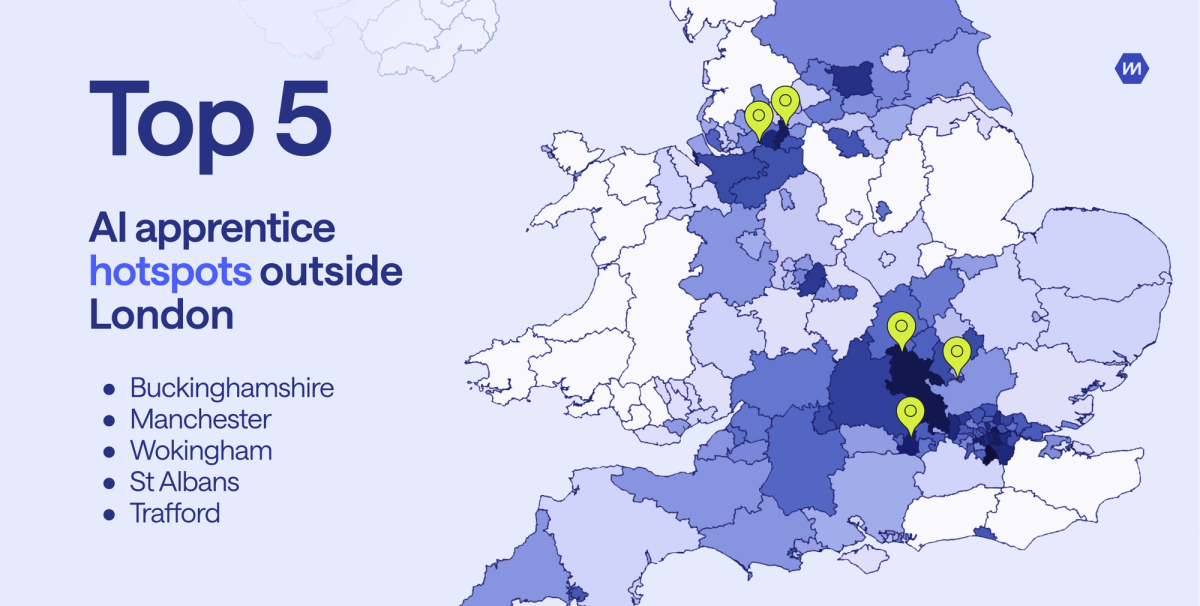
The analysis also maps the UK’s emerging AI hotspots, finding that while London remains a major centre, significant talent clusters are growing nationwide. The top ten districts with the most AI apprentices outside the capital include Trafford, Cheshire West and Chester, Leeds, and Birmingham. This geographic spread points to a democratisation of AI skills that is empowering regional economies.

Meanwhile, the top London borough for AI apprentice talent is Croydon, followed by Tower Hamlets, Lewisham and Wandsworth.
The UK’s emerging AI workforce is also made up of a diverse mix of ages and genders. The gender split is nearly even, with 45% of AI apprentices identifying as female and 54% male – compared to the 22% of women working in AI roles in the UK as a whole. The age range also spans from 19 to 71. This points to how workers at every career stage are embracing AI, from early talent to experienced workers seizing the opportunity to reskill.

Anna Lazcano, a nurse at Barts Health NHS Trust, is building an AI solution that can interpret communications from intubated and tracheostomy patients using gesture tracking and speech-to-text technology. She said: "Effective AI solutions in healthcare have to be driven by frontline clinical needs. My experience in critical care means I understand the requirements of my patients -- and now AI skills have essentially given me a new clinical tool to address their needs."
Stephen Mansfield, a fundraiser at Mencap, has built an AI assistant that surfaces relevant information to respond to the 7,000 annual queries received to its Wills and Trusts information service, vastly speeding up the pace of response. He said: “I never thought I’d be building AI tools within my charity role, but I’m now using AI to improve the services we offer to people with a learning disability and their support networks. It’s opened up a new dimension to my career and is delivering real efficiencies for the organisation, meaning that we can reach more people with our service.”
Multiverse is the upskilling platform for AI and tech adoption, equipping the workforce to win in the AI era. Multiverse has trained more than 20,000 apprentices in AI, data and digital skills since 2016, and has committed to training 15,000 AI apprentices in the next two years.
Over 1,500 companies work with Multiverse to deliver applied learning that’s transforming the workforce at scale. Programmes are targeted at people of any age, role, location and career stage.
South Gloucestershire Council expands training in latest upskilling and digitisation drive
News
Team Multiverse
South Gloucestershire Council is doubling down on efforts to leverage technology and drive efficiencies by training more of its team members in AI and data skills. Following a successful pilot programme, delivered by Multiverse, the council has extended the training, bringing the total number of learners to 60 in efforts to continue improving local services for South Gloucestershire residents.
The Transformation Academy builds on initial training to equip more of its people with the skills to enhance organisational performance, modernise processes and secure cost savings, extending the scope of training to feature AI programmes. Digital skills gained from these courses have already seen team members secure thousands of pounds worth of savings across the council, and hours of time through increased efficiencies.
Multiverse’s Skills Intelligence Report found that nearly 30% of local government employees’ time working with data is spent unproductively. This skills initiative marks South Gloucestershire Council’s efforts to empower its employees with the training they need to drive greater efficiency and impact, in turn benefiting local residents.
The new academy will see staff enrolled from all three of the major areas of the Council, such as the ‘People’ Directorate, including Housing, Children and Adult’s Care, Education and Public Health, as well as Resources and Business Change and the 'Place' Directorate, which includes Planning, Place Shaping, Operations and Streetcare. This demonstrates the broad-reaching efforts to upskill the organisation’s data and AI capabilities, which will ensure decision making is evidence-based and existing manual processes are streamlined.
Key to the new cohort’s training will be the inclusion of AI programmes, such as the Level 4 AI for Business Value and Level 3 AI Powered Productivity. These programmes will introduce AI fundamentals and boost engagement with tools like Microsoft 365 Copilot and Gemini, building on the success of previous training.
Programmes also include ‘Data Insights for Business Decisions,’ which equips teams with the technical skills and knowledge to confidently navigate the data landscape, and the 13-month ‘Data Fellowship’, which is a Level 4 apprenticeship upskilling data-literate staff into high-performing analysts and data science professionals.
Nigel Riglar, Executive Director of Place at South Gloucestershire Council said: “This training is already helping us make better decisions, cut costs, and modernise how we work. By adding AI skills, we’ll go even further in delivering the best service for our residents.”
Gary Eimerman, Chief Learning Officer at Multiverse said: “Our research shows that many councils struggle with a data skills gap. Through this Data & Business Academy, South Gloucestershire Council will give its team members boosted confidence in data, ultimately enabling them to deliver better service outcomes for local residents.”

Learning scientists identify 13 human skills gaps that could threaten AI adoption, as companies race to integrate the technology
News
Team Multiverse
As companies invest millions into artificial intelligence, reports from sources such as MIT are beginning to suggest that over-reliance on generative AI can reduce critical thinking. This resulting human skills deficit could itself threaten the effective adoption of AI if not properly addressed, according to findings published today by learning scientists at upskilling platform Multiverse.
The researchers found that creativity, analytical reasoning and systems thinking are among the 13 human skillsets required for the workforce to successfully adopt AI. These sit alongside technical skills such as prompt engineering, AI model evaluation and AI process modelling, and hold the keys to effectively bringing together people and technology to drive value.
The findings were uncovered through qualitative and observational research with AI power-users, alongside expertise derived from upskilling thousands of workers in the use of the technology. The resulting skills framework will support workers and organisations looking to improve their AI maturity – their ability to deliver meaningful impact with AI.
Accenture predicts that AI could contribute £736 billion to UK GDP by 2038, but also notes that leading companies are nearly twice as likely to prioritise ‘soft skills’. A substantial gap between AI’s potential and the human skills required to use it effectively could therefore represent a major risk to UK productivity and growth.
“Leaders are spending millions on AI tools, but their investment focus isn't going to succeed. They think it's a technology problem when it's really a human and technology problem. Without a deliberate focus on capabilities like analytical reasoning and creativity, as well as culture and behaviours, AI projects will never deliver up to their potential," said Gary Eimerman, Chief Learning Officer at Multiverse. "This framework provides a new model for talent development in the age of AI, which must include human skills as well as technical skills in order to drive tangible business results.”
Focusing on the requirements for effective collaboration between humans and AI, 13 human skills have been identified as critical to support technical AI adoption. These form part of Multiverse’s broader skills taxonomy, a hierarchical system mapping the skills required for success in the digital era.

The most essential human skills identified for meaningful AI adoption are:
Cognitive skills: Mental abilities used for learning, reasoning, problem-solving, and decision-making.
- Analytical reasoning: Breaking down complex information for AI to more effectively deliver its instructions; recognising tasks that AI is not suitable for.
- Creativity: Pushing the boundaries of AI use and experimenting with new approaches to drive innovation.
- Systems thinking: Identifying patterns in AI performance to predict how AI will respond to a task.
Responsible AI skills: Applying ethical principles to ensure the responsible use of AI, considering its impact on individuals and society.
- AI ethics: Spotting bias and recognising how it affects AI outcomes; using AI outputs in an ethically sound way to inform business recommendations.
- Cultural sensitivity: Identifying when AI outputs lack sufficient geographic or cultural awareness.
Self-management skills: Recognising thoughts, values, feelings, and behaviours, and how they impact the ability to achieve objectives when using AI.
- Curiosity: Examining the broader context and requirements of a task to augment AI outputs.
- Self-regulated learning: Reflecting on the success of a chosen AI approach; partnering with AI to self-assess its outputs.
- Detail orientation: Fact checking AI for hallucinations and errors; using one’s own domain expertise to ensure accuracy.
- Adaptability: Iterating and refining one’s approach to interacting with AI based on the quality of outputs.
- Determination: Patience and willingness to continue trialling new approaches with AI, even during unsuccessful AI interactions.
Communication skills: Strong interpersonal skills which support the optimisation of AI outputs.
- Empathy: Treating AI as an extension of one’s own mind and thoughts; anthropomorphising AI to create more thoughtful, receptive, and intentional dialogue.
- Tailoring communication: Discerning whether AI output has the desired tone for a particular audience or situation, and refining prompts if it is not.
- Exchanging feedback: Using AI to proactively seek feedback on work.
These key skillsets, alongside the broader skills taxonomy, underpin the proprietary skills assessment tools embedded in the Multiverse platform. These tools help organisations better understand the current capabilities of their staff ahead of embarking on upskilling initiatives.
“We need to start looking beyond technical skills and think about the human skills that the workforce must hone to get the best out of AI,” said Imogen Stanley, Senior Learning Scientist at Multiverse, who led the development of the skills taxonomy. “What we found during our first principles research phase was that skills like ethical oversight, output verification, and creative experimentation are the real differentiators of power AI users. By developing these specific skills, employees can move from being passive users of AI to active drivers of innovation and value.”
Multiverse is the upskilling platform for AI and tech adoption, which delivers personalised, on-the-job learning. Multiverse has trained more than 20,000 apprentices in AI, data and digital skills since 2016.
Over 1,500 companies work with Multiverse to deliver impactful learning that’s transforming the workforce at scale. Programmes are targeted at people of any age or career stage.
The Royal Institution of Chartered Surveyors embraces AI and data with new training academy
News
Team Multiverse
The Royal Institution of Chartered Surveyors (RICS) has partnered with Multiverse to launch a Transformation Academy for staff. A suite of tailored data and AI courses will enable teams to harness data and insights to improve decision-making, enhance operational efficiency, and drive a culture of innovation to improve service for its members.
The academy will provide upskilling opportunities that will support RICS’ mission to modernise its workforce and elevate built and natural environment industry standards. With a focus on both foundational and advanced AI and data skills, the training will enable staff to implement new ways of working and optimise processes.
This will in turn enhance the experiences provided to members from faster, more responsive support to more relevant insights and services. It will also enable RICS to streamline internal reporting and processes, and make smarter, data-informed decisions that strengthen its role as a trusted voice in the built and natural environment.
According to Multiverse’s Skills Intelligence Report 2025, the construction industry loses 26 days of productivity every year, with 33.9% of employees’ time working in data spent ineffectively. RICS is enhancing its workforce capabilities by enrolling teams across three specialised cohorts, each aligned to deliver hands-on experience to ensure AI and data training can be applied to role-specific day-to-day activities.
The Data Cohort will focus on building a strong foundation through the Level 3 Data Insights, Level 4 Data Fellowship, and Level 5 Applied Data Engineering courses. Practical tools like Microsoft PowerBI will be introduced to apply insights in real time.
The Transformation and Project Management Cohort will take the Level 4 Business Transformation and AI for Business Value courses. Meanwhile, the AI Cohort will learn how to apply AI-driven tools to deliver measurable improvements via Multiverse’s Level 3 AI-Powered Productivity and Level 4 AI for Business Value.
Robyn Mckenna, Chief Product Development Officer at RICS, said: “At RICS, we’re committed to equipping our people with the skills and tools they need to thrive in a rapidly evolving landscape. The launch of the Transformation Academy in partnership with Multiverse is a critical step in embedding data and AI capability across our organisation. It will not only improve how we operate internally but also how we serve our members; with faster insights, smarter decision-making, and a stronger foundation for innovation. This is about future-proofing both our workforce and the profession we support.”
Gary Eimerman, Chief Learning Officer at Multiverse, said: "RICS is a world-renowned organisation with a 150-year foundation of supporting a sustainable and insight-led chartered surveyor community. The launch of our training programme underlines this commitment, supporting teams with the digital tools and skills they need to make data-driven decisions, enhance client service and streamline manual processes.”
Multiverse is the upskilling platform for AI and tech adoption, which delivers personalised, on-the-job learning. Multiverse has trained more than 20,000 apprentices in AI, data and digital skills since 2016.
Over 1,500 companies work with Multiverse to deliver a new kind of learning that’s transforming the workforce at scale. Programmes are targeted at people of any age or career stage.
Multiverse appoints Donn D’Arcy as Chief Revenue Officer while company growth accelerates
News
Team Multiverse
D’Arcy joins from MongoDB, where as Head of EMEA he helped scale the business to $700M in ARR, representing over 30% of MongoDB’s global revenue. His appointment as CRO will help scale Multiverse's goal to build the AI adoption layer for the enterprise through transforming workforce skills.
D’Arcy is the latest in a series of strategic Multiverse leadership appointments in the past year, including MongoDB’s Jillian Gillespie as CFO and digital pioneer Martha Lane Fox to the Board. This latest move underpins Multiverse’s ambition to become a generational British tech success story by solving a critical problem: while companies are investing heavily in AI tools, they lack the workforce skills to unlock their true value.
D’Arcy brings extensive experience in scaling high-growth technology companies. Prior to his success at MongoDB, he spent over twelve years at BMC Software, where he led BMC UK to $500M in revenue, making it the top-performing region worldwide. His expertise will be instrumental as Multiverse builds upon its partnerships with leading global companies. Multiverse works with over a quarter of the FTSE 100, as well as 100 NHS trusts and more than 55 local councils.
Euan Blair, Founder and CEO of Multiverse, said: “Truly seizing the AI opportunity requires companies to build a bridge between tech and talent - both within Multiverse and for our customers. Bringing on a world-class leader like Donn, with his incredible track record at MongoDB, is a critical step in our goal to equip every business with the workforce of tomorrow.”
Donn D’Arcy, Chief Revenue Officer at Multiverse, said: “Enterprise AI adoption won't happen without fixing the skills gap. Multiverse is the critical partner for any company serious about making AI a reality, and its focus on developing people as the most crucial component of the tech stack is what really drew me to the organisation. The talent density, and the pathway to hyper growth, means the next chapter here is tremendously exciting.”
D’Arcy joins as Multiverse continues to ramp up business momentum. Multiverse has more than doubled its revenue in the last two years, with more than 22,000 learners now in its global community of tech, data and AI upskillers.
To accelerate this growth and help organisations capitalise on AI, the company recently announced a commitment to create 15,000 new AI apprenticeships over the next two years, directly addressing the skills bottleneck that hinders technology adoption.

Multiverse commits to creating 15,000 AI apprenticeships in next two years to support UK government’s AI mission
News
Team Multiverse
Today Multiverse, the upskilling platform for tech and AI adoption, announces a commitment to train 15,000 new AI apprentices over the next two years. This ambitious initiative supports the UK Government's AI Opportunities Action Plan, laying out a tangible first step towards expanding pathways into AI careers across the nation.
The adoption of AI technologies is projected to contribute £79.3 billion to the UK economy by 2035, but businesses urgently need skilled workers in order to realise these gains. More than half of workers have received fewer than five hours of training on AI, and just one third (34%) of FTSE 100 companies reference AI training in their latest annual reports.
These new AI apprenticeships will be created and delivered in partnership with leading employers across the country, including Skanska, John Lewis Partnership, Visa, The University of Manchester and Legal & General, ensuring that AI opportunities are not confined to certain regions.
Multiverse’s existing AI learner base spans geographic locations. More than 2,200 AI apprentices are currently enrolled through over 200 employers, from Wigan to Wiltshire and Manchester to Maidstone, demonstrating the nationwide demand for these critical skills. The 15,000 new AI apprentices will join their ranks, creating a nationwide community of AI experts that will boost the productivity and innovation of their organisations.
Science and Technology Secretary, Peter Kyle said: "Cutting-edge technologies like AI are transforming the way our economy works, so it is vital that British people have the right skills to make the most of the new opportunities tech presents. These efforts are central to the ambitions for jobs and growth, at the heart of our Plan for Change.
“Multiverse's commitment to thousands of AI apprenticeships will help us achieve just that, backing people right across our country to develop the skills they need to for a career in AI, no matter where they live.”
Katy Dowding, President and CEO at Skanska, said: “The construction industry is a key driver of economic growth, and we are equipping ourselves with the core foundational skills in AI that will ensure we can support our customers in delivering their ambitions, drive efficiency and improve productivity. Our first 25 AI apprentices are already showing the great potential of these technologies.”
Financial services provider Legal and General recognised the opportunity to proactively adopt responsible AI across its functions through upskilling. It has 50 apprentices on AI programmes.
Derrick Hastie, Chief Technology Officer, Asset Management, L&G said: “AI isn't just a buzzword for us; it's a critical enabler of efficiency and growth. AI will soon be embedded in all our delivery teams, to help us create innovative solutions for our customers. But technology alone isn't enough. Education and skills are essential to ensure our people aren't just observers of change — they're active architects of it.”
Baroness Martha Lane Fox, Non-Executive Director at Multiverse, said: "The promise of AI will remain unfulfilled unless all kinds of people possess the skills to truly harness it. This is no longer a distant concern but an urgent agenda in boardrooms nationwide. Training is a vital conduit to productivity, ensuring that the UK workforce is not just AI-literate, but AI-fluent, and capable of turning potential into prosperity."
Euan Blair, CEO, Multiverse, said: "Whether it's impacting you directly yet or not, we are already undergoing an AI revolution - and the key to winning in this new era lies in augmenting human capability. Our commitment to 15,000 AI apprenticeships is a bold declaration that AI skills must be for everyone, at every stage of their career. We want to equip entire organisations with the ability to seize the opportunities AI offers and build the workforce of tomorrow."
The new AI apprentices will enrol through their employers as early as June, either coming in as new hires or through upskilling initiatives for existing staff, and programmes will be funded by the Growth and Skills Levy. Learners will develop skills tailored to their requisite level of expertise, from AI ethics and prompt engineering, to data management and governance, to building and deploying machine learning and AI models.
All programmes will be delivered by industry-expert coaches, with apprentices’ new skills applied within the day-to-day requirements of their roles. Business impact is measured through projects, in the form of new revenue unlocked by skills, or costs avoided through additional productivity.
Rachané Bryan-Henderson, an account manager at advertising agency BBH, part of Publicis Groupe, said: “As someone who didn’t go to university I didn’t take a “traditional” pathway. The experience I gained through working has stood me in good stead, but AI now gives me an even greater advantage. By applying these new skills in my role I’m able to lead the way in my company, putting AI to use as we grow.”
For more information on apprenticeships, visit the Government’s Find an Apprenticeship service.
Professional services company Capita has enrolled nearly 200 apprentices onto AI programmes across its UK offices, from Bradford to Bristol. Adolfo Hernandez, Capita’s CEO, said: "Developing our colleagues’ AI proficiency is not just about identifying opportunities for efficiency, but about future-proofing our workforce and driving innovation across our organisation. By combining people, processes, and technology we help our clients across the public and private sectors deliver better, faster, and more efficient services to customers and citizens. We see AI as a once-in-a-generation shift that will redefine how organisations operate, and Multiverse's approach ensures our colleagues gain practical, job-relevant AI skills that make an immediate impact."
Nottingham City Council is upskilling 40 of its staff in AI, the latest step in its efforts to digitally transform its workforce. Sajeeda Rose, chief executive of Nottingham City Council, said: “As a council we are always looking for ways to bring better services to the people of Nottingham.Combining data insights with AI capabilities will help us to effectively deliver on our improvement plan.”
Mandy Lamb, Managing Director, Visa UK and Ireland, said: “Visa has been harnessing the power of AI for decades. We see AI as a catalyst—not just for technology, but for talent. We’re excited to be investing in the next generation of leaders who can harness the power of AI and continue to help shape the future of payments.”

Swim England dives into data and AI skills with Multiverse apprenticeships, funded by Amazon
News
Team Multiverse
Swim England, the national governing body for swimming in England, has partnered with Multiverse to launch a new data and AI skills programme for its employees. The initiative aims to empower Swim England staff with the expertise needed to supercharge its mission of great experiences for all involved in aquatics and has been supported by an apprenticeship levy transfer from Amazon.
Beginning with an initial pilot, Swim England plans to enrol 30 apprentices onto Multiverse programmes over the next year. This investment in data and AI literacy will enable Swim England to better analyse participation trends, optimise programme delivery, and measure the impact of its initiatives.
Training programmes will include AI-Powered Productivity, AI for Business Value and Data and Insights for Business Decisions. The resulting data and AI skills will play a key role in Swim England’s digital transformation journey, empowering staff to make data-driven decisions, streamline processes, and reduce manual administrative tasks.
Training is being delivered by Multiverse, a tech company that identifies, closes and prevents skills gaps, through personalised, on-the-job learning. Multiverse has trained more than 20,000 apprentices in AI, data and digital skills since 2016.
Maria Papadopoulos, People Director at Swim England said: “Data is crucial to understanding how we can best lead and serve our aquatics community and grow swimming participation. This partnership with Multiverse will equip our team with the skills to use data and AI effectively, ensuring we can make informed decisions and maximise our impact.”
Gary Eimerman, Chief Learning Officer at Multiverse,said: "By investing in skills, Swim England is empowering its employees to drive innovation and make a real difference in the health and engagement of communities across the country."
Multiverse combines work and learning to unlock economic opportunity for everyone. It works with more than 1,500 organisations to close critical skill gaps in the workforce in AI, data and technology.

Capital One and Enterprise fund Multiverse AI Academy in continued upskilling drive for Nottingham City Council
News
Team Multiverse
The Academy includes staff from major areas of the Council, from public health to public transport, and children’s services to neighbourhood safety. Training will equip employees with practical, applied AI skills, enabling them to reduce manual work, enhance decision-making, and unlock innovation in their day-to-day roles. It aligns closely with the council’s strategic drivers, including boosting productivity, minimising external spend, and improving resident outcomes.
The programmes are being delivered by Multiverse, the upskilling platform for AI and tech adoption, which delivers personalised, on-the-job learning. Multiverse has trained more than 20,000 apprentices in AI, data and digital skills since 2016, and has been a longstanding training partner for the Council.
Previous Nottingham City Council data learners have already improved individual efficiency in working with data by 21%, with the average learner projected to save more than one working month per year in improved productivity by end of programme.
The new cohort has enrolled on the 13-month AI for Business Value programme, a Level 4 apprenticeship. This will train staff to identify business value gains that can be achieved through using AI, as well as how to execute ethical AI projects for the benefit of local people. These new skills will help ensure more sustainable and effective public services.
Sajeeda Rose, Chief Executive of Nottingham City Council said: “This expanded Data and AI Academy allows us to combine data insights with AI capabilities, putting us in a strong position to deliver on our improvement plan. We’re striving to be a council that works more effectively and efficiently for the people of Nottingham, and the skills acquired through our partnership with Multiverse will help us to achieve this goal.”
Gary Eimerman, Chief Learning Officer at Multiverse said: “Building on nearly four years of Multiverse training, Nottingham City Council’s latest cohort is taking the next step in digital skills development: AI literacy. These are key credentials that will further empower the council to deliver tangible benefits to their residents, from community services to transportation, while enriching the careers of their teams.”
Multiverse combines work and learning to unlock economic opportunity for everyone. It works with more than 1,500 organisations to close critical skill gaps in the workforce in AI, data and tech, through a new kind of apprenticeship.
University Hospitals of Northamptonshire to receive data training to improve patient experience
News
Team Multiverse
The University Hospitals of Northamptonshire (UHN) have launched a Data Academy for a wide range of staff working across clinical, operational, administrative and data-focused roles. By increasing the operational efficiencies of both patient and non-patient facing staff, the Academy aims to improve patient experience and outcomes, boost employee job satisfaction and enable UHN to get more value from its digital investments.
Funded by the Apprenticeship Levy, the training is being delivered by Multiverse, the upskilling platform for AI and tech adoption. Multiverse has trained more than 20,000 apprentices in AI, data and digital skills since 2016, and works with 100 NHS trusts, empowering their employees to unlock innovation and improve patient care through its dedicated NHS Coaching team.
UHN’s new Data Academy will see staff with roles in theatres, pharmacy, quality and clinical coding enrol across four different programmes. Multiverse’s Level 3 Data & Insights for Business Decisions develops analytical and technical skills to use data to identify areas for improvement and enact change. The Level 4 Data Fellowship will help drive measurable impact by upskilling staff to harness tools like Power BI, while the Level 4 Business Transformation Fellowship will enable staff to develop digital solutions and support strategic change.
Multiverse will also deliver its three-year Level 4-6 programme Advanced Data Fellowship, an applied degree-equivalent course that builds on data capabilities and upskills staff in areas such as data infrastructure and machine learning.
Learners’ projects will contribute to real organisational initiatives such as reducing patient waiting times from referral to treatment, and improving theatre utilisation.
Jayne Chambers, Transformation Programme Manager and data apprentice at UHN, said: “Data skills have been transformational for me. Though I came to this programme later on in my career, I’ve found that the learning I’ve applied to my role has already been impactful in helping me create sense out of disparate data sources and truly drive change.”
William Monaghan, Group Chief Digital Information Officer at UHN said: “This academy has already proven itself to be the gateway to a far more data-enabled organisation. Our view has been those closest to the change are those who will always know best what needs to change. By equipping our colleagues with the skills to better interpret and use data, we’re not only making the care we deliver safer and more efficient but more importantly, ensuring our patients receive the excellent care they deserve.”
Gary Eimerman, Chief Learning Officer at Multiverse said: “Across the healthcare sector, we’re seeing that when staff are empowered to understand and act on data, it leads to smarter decision making, average time savings of 7.4 hours per week and greater opportunities for cost reduction and cost avoidance. It’s incredibly rewarding to support organisations like University Hospitals of Northamptonshire as they drive meaningful change through data that ultimately helps create better patient outcomes for all they serve.”
Multiverse combines work and learning to unlock economic opportunity for everyone. It works with more than 1,500 organisations to close critical skill gaps in the workforce in AI, data and tech, through a new kind of apprenticeship. Multiverse has delivered more than £10M+ in savings for NHS trusts through the application of new digital skills, helping to build an NHS workforce that’s fit for the future.
Sorry, no results found.