








We couldn’t find what you are looking for. Please try another way.
The Multiverse blog
Thank you! Your submission has been received!
Oops! Something went wrong while submitting the form.
Get AI skills with free, open modules from Multiverse
News
Team Multiverse
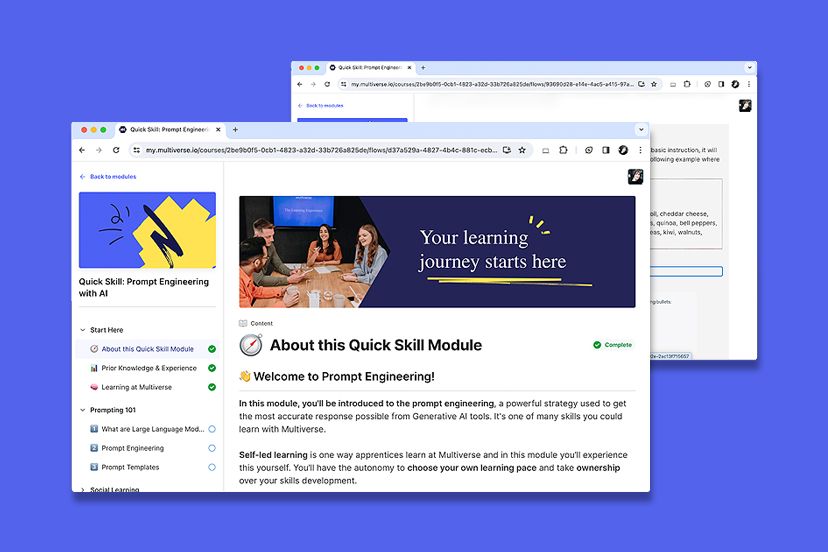
Now, we’re opening up a sample of the Multiverse learning experience to everyone: so you can improve your skills on one of our modules.
You can develop an in-demand skill in about an hour on the Multiverse learning platform.
Not only will you gain a new skill that will help you be more effective at work, but you’ll also get a taste of a Multiverse apprenticeship - and find out if it might be right for you.
We’re launching with a set of skills that apprentices tell us have unlocked new opportunities and efficiencies for them at work:
- Prompt Engineering: unlock your use of Generative AI tools and LLMs with prompt engineering, a set of powerful strategies that will help you get the most accurate and useful responses from Generative AI tools. Not to mention, Prompt Engineer vacancies are currently commanding salaries above $300,000
- AI Ethics: with many businesses concerned about the use of AI, employees who can navigate some of the legal and ethical dilemmas are in high demand. Through this module, you’ll learn about some of the considerations that should be made when using AI tools: like copyright, data protection and fair use
- VLOOKUPs: if you want to expand your spreadsheet skills, using VLOOKUPs is a fundamental skill that enables you to connect data points, enabling easier data retrieval and analysis
We’ll add more taster modules in the future based on your feedback.
We know from our thousands of learners that better skills unlock better opportunities at work.
We believe that the best learning happens through immediate application and practice. Our unique applied learning approach brings together real projects, an ecosystem of support and interactive learning that guides our apprentices to apply their skills both as they learn and as they work. You’ll get a taste of that while learning a quick skill on our platform: with quizzes, videos, challenges and personalized learning pathways.
While these modules are self-guided, Multiverse apprentices enrolled via their companies receive personalized, one-to-one support in order to guide both their learning and working experiences while on program.
Opening up these taster modules to everyone is just one of the ways that we’re opening up world-class training to everyone. For our apprentices, we’re using AI to facilitate on-demand coaching, launching new programmes in Artificial Intelligence for business, and more as part of a multi-million dollar investment in our tech.
The Power of Metacognition: Elevating Learning at Multiverse
Learning Science
Team Multiverse
This might sound simple, but this internal monitoring process is an incredibly powerful skill that we all possess: metacognition.
What is metacognition?
In essence, metacognition is thinking about your own thinking. It involves observing your thought patterns, tracking your attention, identifying areas where your knowledge may be lacking, and using these insights to bolster how you learn and retain new information. It relies on three main elements; metacognitive knowledge, skills, and experiences. Metacognitive knowledge entails understanding how you think, while skills are about knowing how to regulate your learning. Experiences, on the other hand, involve thinking about and adjusting your approach to learning in the moment. Let's take the example of learning a new language again. If you ever feel that you're not taking in the content from a book, your metacognitive skills and experiences are kicking in, nudging you to make a change.
“Metacognition is at the root of all learning” - James Zull (2011)"
Why does metacognition matter? Well, it arms you with the power to steer your own learning. Having a deeper understanding of our cognitive processes enables us to adjust our learning strategies to get better results. Let's face it, if you find that absorbing information from a book isn't working for you, wouldn't it be better to explore other methods such as interactive practice?
There is a wealth of literature to show that engaging in metacognitive practices can enhance learning outcomes (Akyol & Garrison, 2011; Anthonysamy, 2021; Stanton, Sebesta & Dunlosky, 2021). Learners who set clear learning goals, track progress, and reflect on their learning experiences can improve their acquisition of new knowledge and skills (Efklides, 2011). In addition, metacognition plays a crucial role in fostering a deeper understanding and mastery of new concepts as well as critical thinking (Shea & Frith, 2019; Wozniak, 2015). At Multiverse, we believe that encouraging our learners to reflect on how they think and learn allows them to take control of their own learning journey and build the skills needed to tackle complex challenges. This proactive approach to developing metacognitive abilities empowers our learners to solve problems and equips them with the cognitive tools needed to navigate the workplace.
The Multiverse Perspective
Our guided learning techniques nurture the metacognitive abilities of our learners, fostering a positive impact on their educational experiences, workplace performance, and everyday life skills.
Three examples of metacognitive practices used at Multiverse are:
- A proprietary metacognition assessment that is used to better identify where additional support is required for our learners
- Our expert tutors and AI-powered coach use the Socratic method to encourage learners to think critically and self-reflect, thus helping to enhance their analytical skills
- Regular progress reviews and self-reflection among learners, through peer-to-peer discussions and active reflection activities, facilitating continuous improvements in their learning experiences
To us, metacognition is a fundamental aspect of our pedagogical approach, arming learners with the necessary cognitive tools for success in a rapidly changing society.
Want to learn more about metacognition? We recommend reading:
- Anthonysamy, L. (2021). The use of metacognitive strategies for undisrupted online learning: Preparing university students in the age of pandemic. Education and information technologies, 26(6), 6881-6899.
- Akyol, Z., & Garrison, D. R. (2011). Assessing metacognition in an online community of inquiry. The Internet and higher education, 14(3), 183-190.
- Wozniak, K. (2015). Supporting Adult Learners' Metacognitive Development with a Sociotechnical System (Doctoral dissertation, DePaul University)
- Efklides, A. (2011). Interactions of metacognition with motivation and affect in self-regulated learning: The MASRL model. Educational psychologist, 46(1), 6-25
- Stanton, J. D., Sebesta, A. J., & Dunlosky, J. (2021). Fostering metacognition to support student learning and performance. CBE—Life Sciences Education, 20(2).
- Shea, N., & Frith, C. D. (2019). The global workspace needs metacognition. Trends in cognitive sciences, 23(7), 560-571
- Zull, J. E. (2011). From brain to mind: Using neuroscience to guide change in education. Routledge
The Impact of AI Feedback in Applied Learning
Learning Science
Team Multiverse
Learner feedback is traditionally viewed as a passive transmission of information from a teacher to a learner. However, the modern learning landscape emphasises a more engaging and responsive process centered around the learner, where the exchange of ideas is just as crucial as the information itself (Griffiths, Murdock-Perriera,& Eberhardt, 2023). The potential role of AI and particularly, ChatGPT, cannot be overemphasized in the development of this modern landscape. At Multiverse, we believe that these technologies could revolutionise work-based learning environments by offering effective feedback and positioning the learner as active participants in their feedback process.
A Comparative Study: Traditional Coaching Methods vs AI-feedback
In a recent study (Teasley, 2023), we explored the potential of ChatGPT for delivering meaningful feedback. We compared AI-driven feedback with traditional coaching methods, taking into account the learner’s acceptance and reactions to AI-assisted feedback. We also explored the interaction between both the AI and the learner (Neurerer, et. al, 2018). Although previous research has explored assisted feedback (Maier & Klotz, 2022), this work is at the forefront of using AI to deliver feedback in work-integrated learning environments.
Initial hypotheses were that apprentices would prefer coach feedback over AI-generated feedback. Surprisingly, we found that 70% of apprentices showed a preference for receiving both AI and coach feedback. ChatGPT offered a greater amount of feedback that encouraged self-regulation and autonomy in learners compared to human coaches, showcasing the reliability of AI in providing feedback. Furthermore, we found no significant difference in feedback effectiveness between ChatGPT and coaches, with ChatGPT's feedback slightly favored. Virtual rapport assessments indicated a moderately positive perception of ChatGPT's feedback for its human-like qualities and coherence. Qualitative feedback showed a preference for combining AI's specific and objective feedback with the personal touch and context understanding of human coaches.
Our study suggests that while AI can offer specific and objective feedback, the nuanced understanding and personal engagement provided by human feedback is irreplaceable, advocating for a complementary use of both AI and human feedback in educational contexts. At Multiverse, our exceptional coaches are at the heart of our learning experience. They offer personalized engagement through direct human interaction, which is enhanced by the use of AI technology. Our learners also have access to real-time AI feedback, whenever they need it, through our new on-demand AI tutor. This provides our learners with the tools and resources to reap the benefits from both human and AI feedback.
In summary, by utilizing the cognitive apprenticeship model and AI-enablement (Amankwatia, 2023) we can offer real-time coaching, adaptively scaffold support based on learner performance, and encourage reflective practice through dialogue, enhancing understanding and skill acquisition in a collaborative learning environment.
Study Details
Our study was a mixed methods design which used data from thirteen apprentices enrolled in a technology consulting degree programme. Naturally occurring coach feedback was compared with ChatGPT-generated feedback. This feedback was generated and coded against an Agentic Feedback taxonomy. Surveys measuring apprentice perceptions of feedback, acceptance, motivation, and virtual rapport were developed from the Feedback in Learning Scale (FLS; Jellicoe & Forsythe, 2019).
Survey data was compared and differences were tested for significance and effect sizes. Qualitative data was analysed for key themes and reported. Inter-coder reliability was calculated for feedback coding trials (overall agreement, 79.8%).
Overall, the study demonstrated that ChatGPT's feedback on digital apprenticeship assignments matched the agentic quality of coach feedback and suggests the potential for AI tools to enhance feedback in work-integrated learning by complementing human inputs with timely, specific, and effective feedback (Teasley, 2023).
References
- Amankwatia, T. (2023). Using AI with Cognitive Apprenticeship Theory, Upscaling and Retooling. The Evolllution. Retrieved March 22, 2024, from https://evolllution.com/technology/tech-tools-and-resources/using-ai-and-cognitive-apprenticeships-to-upskill-and-retool-adult-learners
- Griffiths, C. M., Murdock-Perriera, L., & Eberhardt, J. L. (2023). “Can you tell me more about this?”: Agentic written feedback, teacher expectations, and student learning. Contemporary Educational Psychology, 73, 102145.
- Hattie, J., & Timperley, H. (2007). The power of feedback. Review of educational research, 77(1), 81-112.
- Jellicoe, M., & Forsythe, A. (2019, August). The development and validation of the Feedback in Learning Scale (FLS). In Frontiers in Education (Vol. 4, p. 84). Frontiers Media SA.
- Maier, U., & Klotz, C. (2022). Personalized feedback in digital learning environments: Classification framework and literature review. Computers and Education: Artificial Intelligence, 3, 100080.
- Neururer, M., Schlögl, S., Brinkschulte, L., & Groth, A. (2018). Perceptions on authenticity in chat bots. Multimodal Technologies and Interaction, 2(3), 60.
- Teasley, W.P. (2023). Evaluating the suitability of ChatGPT to deliver effective feedback in work-integrated learning environments. (Unpublished master's thesis). University of Oxford, Oxford. http://dx.doi.org/10.13140/RG.2.2.26629.77287
The Four Engines of Social Learning at Multiverse
Learning Science
Team Multiverse
Rest assured, as humans, our learning capabilities extend beyond those of pigeons. Behaviourists assume that the best learning is when teachers or instructors take control over the learning process, actively reinforcing learners in order to get desirable learning outcomes. Although we can learn a lot from this approach, the “carrot on a stick” notion of reward learning is not holistic. What about the past experiences learners have? What agency do they have to shape their own experience?
Zoom into modern day, education has shifted from an era of teachers being a “Sage on the stage” to a “guide on the side”. This shift has been powered by the increasing popularity of Constructivism. Constructivists believe that learning is an active process where individuals construct new knowledge based on their prior experiences and interactions with the environment. This approach emphasises the importance of hands-on experiences, social interactions, and reflection in the learning process. Constructivist theory suggests that learners build their understanding through exploration, problem-solving, and collaboration rather than passively receiving information.
When we look at learning through the lens of constructivism, we want to maximise opportunities where learners build their own understanding, and a truly powerful way to do this is through social interaction.
“Social learning can be defined as joining with others to make sense of and create new ideas.” - (Bingham and Conner, 2015)
How does social learning work at Multiverse?
Social learning can happen casually when you have a conversation with someone, or it can happen during a structured group learning exercise. Where and when people learn socially can vary. At Multiverse, we use four research-backed strategies to drive collaborative learning in our programmes. These four engines are presence, inclusion, accountability, and reliance.
Presence
Presence helps learners feel like they are part of a community and are able to interact with each other while focusing on a similar goal. The feeling of presence in our programs is often facilitated through two key strategies:
- Cohort-based Learning: Learners are grouped together in cohorts, allowing them to form bonds, support each other, and collaborate on various learning activities. Cohorts provide a structured environment for learners to engage with peers who share similar interests and goals.
- Group Coaching: Through group coaching sessions, learners receive guidance and support from experienced coaches. These sessions not only provide valuable insights and knowledge but also encourage interaction and collaboration among learners within the group.
Inclusion
Inclusion is another important aspect of our collaborative learning approach, aimed at fostering a healthy culture and promoting psychological safety among learners.
- Multiverse community: Multiverse apprentices get lifelong membership to a global community of professionals who are taking their careers to the next level. This community experience plays a vital role in providing a supportive and inclusive environment where learners feel valued, respected, and encouraged to share their ideas and perspectives without fear of judgement. With a mix of career support, development opportunities and exclusive events, apprentices can find forums and groups of like minded individuals who share similar interests and passions.
Accountability
Accountability is essential for ensuring that learners take ownership of their learning journey and are responsible for achieving specific outcomes. To instil a sense of accountability, we often incorporate the following mechanisms:
- Progress Reviews: We invite coaches, apprentices and their managers to take part in regular reviews of apprentice progress to help track their development and identify areas for improvement. These reviews provide valuable feedback and guidance to learners, helping them stay on track and motivated to reach their goals.
- Project Feedback: As Applied Learning is core to our apprenticeship model, at Multiverse we use a mix of coach, peer and AI feedback to provide timely feedback to apprentices who are applying new skills in their role and driving business impact as a result. Our feedback mechanisms foster a culture of continuous learning and help learners to gain new perspectives to improve their skills.
Reliance
Reliance is a key strategy used to reinforce the importance of teamwork and collaboration among learners. By encouraging learners to rely on each other for support and success, we promote a culture of interconnectedness and mutual trust. How reliance is embedded can vary by programme but two key examples are:
- Hackathons - Participating in hackathons challenges learners to work together on innovative projects, collaborate on problem-solving, and showcase their collective skills and abilities. This helps apprentices build their confidence by simulating work-based projects that they may have to tackle in their current or future roles.
- Learning Pods - Learning pods are small groups of learners who work together on specific projects or learning activities. These pods encourage learners to share knowledge, support each other, and collaborate towards achieving common goals, enhancing the overall learning experience.
Want to learn more about social learning methodologies? We recommend reading:
- Brown, J. S., Collins, A., & Duguid, P. (1989). Situated cognition and the culture of learning. Educational Researcher, 18(1), 32–42.
- Garrison, D. R., Anderson, T., & Archer, W. (2000). Critical inquiry in a text-based environment: Computer conferencing in higher education. The Internet and Higher Education, 2(2-3), 87-105. https://coi.athabascau.ca/coi-model/
- Hyslop-Margison, E. J., & Strobel, J. (2007). Constructivism and education: Misunderstandings and pedagogical implications. The Teacher Educator, 43, 72-86.
- Kagan, S. (2001). Kagan Structures and Learning Together: What is the Difference? Kagan Online Magazine, Summer 2001. Kagan Publishing. https://www.KaganOnline.com
- Vygotsky, L. S., & Cole, M. (1978). Mind in society: Development of higher psychological processes. Harvard University Press.
- Bingham, T., and Conner, M. (2015). The new social learning: connect. collaborate. work., 2nd Edition. ATD Press.
MAGE: Driving Learning Effectiveness at Multiverse
Learning Science
Team Multiverse
We drive learning through MAGE – Measured, Applied, Guided, and Equitable learning. These principles guide our curriculum development and learning experience design. In other words, these pillars are the standards we hold ourselves to when deciding what learning we offer and how we deliver it.
“We unlock economic opportunity and potential for individuals and organizations by closing the skills gaps of today and tomorrow through measured, applied, guided and equitable learning”
Measured learning
Measured Learning means we collect the right data at the right time in order to demonstrate that learning is occurring as anticipated, as well as capturing whether it is having the desired impact. This calls for continuous effort, but at Multiverse, we’re committed to achieving it.
We build upon established learning measurement frameworks like Learning-Transfer Evaluation Model (Thalheimer, W., 2018) to create a map of data we collect throughout the learning journey. Not only do we measure whether knowledge, skills and behaviors can be evidenced; but we measure a litany of other data points that allow us to monitor learning performance and triage support as necessary. In many cases, we also support our learners in highlighting and celebrating the real-world transfer of this learning into workplace performance gains.
"One of our apprentices was able to demonstrate a saving of 20 hours per week through the automation of a previously manual financial process. At the heart of this was an automated dashboard taught on one of our data programs."
Applied Learning
Applied Learning means that our learning happens in a real-world context, learning what you need to know when you need to learn it. As Josh Bersin (2018) states, the more we learn in the flow of work (opens new window) the more impact we can have. We facilitate an active learning environment by encouraging apprentices to apply what they learn within the context of their own role. This makes it a transformative experience that facilitates lasting changes in mindset, perspective, attitudes as well as knowledge and skills. We support this in a myriad of ways including:
- We focus on knowledge, skills and behaviors that are in demand; from first principles, our portfolio is assessed against market requirements
- We mandate applied learning projects throughout every learning journey to ensure immediate real-world application
- We collaborate with managers to ensure learning is applied in line with job requirements
Guided learning
Guided Learning means that learners are continually supported on their learning journey through a unique blend of AI-powered, on-demand and human-centered coaching. Our aim is to ease learners into that “goldilock’s zone” of challenge (Vygotsky, 1978; Wilson et al., 2019); ensuring they can do more with the guidance of knowledgeable experts and other forms of scaffolded support.
The benefits of a guided learning process have long been documented (e.g. Bloom, 1984). However, many learning providers have felt the tension between providing guided experiences and scaling their delivery through remote, productised experiences. At Multiverse, we believe this is a false choice, and aim to do both through our blend of AI and human approaches to coaching. We also believe there are a range of knowledgeable experts within a learning journey, encouraging apprentices to not only learn from their coaches but also their peers and extended Multiverse community.
Equitable learning
Equitable Learning means learning is accessible to everyone and can be used as a means to open up career possibilities. It means that everyone's unique qualities are valued and represented in our learning experience. As such, we’re continuously aiming to assess what makes each learner unique (e.g. how they think, how they learn, what motivates them) such that support and guidance can be tailored to each individual.
Within our Learning Science team, we have a blend of experts in workplace psychology and learning assessment to continue to put each individual learner at the center of each experience. As emphasized by Multiverse’s mission “Providing equitable access to economic opportunity for everyone”, equity and inclusion are at the heart of what we do.
By incorporating the MAGE framework into how we think about, build and deliver learning we can ensure we deliver learning effectively. In particular, this framework has been developed with on-the-job, professional learning in mind; as we at Multiverse help solve your business-critical problems and prepare you for the future of work.
References
- Bloom, B. S. (1984). The 2 sigma problem: The search for methods of group instruction as effective as one-to-one tutoring. Educational researcher, 13(6), 4-16.
- Josh Bersin (2018, July 8) “A New Paradigm For Corporate Training: Learning In The Flow of Work”. Josh Bersin. https://joshbersin.com/2018/06/a-new-paradigm-for-corporate-training-learning-in-the-flow-of-work/
- Knowles, M. S., Holton III, E. F., & Swanson, R. A. (2014). The adult learner: The definitive classic in adult education and human resource development. Routledge.
- Thalheimer, W. (2018). The learning-transfer evaluation model: Sending messages to enable learning effectiveness.
- Vygotsky, L. S., & Cole, M. (1978). Mind in society: Development of higher psychological processes. Harvard university press
- Wilson, R. C., Shenhav, A., Straccia, M., & Cohen, J. D. (2019). The eighty five percent rule for optimal learning. Nature communications, 10(1), 4646.
- World Economic Forum. (2024). Reskilling Revolution. World Economic Forum. Retrieved 20/03/2024, from https://initiatives.weforum.org/reskilling-revolution/home
Learning Agility: A New Model of Learning Potential
Learning Science
Team Multiverse
Learning Agility is not only important regarding an individual's potential to learn (Eichinger & Lombardo., 2004), but also their effectiveness at work (DeRue et al., 2012). At Multiverse, we double down on the concept of applied learning; learning that translates into improved performance and therefore career success. This concept is therefore critical for us to measure. But what exactly do we mean by Learning Agility?
Learning Agility - What it really means
Learning Agility has historically been used more often in leadership frameworks than learning frameworks. We see this as a missed opportunity. Learning Agility can help us delve into understanding the intricate patterns of behaviour, the methodologies individuals use to learn, and the specific factors that significantly influence their learning processes. This provides a clear and detailed view of their strengths and potential areas of growth, enabling the development of more personalised strategies for their learning and development. In simpler terminology, Learning Agility not only aids in identifying potential but also assists in mapping out the most effective and personalized pathways for individual learning and growth.
How we define Learning Agility at Multiverse
Our model of Learning Agility is inspired by and builds on both the literature and our own empirical research findings. In simple terms, it splits learning agility into three crucial areas: the Head (thinking capabilities), the Heart (motivation), and the Hands (action).
- The Head: How do learners process information, use strategies to speed up learning, and apply knowledge independently? For example, our metacognition assessment helps to understand how well individuals can pick up and utilise newly learned skills in their day-to-day work.
- The Heart: What is it about learning that an individual finds most motivating? It involves a deep-dive analysis of seven unique motivation factors. It’s all about understanding how different motivations directly affect how someone interacts with the learning journey, and how they affect learning outcomes.
- The Hands: What are the behavioural traits that can either help or hinder the learning process? We delve into specifics, looking at things like ownership and openness, to reveal the natural tendencies of each learner.
Applying this in practice
All this additional insight about each learner is only valuable if it is actionable. It’s imperative that this data is used in a manner that helps optimize applied learning outcomes.
Here are a few ways in which we are using these insights at Multiverse:
- Design learning plans that work with individual thinking skills, motivational profiles, and natural tendencies.
- Spot potential learning hurdles early on, allowing for early intervention, increased retention and engagement, leading to better learning outcomes.
- Make the best use of resources by matching learners to the most suitable level of support.
In Summary
Our model of Learning Agility is a major step forward in understanding and applying individual differences research within a professional development context. By zeroing in on the individual elements of the Head, Heart, and Hands, training providers can deliver unprecedented levels of personalisation and effectiveness in their training programs. Plus, it leads to a more inclusive and equitable learning environment. It's all about giving every professional a fair shake at reaching their full potential.
References
- DeRue, D. S., Ashford, S. J., & Myers, C. G. (2012). Learning agility: In search of conceptual clarity and theoretical grounding. Industrial and Organizational Psychology, 5(3), 258-279.
- Eichinger, R. W., & Lombardo, M. M. (2004). Learning agility as a prime indicator of potential. People and Strategy, 27(4), 12.
Princes prioritises data skills with new Academy partnership
Employers
Team Multiverse
The partnership will initially train 50 Princes employees across multiple business functions, with the ambition to empower colleagues, advance data skills, encourage revenue growth and boost efficiency.
Colleagues from areas including Commercial, Finance, IT, HR, Supply Chain, Operations and Strategy & Innovation will embark on one of three Multiverse programmes, each offering a chance to develop data understanding and technical skills.
Participants will take part in either a 13-month Data Literacy course, an 18-month Data Fellowship, or a degree-level Advanced-Data Fellowship. Each pathway is designed to develop data and analysis skills.
The ambition is that colleagues trained by Multiverse will be able to better harness the power of data to establish opportunities for revenue growth, and to help make the transition from manual to automated data processing practices within the business.
The first cohort of 25 Princes colleagues began their studies in December 2023, with over 40 more planned to start in 2024.
This investment comes as Princes outlined its refreshed people-focused company values, which aim to enhance business culture and future preparedness. These include encouraging ‘Trusted & Empowered’ coworkers and allowing employees to ‘Bravely Explore’.
Connie Emerson, Group Strategy & Transformation Director and Programme Sponsor at Princes said: “Multiverse is a proven leader in specialist apprenticeship training, which we are proud to be partnering with to establish this Academy at Princes. Through this collaboration, we’re confident that our Princes apprentices will build expert knowledge and improve the business’s approach to data analysis and planning. Our Multiverse-trained cohorts of apprentices will support Princes in making informed and data driven decisions to turbo-charge our growth and success."
William Hofmann, Head of Analytics & Programme Lead at Princes said: “The launch of our Analytics & Data Academy is a great opportunity for Princes colleagues from across the business to grow their skillset and diversify their value and capabilities as professionals. Across the Group, this increased data literacy will allow our teams to recognise business and revenue opportunities, and modernise our practices across a number of business functions.”
Peppa Wise, Vice President of Go to Market at Multiverse, said: “Enhanced data skills will unlock new opportunities for Princes: both as a business and for the individuals within it. The business will enhance its data-driven decision-making and delivery. Apprentices will enhance their career trajectories, gaining some of the most in-demand skills through our applied learning programmes."
With a commitment to helping people from all backgrounds to develop and build their future, Princes currently employs over 60 colleagues across the UK apprenticeship schemes.
In 2021, Princes was named ‘Employer of the Year’ at the prestigious Grocer Gold industry awards.
Making the business case for apprenticeships
Employers
Claire Williams
Businesses are struggling to meet increasing demand for digital and data skills, and with emerging technologies like Artificial Intelligence (AI) opening up limitless growth opportunities, the pressure to keep up has reached its peak.
But how can leaders create opportunities for workers at all stages to upskill and reskill? By combining real-world training with durable and industry-relevant technical skills, apprenticeships can help close the gap between the skills businesses need and those taught in the classroom - propelling careers forward in the process.
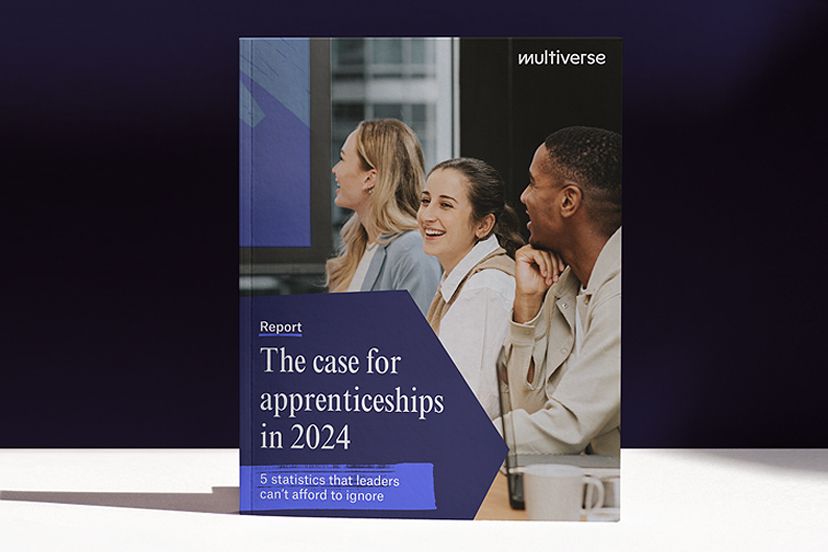
In our new report, we reveal the trends driving the business case for apprenticeships in 2024, based on our original research with hundreds of leaders across the globe. Download the report for full access, or read on for key insights.

Rethinking the way we train our workforce
In all our research, one message is clear: we need a new approach to deliver the skills most needed in future.
Multiverse data shows that the majority of business leaders are concerned about traditional education’s ability to deliver the digital, data, and tech skills in top demand. And with almost 50% of workers saying they’ve received no training in the last five years, the existing workforce isn’t being upskilled to fill the gaps.
That’s where apprenticeships can offer a solution – 70% of business leaders believe on-the-job learning is the best way to develop in-demand skills.
Building tomorrow’s skills, today
According to our research, over two-thirds of business leaders believe their business will need different workforce skills to remain competitive by 2030. They also believe AI will improve productivity and customer experience, and create more informed business strategies.
But a lack of AI skills in the workforce is already being felt. Leaders named AI as their most significant skills gap today, with employees lacking the training and knowledge needed to effectively harness new tools in the flow of work.
To leverage AI now and in the future, businesses can’t afford to leave knowledge in the hands of a few specialists. New methods for building emerging skills at scale are required. And the sooner, the better.
Over 70% of business leaders say they are investing in upskilling and reskilling as part of their future strategy, and 83% say they are moving quickly to implement AI skills training.
By tailoring learning directly to today’s business needs, apprenticeships offer a scalable way to upskill and reskill employees in emerging digital, tech and data skills.
Skills gaps create a clear impact on the bottom line
Our research shows 8.5% of annual revenue is lost as a result of digital and data skill gaps. But just as a lack of skills can hold a business back, new capabilities can propel it forward.
Upskilling and reskilling apprenticeships can help leaders close critical skills gaps while empowering employees in every function to improve speed and efficiency, leading to increased capacity and reduced time per task.
In our report, we reveal how Multiverse apprentices have used their skills to drive business impact worth millions, by identifying revenue generating and cost saving opportunities.
People of all ages need new skills and opportunities
When it comes to career progression opportunities, too many workers are being held back by a lack of skills.
Our research, conducted in partnership with the Burning Glass Institute, shows that in America, three quarters of the workforce (76.2%) are underemployed, facing blockers to upward career advancement, or otherwise in need of reskilling or upskilling opportunities.
By breaking the expensive barrier between education and employment, apprenticeships can help all individuals to gain new skills and access life-changing growth trajectories – whether they’re aiming to restart their career, change direction in their current company, or even enter the workforce for the first time. That’s why Multiverse apprenticeships are open to employees of all ages.
Transforming skills at scale through apprenticeships
In the future of work, businesses can’t rely on one shot of learning at the start of a career.
Apprenticeships can help leaders ensure that employees have the skills required to thrive as technology develops, build new talent pipelines from a broader range of backgrounds, and boost career longevity for their employees – all while contributing toward a more resilient economy.
Reach out to our team to learn more, or download our full report to explore our findings.
Launching on-demand coaching, powered by AI
News
Team Multiverse
Artificial Intelligence is creating new ways to add value to our learners and customers, and better routes through which to do it.
First, we’re equipping people with the skills they need to thrive in an AI age. We’ve already trained thousands of individuals in advanced AI skills via our data programmes, and last summer we rolled out AI training to every one of our apprentices.
And secondly, we see AI as a solution to some of the biggest challenges that education has faced to date. World-class training has been held back by scarcity: but the strength of AI is its ability to turn scarcity into abundance.
It’s why we’re investing heavily in our technology, to develop the tools that will unlock outstanding training to hundreds of thousands of learners.
This month, we’re launching one such tool: on-demand coaching, powered by AI.
The story so far
Expert, human coaches have always supported our apprentices, and will continue to do so. But we wanted to create something that could build on that support. To be there for apprentices whenever they have questions, with no delays. We know that, for example, our apprentices have a lot of questions as they approach crunch moments, projects and assessments - and those questions don’t always come during working hours.
So, during one of our regular hackathons, our tech team built a first iteration of an always-on, AI-powered assistant coach. It was immediately clear that this could benefit apprentices as a first port of call: to help them understand course material, overcome challenges, or brainstorm ideas.
Cem Gurkan, Product Manager, said: “As the world of work becomes more flexible and we push for more inclusive workplaces: not every assignment is done from 9-5 any more. The rapid acceleration in AI technology can make it possible for us to be there for apprentices whenever they need us.”
Enter: Multiverse Atlas.
Introducing Multiverse Atlas
Multiverse Atlas is built on a commercially available Large Language Model (LLM), and has been carefully prompted to support our apprentices.
It’s designed to encourage a socratic method of coaching, aiding apprentices to delve into topics themselves and find solutions, rather than simply giving answers like an off-the-shelf chatbot might. Atlas can give career advice, answer questions on topics related to our programmes, and quiz apprentices on topics - helping them to study.
Clare Dodd, VP Global Delivery, said: “Our coaches are industry experts that go through a rigorous coaching academy that covers our coaching philosophy: how we teach apprentices to ensure they are empowered to do their best work, retaining and applying their skills and knowledge. Atlas enables coaches to do what they do best, whilst also providing assistance in the moment an apprentice needs it most.
“For Atlas to do that successfully, the learning team worked closely with the tech team to test and iterate Atlas’ style of responding to apprentices - guiding them to find answers, and referring them to their human coach when they need additional support.”
The prompt that powers Atlas went through more than 100 iterations over a three month building process, and it continues to evolve with the close input from our coaches.
Atlas tailors its responses to the apprentice it is speaking to: it knows who they are, the industry they work in, the sort of job they do and the apprenticeship programme they are studying. At the core of what we do is the belief that people learn better when content is personalised to them, and AI enables that at scale.
In our beta tests, more than 10,000 questions have been asked and apprentices found 90% of Atlas’ responses to be helpful. For when Atlas doesn’t have the answer, apprentices can speak directly to their coach from the same on-demand chat application. Coaches can also see Atlas’ responses and can clarify or correct. On-demand coaching ultimately enables apprentices to connect directly with support, no matter where they are.
Atlas in action
The future of AI at Multiverse
This is just the beginning. Multiverse Atlas, and our on-demand coaching, will keep evolving.
As you read this, Atlas is being trained on all of our courses: so it will soon know our programmes like Software Engineering or the Data Fellowship back to front, to guide apprentices through their work. We’re continuing to personalise Atlas to each learner, so it can provide advanced contextual support based on where they are in their programme. We want to build the ultimate assistant coach that journeys with apprentices and provides them helpful, tailored assistance as they learn.
Peppa Wise, VP GTM, said: “When we’ve asked business leaders, they’ve told us that they don’t have the skills they need to reap the productivity gains AI could bring. Through our module - AI Jumpstart - we're offering training to all of our apprentices in these technologies, to start to close that skills gap. And AI tools themselves will enable us to make that training even better, and reach even more people: so more businesses can see the benefits that AI will bring.”
And Atlas is just one part of how we’re thinking about AI. Looking to the future, we’ll launch more ways to ensure our apprentices are power-users of AI tools, and experts in machine learning: while building the tools that will enable world-class, personalised, applied learning at scale.

Nuffield Health invests in data development enabling staff to improve health and performance outcomes
Employers
Team Multiverse
By prioritising the skills development of their employees, Nuffield Health aims to improve the use of data and digital skills across the organisation, delivering better outcomes for patients and beneficiaries across its services. Employees will benefit from new skills, enabling them to make faster data-informed decisions, whilst becoming more self-efficient when working with data.
The programmes will cover a range of skills including analytics, AI, and predictive modelling. Training will be delivered by Multiverse, a tech company that has trained more than 10,000 learners in digital skills. Staff will enrol on one of two Multiverse programmes; the 13-month Data Literacy apprenticeship introduces apprentices to the use of data and covers the core technical skills required to transform data into insights, as well as softer skills like building narratives and presenting findings.
The 15-month programme Data Fellowship covers more advanced data analytics and modelling, giving learners the skills to clean, analyse and model data; the ability to visualise and tell data stories to non-specialists; and the confidence to lead conversations around machine learning.
Professor Ben Kelly, Director of Data at Nuffield Health, said: “It’s vital that we are data-driven in everything that we do in order to deliver the best outcomes for all who use our services. Our use of data has helped to identify the need for our free-to-access initiatives, as well as establishing and evolving how these are delivered by analysing the outcomes. We have ambitious plans for the future, and offering our people the opportunity to enhance their skillset will, in turn, help us to develop our data analysis, bolstering the health outcomes for all the services we provide. High-quality training is the way to unlock the use of data across Nuffield Health, and our partnership with Multiverse ensures that training is grounded in real-world application.”
Ben Davies, Organisational Development Director at Nuffield Health, said: “We want to see more of our people with these in-demand skills. Whether they are working from our head office, on the gym floor in one of our fitness and wellbeing centres, or working on the ward in one of our 37 hospitals; everyone at Nuffield Health will see the benefit of enhanced data skills and this benefit will positively impact all who use our services. The use of data will help us deliver on our purpose to build a healthier nation, but it will also greatly enhance the long-term career prospects of individuals who do the course by providing them with the most in-demand skills and valuable qualifications that are essential in this modern world.”
Peppa Wise, VP GTM at Multiverse, said: “Nuffield Health has recognised that data skills cannot be concentrated in a single data team or silo, they need to be spread across an organisation. Through this programme, team members across Nuffield Health will be able to use data to do their jobs better, and deliver better outcomes for their patients and beneficiaries.“
Sorry, no results found.