










We couldn’t find what you are looking for. Please try another way.
The Multiverse blog
Thank you! Your submission has been received!
Oops! Something went wrong while submitting the form.
How much do apprentices get paid? Updated for 2024-2025
Apprentices
Team Multiverse
The short answer: It depends.
High-growth industries, like tech, may pay over £25,000 for entry-level apprenticeship roles. Apprenticeship opportunities in other industries might pay less. Your apprenticeship wage also depends on what company you work for and the level of your position.
To help you understand how much you could earn as an apprentice, we'll guide you through the following:
- What’s the apprenticeship minimum wage?
- Can apprentices earn more than the minimum wage?
- Multiverse apprenticeship wages
- How much money will you make as an apprentice?
- Apprentice working hours
- What else are apprentices entitled to?
- Is an apprenticeship right for you?
- What happens when I finish my apprenticeship?
- How to start your apprenticeship journey
What’s the apprenticeship minimum wage?
The apprenticeship minimum wage is the basic hourly amount employers must pay apprentices. The minimum pay depends on your age and how long you’ve been an apprentice.
For example, in 2024, the apprentice wage for those aged under 18 is £6.40 per hour. But if you’re 19 or over and have completed your first year, you’re entitled to the National Minimum Wage for your age group.
Here’s a breakdown of the minimum hourly wage for apprentices depending on your age and year of study. Note: these figures represent the minimum hourly wage for 2024. The 2025 minimum wages, which go into effect in April 2025, are also listed.
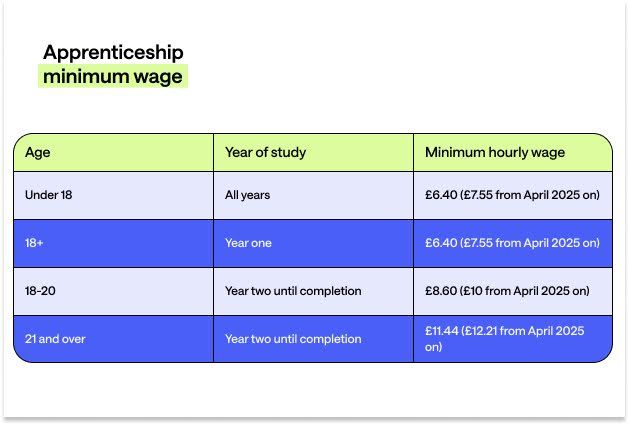
In the UK, the National Minimum Wage is updated each April. Apprentices aged 21 and over who’ve completed the first year of their apprenticeship are eligible for the National Living Wage.
Can apprentices earn more than the minimum wage?
The National Minimum Wage for apprentices is the minimum your employer must pay you. Many organisations (including Multiverse) pay you much more than the National Minimum Wage rate to complete your apprenticeship. For instance, if you’re entering a high-growth and in-demand field like tech, wages tend to be higher than the minimum.
Multiverse apprenticeship wages
At Multiverse, the companies we work with pay a minimum of £18,000 a year. But you’ll find roles on our platform that pay £25,000 or more per annum (per year). We focus on the skills of the future, offering high-quality apprenticeship opportunities across key sectors like Business, Digital and Tech.

Multiverse programmes include:
- Software Engineering (Level 4)
- Advanced Data Fellowship Whole (Level 4-6)
- Digital Business Accelerator (Level 3)
- Business Transformation Fellowship (Level 4)
How much money will you make as an apprentice?
Let’s break it down. Your apprenticeship salary is the amount an employer pays you yearly before income tax and other deductions like National Insurance. How much income tax you pay depends on which tax band you’re in, and your total earnings determine your tax band.
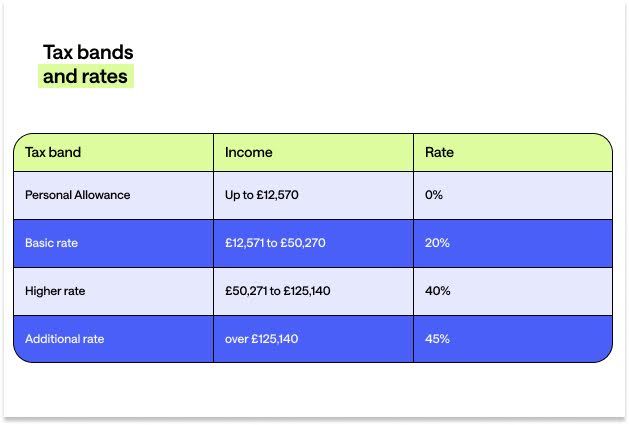
You’re likely in the basic band if you’re working in an entry-level role. In the basic band, you’re taxed on income between £12,571 to £50,270. You don’t pay tax for income below £12,570 (your tax-free Personal Allowance limit). The UK Government taxes earnings in this threshold at 20%.
You’re in the next tax band (the higher rate) if you earn above the basic rate threshold. In the higher rate tax band, you’ll be taxed 40% for income between £50,271 and £125,140. An additional rate of 45% applies to incomes over £125,140.
Now for the maths. Let’s say your salary is £20,000 per annum (per year), and you’re doing an apprenticeship lasting 15 months. Yearly you’ll take home around £17,624 after tax and National Insurance. Monthly you’ll take home around £1,468. Throughout your entire apprenticeship, you’ll earn £22,020.
Apprentice working hours
To complete your apprenticeship full-time, you are typically expected to work at least 30 hours per week. However, if you have specific circumstances (for example, if you’re a carer for a family member), you may be able to work part-time. For part-time apprentices, such as those working 16 hours per week, the apprenticeship duration will be extended to ensure adequate training time.
Your employer must follow employment regulations regarding your working hours:
- Under 18: As a young worker, you can legally work a maximum of 8 hours per day and 40 hours per week.
- 18 and Over: For adults, the standard working limit is an average of 48 hours per week, though you may choose to opt out if desired.
In addition to your set working hours, apprenticeships require that you dedicate at least 20% of your working time to training or studying for your qualification. In a Multiverse programme, you’ll typically spend at least one day a week studying toward your apprenticeship qualification.
What else are apprentices entitled to?
Whether you complete your apprenticeship full-time or part-time, your employer will pay you for working and training hours. Aside from being paid to complete your apprenticeship, you’re legally entitled to employee benefits like holidays, sick pay and rest breaks.
Training
As an apprentice, you’ll be paid for your time at work. You’re also paid for the time you’re in coaching sessions and bootcamps with industry experts (off the job training). You’ll spend 80% of your time working for your employer and 20% of your time doing off the job training. You’ll also be paid for time working towards English and Maths qualifications if they’re part of your apprenticeship.
Holidays
As a full-time apprentice, you’re entitled to a minimum amount of paid holiday. For each year of your qualification, you’ll get at least 20 days of holiday pay plus bank holidays. Many employers provide apprentices well above the minimum paid holiday and offer company-wide shutdowns once a year.
Sick pay
If you’re too ill to work, sick pay offers peace of mind. You’re entitled to Statutory Sick Pay (SSP) as an apprentice. The minimum amount is £116.75 a week for 28 weeks. Some companies offer sick pay schemes that pay more than the basic weekly amount. For example, an employer might offer up to two weeks of paid sick leave at your usual weekly rate.
Rest breaks
You’re legally entitled to rest breaks at work like any other employee. If you’re under 18 and your working day is longer than 4.5 hours, your employer must give you a 30-minute break. If you’re 18 or over, you’ll get a 20-minute break if you work more than six hours daily. As with holiday and sick pay, many companies will offer apprentices above the minimum amount. For instance, you might get up to an hour for lunch and shorter breaks throughout the day.
Is a Multiverse apprenticeship right for you?
There’s never been a better time to start your apprenticeship journey. A Multiverse apprenticeship enables you to learn the skills you need to level up your career without taking time away from your current role. To top it off, you’ll continue to be paid for the time you spend learning on the job. All training is paid for by your employer once they partner with Multiverse.
Train in high-growth industries
Apprentices are in demand across the board, especially in high-growth sectors. Let’s take the tech industry as an example. In 2024, there were 122 “unicorn” startups — startups with a valuation of $1 billion (roughly £770 million) — in the UK alone. The UK tech sector is still growing in 2024, and companies need new, diverse talent. AI is also driving high levels of investment by tech companies. According to Multiverse data, 81% of tech leaders plan to increase investments in AI — including on human capital — over the next three years.
Get paid to learn
All apprentices get paid to work and learn. Some industries pay more than others. Companies with a skills gap will happily pay you to complete your apprenticeship and gain industry expertise in your field.

What happens when I finish my apprenticeship?
After you finish your apprenticeship, you may be in a position to grow your career through a new role or promotion. Promotions usually come with a pay rise as compensation for your increased experience and responsibilities. Having a new qualification will help you now and for the rest of your career.
Start your apprenticeship journey
If you're looking to gain new and exciting skills on the way to future-proofing your career in the dynamic tech industry, apply for a Multiverse programme in minutes today.

How to build a data culture: 5 steps to follow
Employers
Claire Williams
Without it, a lack of clear vision, skills, and data literacy will hold back growth – with companies unable to turn an exponential explosion of data into a competitive advantage.
By 2030, GDP could increase by as much as 26% from AI productivity gains, according to PWC. This expansion will only come if workers have the skills to input clean data into AI models.
It means companies with a strong data culture will have the upper hand as AI adoption takes hold.
In this article, we’ll explore what a data culture is and the practical steps for building one from our data experts.
What is a data culture?
Data culture is where data is deeply integrated into all aspects of an organisation’s operations and decision-making, with every individual fluent in what data means for their role.
The ingredients of a strong data culture include:
- Data-driven decision-making: A commitment to make decisions based on data rather than intuition or guesswork.
- Widespread data literacy: Any employee, at any level, can read, understand, create, and communicate data.
- Data governance and trust: Solid data governance frameworks ensure data quality, security, and compliance – creating trust for anyone using it.
- Data accessibility: There’s transparency in how data is collected, processed, and used. There are no silos, with data readily accessible to anyone.
- Data is seen as a strategic asset: There’s a clear understanding of how data contributes to success and competitive advantage.
In a strong data culture, the average employee lives and breathes data within their day-to-day tasks. Managers use data to inform decisions. And senior leaders underpin the wider business strategy with data.
Why build a data culture? Benefits and examples
Nearly nine out of ten (88%) business transformation initiatives fail to achieve their original goal, according to Bain & Company. For many companies, this is because they lose focus on maintaining and developing their new capabilities.
A data culture overcomes this, with teams ready to take on new tools and change their ways of working. Benefits include:
- Greater productivity and operational efficiency: Employees can easily process and visualise data, saving time on every data task. Examples include using predictive analytics to optimise the supply chain or improving inventory management by accurately forecasting demand.
- No more ring-fenced data teams: With widespread data literacy, employees can self-serve insights, reducing the load on internal data specialists – who in turn gain time back to focus on more complex initiatives in the overall data strategy.
- New opportunities: When encouraged to work with a data-first mindset, employees can accelerate the speed of projects and uncover new revenue stream opportunities through advanced insights – bringing new ideas and products to market faster.
Five steps to build a strong data culture
Once you’ve identified your current state, be bold in your ambition. A strong data culture is not the destination, it’s a journey. Here’s how to bring everyone along the way:
1. Align a data culture with your business goals
Start with a clear rationale for your data culture. Assess the internal data capabilities and employee skills you would need to establish one. Set out the benefits for the business as a whole, as well as the benefits for individual functions and role types.
2. Spot skills gaps and spread data learning across all levels
Assess your training needs by identifying data skills gaps. A skills matrix is a simple framework to map out your state of play, helping you target learning opportunities for all employees at any seniority level. Building data capabilities at all levels of the org chart means everyone takes a stake in supporting culture change, rather than creating silos.
3. Help employees understand the value of data
When employees see the value data can create, more will look at how their data skills can be applied to improve their roles. When a data culture takes hold, this mindset supports data-driven decision-making. Managers and leaders will act on real insights rather than hearsay, making decisions more targeted and impactful.
4. Create space to share ideas and best practices
Cross-functional data projects and creating Centres of Excellence (COEs) can help to build good data practices across the workforce. By offering opportunities for teams to collaborate with data, knowledge sharing and data-driven efficiencies break out of silos.
5. Measure the impact of your data culture
Transparency and reporting back progress to the whole business creates a feedback loop grounded in data, showing success and keeping everyone bought in. One example is CBRE, which measured the time saved on run-rate processes and calculated the overall time and financial savings for the business.
The need for upskilling in a strong data culture
Across the workforce, data skills are in high demand and short supply. According to our Skills Intelligence Report, 25 days of productive time are lost to data skills gaps annually. More than half (57%) of workers have no – or just basic – Excel skills. Some 86% have no Python skills.
Upskilling is one way to bridge this gap: by expanding skills and knowledge to better meet the demands of evolving job roles. It’s a route that helps your existing workforce make the most of vast internal and external datasets, readying them for the rise of artificial intelligence.
When coupled with continuous learning, these training tactics can help employees make the most of data, supporting a strong data culture.
Start shaping your workplace data culture with Multiverse
Need more advice on building a thriving data culture?
Multiverse can help. Learn more about our range of employee training and data upskilling programmes.
3 common barriers to AI adoption
Employers
Claire Williams
It’s beyond doubt there’s huge potential for AI to deliver results and economic value for businesses, from greater productivity to improved customer experience.
But to build a truly AI-native business – where AI is baked into the DNA of your business, and delivering maximum ROI – multiple elements must work in harmony, or momentum can easily stall.
We recently spoke to 2,000 tech leaders and employees – to get a realistic understanding of AI maturity today and what businesses can do to improve. And it’s clear that barriers to AI adoption are preventing the technology from delivering on its promise.
But what are they? Here’s three common roadblocks and how your business can start to overcome them:
1. Overestimating AI maturity
We found that four in five leaders say implementing AI has led to an increase in revenue generation, while 97% say the benefits have met or exceeded their expectations. Overall, 57% believe they are ahead of the competition in AI maturity.

Today, optimism in AI for businesses is understandably high. However, there are signs this may be an overestimation of progress. And optimism could be masking the realities of what it takes to fully implement and benefit from the technology.
As AI continues to evolve, establishing best practice is an ongoing challenge that’s creating risks and potential missed opportunities for the future.
Strength in areas such as data governance and security are vital hallmarks of AI excellence – and necessary requirements to reach AI maturity. But they are being overlooked by many.
Only a small proportion of leaders report they have established key hallmarks of best practice —for example, just 28% strongly agree they have provided guardrails and governance structures to limit AI risk. And less than half (43%) strongly agree they have ensured responsible use of AI in business practices.
This gap between leaders’ expectations and reality suggests that businesses are struggling to objectively assess their own progress with AI – and identify the further steps needed for full implementation.
Using a more objective framework to benchmark progress, categorise the stages of AI maturity, and create a roadmap for next steps can help businesses to plan more holistically – and realistically. We’ve included 3 actions for leaders in our ROI of AI report to get you started.
2. Difficulty securing investment and demonstrating ROI
Our research found tech leaders are positive about AI delivering financial gains in the long term – in fact, 85% expect to see an increase in revenue generation in 3-5 years.
But if businesses are unable to prove the value of AI today, and if employees lack the skills to access its full potential, then it will become increasingly difficult to unlock further investment – and AI progress will stagnate.
Of all the AI adoption barriers cited by leaders, 63% say the biggest blocker to further investment is the inability to fully use existing AI technology. Paired with more than half (58%) reporting resistance from employees to use AI and a lack of ability to demonstrate or predict tangible results (57%), it’s clear we’re at a standstill.
Value driven by AI needs to be tracked diligently and communicated within businesses. Only then can roadblocks, like resistance from employees or workforce skills, be tackled head-on. Take a look at our recommendations for employers in our ROI of AI report to find out more.

3. Employees still lack access to formal AI training
True AI maturity depends on people as much as technology, and our data shows a lack of workforce skills is slowing AI adoption progress.
Businesses need to build workforce expertise, fast, to combat struggles with implementation and get the most from AI. But training opportunities remain in short supply.
We found that most employees (51%) have received fewer than 5 hours of training on AI, with 25% opting to self-fund training. And many have gained skills by playing with ChatGPT (61%) or learning on the job (59%).
Of the employees we spoke to, 56% of workers that describe their AI skills as ‘expert’ have not received any formal training from their employer.
This gap in formal training may mean workers struggle to assess whether their actions are aligned to company policies or broader best practice – in turn, creating potential risks for the business.
Currently, workers are largely fending for themselves which has a number of ramifications for employees and businesses alike. For the worker it can be difficult to understand their personal skills gaps and learn efficiently with limited timeframes. For the business, informal AI usage from employees increases risk of misuse, and limits ability to measure ROI from new tools.
Learn more about your AI maturity
Assessing AI maturity helps businesses get the most out of emerging tech. From prioritising investment to identifying skills gaps, understanding where your business is on the AI maturity scale is the key to access future growth.
To learn more about AI maturity and next steps, check out our full ROI of AI report.
Career Mobility @ Multiverse: Alexander Howarth
Life at Multiverse
Team Multiverse
Tell us about your recent career change at Multiverse.
I joined Multiverse in May 2022 as a Coach in what was then the Data Literacy Programme (DLP). During our first DLP cohort, this programme went from strength to strength, developing into the Data and Insights for Business Decisions (DIBD) programme we know today!
I was invited to apply for an Operations Executive role pilot because of some analysis work I’d done alongside my coaching role. It was a brilliant opportunity to get stuck in with the first iterations of projects to support coaches with our new approach to organising and maintaining high-quality service during our programmes, which are now rolling out across the business.
How are you enjoying your new team and remit?
I've been in the role for six months and I'm loving it! It's great to be able to have an impact on the success of thousands of apprentices, rather than one cohort. I've also gone from quite a structured role as a coach, with defined apprentice touch points, to a role where no two days or weeks are the same. I've found this really refreshing and energising, working with so many more great colleagues across the organisation.
Any career change comes with its challenges, what did you have to overcome and how did you approach this?
One of the best things about working at Multiverse is the wealth of experience you're surrounded by all the time, and how willing people are to share it with you. I have had to adapt to thinking on a larger scale - instead of imagining solutions to problems my cohort of apprentices were facing, which I would devise and implement entirely on my own, I now work on fixing problems for thousands of apprentices.
I have to think through how effectively solutions can be adopted by coaches with competing demands on their time and attention. I've borrowed an old Nike slogan - 'Just do it!' - and lean heavily on colleagues who have expertise and skills that I'm still developing.
If you could share one piece of advice for someone looking to develop their career or move internally, what would it be?
Volunteer for things! I only got the Operations Exec Pilot opportunity because I asked my Delivery Lead if there was anything else I could be doing to develop, so make sure you put yourself out there and say yes!
Alex’s journey from Data Coach to Operations Executive showcases our Career Mobility approach at Multiverse and highlights the importance of keeping an open mind and jumping at opportunities when wanting to make a career change. Want to join a company where career mobility is a priority? We’re hiring.
Differences between AI and machine learning: A breakdown
Apprentices
Team Multiverse
Artificial intelligence and machine learning are distinct but related concepts. AI refers to advanced software that imitates how humans process and analyse information. Machine learning is a subtype of AI that uses algorithms–or sets of rules–to perform specific tasks.
These technologies have many innovative uses in finance, healthcare, logistics, and other industries. But the number of people with artificial intelligence and machine learning skills has not kept up with soaring demand. A 2024 Red Hat survey found that 81% of UK Information Technology Managers see a critical AI skills gap, with 40% citing talent shortages as their main obstacle preventing their organisations from using AI to its full potential.
Expanding your AI and machine learning skills can help you keep up with the evolving tech landscape. We examine the differences between these technologies, applications in the workforce, and more.
What’s the difference between AI and Machine Learning?
Artificial intelligence is a broad term for software that mimics how humans perform complex mental processes. This technology analyses information, learns from its experiences, and solves problems.
Machine learning is one of the most popular branches of AI. This approach uses algorithms — or instructions — to guide decision-making and execute tasks. All machine learning is AI, but not all AI programmes use machine learning.
Businesses often use artificial intelligence without machine learning for repetitive or straightforward tasks. Some people call these applications “Good Old-Fashioned Artificial Intelligence” (GOFAI) because they don’t learn from data like machine learning algorithms. For example, GOFAI chatbots use rule-based systems to respond to customer inquiries. These chatbots provide pre-scripted answers but can’t learn from previous interactions or adapt to different contexts.
However, some organisations create hybrid systems by combining machine learning with symbolic — or rules-based — AI. These models rely on machine learning algorithms to process data, but they also use symbolic reasoning techniques to interpret information based on predefined knowledge.
This dual approach allows hybrid AI systems to mimic human reasoning and solve more complex problems. For example, Google DeepMind has developed geometry-solving software that blends neural networks with a symbolic AI engine. The neural networks use their “intuition” to guess the best way to solve a geometry problem, while the symbolic AI engine generates solutions based on this reasoning.
What is AI?
Artificial intelligence refers to machines and software that imitate human cognitive functions. This technology performs advanced processes that traditionally relied on human intelligence. For example, AI software can identify patterns in large datasets, recognize faces in photographs, and give personalised recommendations.
Businesses use advanced computer systems and infrastructure to build AI applications. On the hardware front, Graphics Processing Units (GPUs) and Tensor Processing Units (TPUs) enable machine learning models to process large amounts of data efficiently. GPUs have powerful parallel processing capabilities, perfect for analysing images and videos. By contrast, TPUs perform complex computations at lightning speed, allowing neural networks to learn faster.
Additionally, many organisations use cloud computing to optimise their AI software. Cloud platforms like Google Cloud enable businesses to draw on remote training data for machine learning models without investing in expensive infrastructure. Users can also access additional resources — such as cloud storage solutions and analytics tools — to improve their AI operations. This flexibility lets businesses scale their AI applications up or down as needed, boosting performance and reducing costs.
Popular AI business applications
One of the most popular types of AI are large language models (LLMS). Engineers use vast quantities of human-generated content to train OpenAI’s ChatGPT and other LLMs. The models learn context and language from the data and use this knowledge to respond to human input.
Engineers also use AI to create robots that respond to their environments and perform intricate tasks. For instance, AI-powered vacuum cleaners avoid obstacles in their paths, while AI surgical robots assist surgeons with operations.
Additionally, AI enables researchers to develop autonomous systems that operate without human guidance. Autonomous drones and vehicles use algorithms and sensor technologies to make real-time decisions and navigate their environment.
Smart assistants have also gained widespread popularity. Applications like Siri and Google Assistant use natural language processing to interpret and respond to human input. Users can ask these assistants to perform many functions, such as adding tasks to their calendars, controlling smart devices, and setting timers.
Finally, retailers and streaming services often use AI-powered recommendation engines to personalise the customer experience. For example, Amazon uses machine learning algorithms to analyse customers’ browsing behaviour and suggest relevant products. The retailer also uses an LLM to tailor product descriptions for individual consumers.
What is Machine Learning?
Machine learning is a subset of AI that uses algorithms to create intelligent systems that learn from datasets. The algorithms detect patterns in data, make predictions based on historical trends, and complete tasks. They refine their performance over time as they receive more data, so humans don’t need to tweak the programming.
There are three main types of machine learning with different applications:
Supervised learning
An algorithm processes datasets with historical inputs and outputs and identifies their relationships. The software generalises and extrapolates this knowledge to predict future outputs. Organisations use supervised learning to teach algorithms to classify items, detect abnormal data points, and forecast future trends.
Unsupervised learning
The algorithm looks for connections and patterns between unlabeled data points and generates insights into the dataset’s structure. For instance, an algorithm could analyse website traffic and sort customers into groups based on browsing behaviour.
Reinforcement learning
The algorithm gains positive or negative reinforcement from its environment and adjusts its behaviour accordingly. AI-powered robots and self-driving cars use reinforcement learning to learn new tasks and optimise performance. The streaming service Spotify also uses reinforcement learning to provide increasingly accurate personalised recommendations.
The role of Deep Learning in AI and Machine Learning
Deep learning is a specialised field within machine learning that uses many layers of neural networks for sophisticated pattern recognition and problem solving. It’s designed to mimic how the human brain processes information, learns from experience, and applies reasoning.
Traditional machine learning algorithms rely heavily on human intervention to learn and often struggle to process unstructured data efficiently. In contrast, deep learning models can interpret many data types and automatically improve their performance with minimal human input.
Deep learning has a wide range of applications across various industries, including automotive, aerospace, healthcare, and security. For example, autonomous vehicles use deep learning to automatically detect and avoid obstacles in the road. Similarly, computer vision programmes use deep learning to recognize faces and classify images.
Machine Learning and AI: How do businesses use them?
Organisations in all industries leverage AI and machine learning to improve their operations. These technologies complete repetitive tasks faster and more accurately than humans, enhancing productivity. Businesses also use AI and machine learning to drive innovation and develop more efficient processes.
To develop and use AI applications effectively, professionals need diverse tech skills. For example, Marketers should be proficient in prompt engineering to effectively use generative AI tools to develop personalised marketing campaigns. Meanwhile, strong data analysis skills enable Supply Chain Managers to use AI for demand forecasting and inventory optimisation.
Here are five use cases for AI and machine learning in different sectors.
Autonomous threat detection
Cybersecurity professionals use AI and machine learning to detect cyber threats more efficiently. This technology autonomously monitors computer networks and systems for abnormal behaviour and data points. Algorithms analyse these anomalies to determine if they’re caused by cyber attacks and trigger defence mechanisms.
Autonomous threat detection lets organisations respond more quickly to cybersecurity incidents. For example, Horizon3.ai’s NodeZero Autonomous Security Platform detects attackers and automatically diverts them to decoy systems, preventing them from accessing critical data. The platform also improves and adapts in response to emerging threats so organisations can stay two steps ahead of cybercriminals.
Diagnostic imaging
AI and machine learning have revolutionised medical imaging. Radiologists and other healthcare professionals use this technology to capture and reconstruct diagnostic images. For example, AI software can create synthetic images based on a single image, so patients spend less time in the radiology department.
AI also helps clinicians analyse images for lesions, tumours, brain aneurysms, and other conditions. In some cases, this technology may detect abnormalities missed by human eyes. This increased precision leads to faster and more accurate diagnoses and improves patient outcomes.
Personalised marketing campaigns
Marketers use artificial intelligence and machine learning to create more effective and targeted marketing campaigns. Machine learning algorithms analyse behaviour, demographics, and other data to gain insights into customers’ preferences. Companies use these findings to provide personalised product recommendations and promotions.
For example, Brewdog uses AI software to personalise its email marketing campaigns based on customers’ recent purchases, web activity, and other data. In a recent experiment, the company found that its personalised campaigns generated 13.8% more revenue than non-personalized ones.
Businesses also use AI to automate time-consuming marketing processes. AI-powered chatbots answer questions from prospective customers, while generative AI tools create articles and other marketing content. These innovations let marketers focus on tasks that require a human touch, like nurturing client relationships and developing the perfect brand voice.
Supply chain optimization
Products often travel through convoluted global supply chains before they reach customers. AI helps organisations streamline and optimise these processes so goods reach their destinations as efficiently as possible.
Sophisticated machine learning algorithms analyse historical data and forecast future trends. These models predict changes in customer demand, the availability of raw materials, and other market dynamics. Businesses leverage this data to anticipate supply chain fluctuations and respond proactively. For example, Unilever uses an AI application called Scoutbee to scrape web data to find alternative suppliers if demand for a product spikes or their usual distributors aren’t able to meet inventory needs.
Fraud detection
Any organisation can fall victim to internal and external fraud. AI fraud detection tools use machine learning algorithms to analyse data and identify suspicious or anomalous patterns. These applications also generate detailed reports that help humans investigate potentially fraudulent activity.
For instance, the UK government developed the Single Network Analytics Platform (SNAP) to detect fraud and organised crime. This AI system analyses data from the World Bank and other sources to detect suspicious activity and networks. With this tool, public sector organisations can effectively detect fraudulent claims and safeguard public funds from criminals.
Ethics in AI and Machine Learning: What professionals need to know
According to Multiverse’s ROI of AI report, 93% of professionals are confident that they use artificial intelligence ethically. However, despite this optimism, researchers and tech experts have raised alarms about the ethical dilemmas associated with this technology.
Bias is one of the most significant ethical challenges posed by AI. Models trained on biased datasets can perpetuate racism, sexism, and other forms of discrimination. For instance, an UberEats courier recently won a lawsuit after the company’s “racially discriminatory” facial recognition system barred him from accessing the platform. This case illustrates how AI systems that make automated decisions based on physical appearance can reinforce inequities.
Data privacy is another pressing concern. Many people worry that artificial intelligence tools collect and use their personal data and intellectual property without consent. In 2024, for example, the UK Information Commissioner’s Office revealed that LinkedIn had been training its AI models with user data without explicit consent. In response to these findings, the social media platform agreed to suspend this training until further notice.
Ethical frameworks can guide professionals as they develop and use AI and machine learning tools. For example, the UK government has created a seven-point framework to help civil servants use this technology responsibly. This blueprint promotes data integrity, fairness, transparency, and other key principles.
Demand for AI and Machine Learning jobs
The widespread adoption of AI and machine learning has opened new career opportunities in every industry. The World Economic Forum’s Global Risk Report 2024 predicts that the demand for AI and Machine Learning Specialists will increase by 40% by 2027.
Data science is one of the fastest-growing AI-related professions. Data Scientists use machine learning algorithms to interpret complex datasets and help business leaders make informed decisions.
Data Analysts and scientists rank sixth on the Future of Jobs Report 2023’s list of the fastest-growing occupations between 2023 and 2027. These professionals also command healthy salaries. Glassdoor data indicates Data Scientists in London earn a median salary of £60,000.
Additionally, LinkedIn’s 2024 Jobs on the Rise Report lists Artificial Intelligence Engineer as the tenth-fastest growing career. These experts use programming languages and technical skills to build, train, and maintain AI software. According to Glassdoor, Artificial Intelligence Engineers in London earn an average salary of £64,000.
Multiverse’s upskilling programmes can help you gain the essential skills to thrive in the evolving job market and pursue AI-related roles. Our AI for Business Value programme teaches you how to implement AI solutions to boost operational efficiency and drive organisational change. Similarly, the AI-Powered Productivity programme focuses on AI literacy, empowering you to use AI solutions to improve efficiency.
These programmes are fully funded by your employer and allow you to gain hands-on experience in your current role. You’ll get at least three hours of protected learning time weekly to complete structured training modules and collaborative projects. You’ll also practise applying your new AI and ML skills in the workplace, accelerating your professional development.
Future proof your career with in-demand skills
AI will disrupt approximately 40% of jobs worldwide, according to a 2024 report by the IMF. This statistic may sound alarming, but this technology will likely change most jobs, not eliminate them. Developing AI and machine learning skills will allow you to adapt to the evolving workforce and fill critical skills gaps.
Immerse yourself in the latest AI and machine learning developments with Multiverse’s free bite-sized AI training. These innovative training modules provide fast, actioned-oriented lessons on foundational AI principles, prompt engineering and teach you how to apply AI ethically in your current career.
Ready to become an AI expert? Talk to your employer about our AI for Business Value apprenticeship to start your journey.
Multiverse Strengthens Leadership Team Amid AI Growth Drive
News
Team Multiverse
Baroness Lane Fox is a serial entrepreneur and tech leader with three decades of experience - guiding multiple companies to public markets. She now serves as President of the British Chambers of Commerce, Chancellor at The Open University, and co-chair of a new government panel tasked with driving improved adoption of technology in the public sector. In addition, she currently serves on the board at Chanel and previously served on Twitter’s board (now X) for almost 7 years until 2022.
The company has also appointed Jillian Gillespie as Chief Financial Officer. Jillian joins from MongoDB, the developer data platform with a market capitalization of $20 billion, where she was Senior Vice President of Finance and Operations. She led the company through major milestones and international expansion over ten years, from its Series F funding round in 2013 through to IPO in 2017, followed by success as a public company.
Multiverse is a tech company that identifies, closes and prevents skills gaps, through on-the-job learning, apprenticeships programmes, and a personalised AI platform. The appointments come off the back of two consecutive record breaking quarters for the company. In October, the company launched an ‘AI-Powered Productivity’ apprenticeship, the first apprenticeship in the country to fully embed training on Microsoft 365 Copilot. AI training programs now make up 22% of Multiverse’s revenue.
Multiverse's research shows 64% of businesses lack confidence in deploying AI and associated technologies – a skills gap that has become more acute with rapid technological advancement. They also support Multiverse's continued expansion in the United States, where 87% of business leaders believe they have skill gaps. The company already partners with more than 1,500 companies across the US and UK.
Euan Blair, founder and CEO of Multiverse: "Multiverse has the capacity to be a generational British tech success story - ensuring people globally can embrace tech with confidence by embedding learning in tech, data, and AI into their daily work. In Martha and Jillian, we're adding two exceptional leaders who understand both the scale of the global skills crisis and how to build and scale transformative solutions. As we expand our footprint with new products and partnerships, their experience in scaling high-growth tech companies will help us seize this moment and reshape how organisations develop talent in the AI era."
Baroness Martha Lane Fox: “The promised gains from technology will never be delivered unless people have the skills to take advantage of them. This is becoming urgent in the boardrooms of every organisation, and Multiverse is perfectly positioned with its model of continuous, applied learning. Across the UK we won’t unlock growth without giving employers access to the skills they need to thrive. The debate about skills reform sorely needs the voice of employers, and I’ll be working to deliver it, alongside companies themselves and learners’’.
Jillian Gillespie, Chief Financial Officer of Multiverse: "I am thrilled to join Multiverse at such a pivotal moment in its journey. What really attracted me is the opportunity to collaborate with such a talented, genuine, and ambitious team in a fast-growing, dynamic, and rewarding business. I firmly believe that applied, on-the-job learning represents the future of workforce development and I look forward to applying my experience to an exciting new challenge.”

Multiverse marks milestone as first independent apprenticeship provider to award undergraduate degrees
News
Team Multiverse
Today, the first cohort of learners graduate from tech company Multiverse’s degree apprenticeships. This marks the first time an independent apprenticeship provider has awarded its own undergraduate degrees.
Forming part of Multiverse’s commitment to promoting equitable access to economic opportunity, the graduating cohort from the Advanced Data Fellowship Level 6 programme will be the first of 850 learners on Multiverse’s degree apprenticeship programmes to receive a Multiverse-awarded degree. The National Student Survey from this programme scored higher than all other providers offering the same standard, with an overall satisfaction rating of 89.5%.
With businesses citing data skills gaps as a key barrier to AI success, and half of employees unable to use data to make analysis more efficient or automate processes, degree apprenticeships offer a way for employers to upskill their workforce while solving real business challenges in the face of rapid technological change.
During the programme over half secured promotions, while the whole cohort have benefited from earning a salary and developing valuable real-world experience while they learned. By comparison, 1.8 million people in the UK are currently saddled with more than £50,000 in student debt. Half of Multiverse’s degree apprentices have not previously pursued higher education, and 30% meet one or more markers of socio-economic disadvantage. This demonstrates how apprenticeships can provide a lever for social mobility alongside their outcomes for business value.
Not only have these apprentices boosted their career prospects, they have also driven value for their employers: apprenticeships generate around £28 for every £1 invested. Tangible projects that this cohort of apprentices have completed include building an invoice reading app using the ChatGPT API and developing a dashboard for the new revenue system that reduced the percentage of hotels with a failed stage gate by 16%.
Liam Cottrell, an apprentice at Mars UK, said: “I was Mars’ first digital apprentice and I’ve been amazed at how much I’ve learnt throughout the process. Never thought I’d be able to build my own data pipeline to help with a work project, which I did as part of the data engineering module.”
Euan Blair, founder and CEO of Multiverse, said: “I couldn’t be prouder of the apprentices graduating today. CEOs tell me time and time again that they learnt their most important skills on the job, so giving learners the opportunity to apply practical skills to real-world projects is key. We set out to deliver degree-level apprenticeships at Multiverse not because of any attachment to the concept of a degree, but because we believed these programmes could deliver real world value that accelerates careers, and delivers value to employers. These apprentices have proved that.”
Multiverse has partnered with more than 1,500 companies across the US and UK including Meta, Citigroup, KPMG, Capita, and Just Eat, with 16,000 apprentices now in its community. Multiverse apprentices have tracked more than £2 billion in return on investment.

Essex County Council launches 40-strong Data Academy in latest upskilling and transformation drive
News
Team Multiverse
Essex County Council (ECC) has launched training for 40 of its staff through a new Data Academy, as part of its ambitious plans to become a data-led organisation.
The goal is to strengthen the organisation’s data capabilities, while boosting productivity and data literacy across teams.
Teaching is being delivered by Multiverse, a tech company delivering high-quality training through applied learning. Multiverse has trained more than 16,000 apprentices in data and digital skills since 2016. According to Multiverse’s Skills Intelligence Report, local government and councils are notably impacted by a lack of data skills, with 26% of employees’ time working with data spent unproductively.
Programmes include ‘Data Insights for Business Decisions’, which equips commissioners working within ECC with the technical skills and knowledge to navigate the data landscape confidently.
The 13-month ‘Data Fellowship’, a Level 4 apprenticeship, will upskill data professionals, while the degree-level ‘Advanced Data Fellowship’ will give graduates the tools to build data analytics capabilities within the organisation and use data to support decision-making.
Staff enrolled in the Academy also have the opportunity to complete a 13-month ‘Business Transformation Fellowship’, which covers key competencies that are most relevant to doing business in the digital age, including defining business objectives, exploring opportunities for digital innovation and adopting agile ways of working.
The Data Academy is funded by the Apprenticeship Levy, a UK tax on employers that is used to fund apprenticeship training.
Nicola Mallett, Head of Profession Analytics and Data Science at Essex County Council said: “Essex County Council provides a diverse learning programme designed to help our colleagues confidently engage with data, fostering evidence-based decision-making at every level. By participating in the Data Academy through the Apprenticeship Levy, we are further investing in our workforce, ensuring they understand the purpose and potential of data. This initiative encourages responsible data use, strengthens robust data processes, and promotes collaboration with our partners. Ultimately, it enables us to leverage data insights to enhance social good and improve outcomes for communities across Essex.”
Gary Eimerman, Chief Learning Officer at Multiverse said: “Essex County Council will be on the front foot in data-led decision making and process modernisation thanks to the skills they will gain on these apprenticeships. All the while, by developing the skills of its people the Council will enhance their careers and access to the best opportunities.”
Multiverse works with more than 1,500 organisations to close critical skill gaps in the workforce in AI, data and tech, combining work and learning to unlock economic opportunity for everyone.
How Laing O'Rourke is building its workforce for a data-driven future
Employers
Gabriela Wasilewska
The challenge
On average, construction employees spend 29% of their time working with data unproductively, according to the Multiverse Skills Intelligence Report. It’s a growing challenge, particularly in a space like construction – where daily workflows are so closely tied to complex, business-critical datasets.
To store, use, and analyse data more effectively, construction companies are taking steps to build their data maturity.
Laing O’Rourke is one example. Since 2021, the team has worked with Multiverse to improve data skills and create data champions across the organisation. At Big Data LDN 2024, we heard how learners have created new efficiencies through data upskilling programmes.
Our panel included Pedro Rente Lourenço, Group Head of Data and Analytics at Laing O’Rourke, in conversation with Louisa Dunwiddie, Enterprise Account Director at Multiverse. We discussed how Laing O’Rourke has enhanced workforce capability and powered a data revolution within its business, laying the foundation for a valuable data strategy.

The upskilling opportunity for construction transformation
The construction industry deals with complex data, from geospatial and survey information to cost estimations and financials. As the scale of projects and data estate grew at Laing O’Rourke, decision-makers realised that data skills were needed outside of a ring-fenced IT department. If not, critical skills gaps could slow productivity.
As Pedro told us, “Data governance cannot be confined to a data team – it needs to spread out across our projects, because every project is almost like its own business.” Multiple teams across Laing O’Rourke stood to benefit from data upskilling programmes.
The Data Academy at Laing O’Rourke
Laing O’Rourke partnered with Multiverse in 2021 to establish their Data Academy. They used the Apprenticeship Levy to fund employee upskilling in data and AI, at no extra commercial cost.
Initially, 87 employees enrolled in courses to improve data skills across the company – transforming how they handle and gain insights from data.
Today, Laing O’Rourke has had nearly 300 members of staff enrol on the programme, driving transformation within the firm.
The results: The impact of the Data Academy
Pedro reflects that initially, Laing O’Rourke simply wanted to see whether the programme would “stick”.
They saw fast success, and now, staff from teams across engineering, quantity surveying, HR and more have learned how to use data more productively.
“It’s created more and more demand, because when staff see the value, they see there is a clear return on investment.”
The Data Academy has shifted Laing O’Rourke’s operating model – bringing data capabilities out of the IT team and closer to other employees who use it every day. It has two main advantages:
1. Measurable efficiencies for dashboard product owners
Employees with newfound data skills have driven new levels of productivity for Laing O’Rourke. Pedro told us how data-literate teams can now generate dashboards, develop systems for automation, and reduce silos across the organisation.
The programme has also helped staff make sense of data and explore new opportunities with technologies like AI. Pedro highlighted how they can “look beyond chatbots” to applications such as risk management and data-driven sustainability initiatives.
But while anecdotal evidence tells a compelling story, Laing O’Rourke’s transformation journey needs to be informed by data. Tools to measure the success of change help the team validate the value of upskilling through a standardised return on investment analysis.
“We are continuously analysing ROI in a standardised way, so when people are going through the cohort and developing new solutions, we can see how much it cost and how much time it saved them,” Pedro explained.
The figures are then validated with line and functional managers to support the business case for upskilling. Ultimately, Laing O’Rourke has found that if more people in the business have data skills, more value can be unlocked.
2. Organisational culture change
To drive the success for the programme, Laing O’Rourke selected members of staff who worked with a lot of data to participate. These were the stakeholders who could influence the most change and increase wider data literacy across the organisation.
They found that once staff were aware of the importance of data quality, they would try to design new ways of working that led to process change. “That’s where we really see increased capabilities,” Pedro reflected, “when staff ask “why is this important? what can I actually do with this?”
This mindset change spread down from leaders, and out through individual branches of the business.
“There’s a butterfly effect when you’re reducing silos and breaking down barriers. When employees can save themselves five hours a week, they can enable their team to each save five hours a week. That’s where we see the culture change and the real transformation.”

Data skills are critical for modern organisations
Since recognising the lack of data maturity in the business, the team at Laing O’Rourke has successfully developed data capabilities and driven business growth.
Embedding data skills throughout the workforce is critical for staying competitive as industries accelerate their transformation efforts.
As Pedro put it, “you can bring as many great technologies in as you want, but if you don’t bring people’s knowledge up and give them skills to work with that data, you’re not going to get the benefit.”
Watch the full session with Pedro Rente Lourenço and Louisa Dunwiddie at Big Data LDN 2024.
Find out more about Multiverse’s data programmes to upskill your staff, achieve greater data literacy and build toward business transformation goals.

Skills England: What do employers need to know?
Employers
Ellie Daniel
Half of business owners believe gaps in key tech and data areas will negatively affect business performance over the next decade, across metrics like profit and customer satisfaction.
But policymakers have plans for change. Labour’s new body Skills England is currently being established to drive economic growth, widen career opportunities, and meet future workforce skills needs.
Here’s what employers need to know.
What is Skills England?
Skills England was one of Labour’s key skills manifesto pledges. It is a new Government agency, sponsored by the Department for Education that aims to unify the skills landscape, assess the UK’s skills gaps and transform the system. It will bring together stakeholders across government and beyond, including businesses, training providers, unions, Combined Authorities and regional organisations to collaborate and inform the design of apprenticeships and other training.
In June 2025, Skills England replaced the Institute for Apprenticeships and Technical Education (IfATE), which was the non-departmental public body that oversaw the UK’s skills system. Skills England will take over IfATE’s responsibilities, and it also has an expanded remit including helping inform policy development.
Skills England is chaired by Former Cisco UK & Ireland CEO and Chairman Phil Smith CBE. The board and members, are responsible for shaping its strategic direction and have been appointed from across the skills system.
Skills England and Apprenticeship Levy reforms
One key responsibility Skills England will hold is to create and maintain a list of training courses eligible for funding through the new Growth and Skills Levy, which is set to replace the Apprenticeship Levy. You can learn more about the Levy reforms in our guide for employers.

What will Skills England do?
Skills England has already started assessing the state of skills in the UK, which will inform future policy on apprenticeships and technical qualifications for businesses. Its first report sets out the challenges limiting growth across three pillars:
- Local-level disparities and immobility
- Mismatched skills
- Future megatrends
One of the main ‘mismatches’ the report flags is between employer needs and digital skills. It calls out that less than half (41%) of the UK’s adult workforce are able to perform all 20 tasks deemed essential digital skills for work. These include everyday workplace skills such as communicating using digital platforms and accessing tax information digitally.
While skills shortages aren’t limited to digital roles, they represent a large gap. According to a Government Employer Skills Survey, vacancies are more likely to be due to skills shortages for digital roles (81%) than across all occupations (63%).
Skills England will use these findings to inform changes to the existing skills system. It plans to bring together different partners to match skills supply to demand and build a more coherent approach to training.
A simpler, more effective system is welcomed – providing businesses with access to essential resources for skill development and filling sector-specific skills gaps.
The Multiverse take
It’s exciting to see the UK Government focus on addressing digital skills gaps in the workforce. We’re looking to working with Skills England and seeing how it will drive positive change.
There's no doubt it will play an integral role in bringing together employers, training providers and the many moving parts of the UK’s skills economy. Collaboration that will help build the workforce the UK needs.
To learn more about Skills England, the Levy, or other ways you can upskill your workforce, get in touch with Multiverse today.
Updated: June 2025
Sorry, no results found.