Machine learning (ML) is a technical discipline within computer science and artificial intelligence (AI). Simply put, it's a way for specialists to build computer systems that learn, make predictions, and perform tasks without human instruction.
To create the systems, ML professionals must first develop, train, and evaluate them. To do this, they leverage large amounts of data and statistical algorithms. If successful, the computer system can mimic how humans learn and perform specific tasks.
An organisation may invest in machine learning for multiple reasons. Fraud prevention and offering personalised customer recommendations are two everyday use cases. Automating specific tasks that would otherwise take serious time and resources is another.
For example, a Machine Learning Engineer might use machine learning to organise large amounts of data for them before they analyse it. Because they don't need to organise the data manually, it's much quicker for a specialist to gain insights.
You may have heard people use the terms machine learning and AI interchangeably. While these fields are similar in many ways — they're not the same.
Think of it this way: Machine learning is how a computer system learns and creates its "intelligence." On the other hand, AI is what a computer system uses to put that "intelligence" into action. Let's return to our data analysis scenario. Machine learning is how a computer learns to organise data. The computer uses AI to organise data with little to no human input.
Now you know what machine learning is, here's why it matters to your career. Whether you have or don't have machine learning skills, one thing remains the same: ML will fundamentally change how we work.
You only need to look at the industry's market growth to see the future of work — though it's arguably already here. By 2030, experts predict the market volume for machine learning will likely reach £371.50bn.

What do businesses use machine learning for?
Around 514 UK companies used "machine learning" to describe themselves and their offering(s) in early 2023. Of those 514, computer software companies made up the most considerable portion at 37%.
Aside from the growing number of self-described "machine learning" companies, organisations of all sizes and across industries use ML techniques in everyday operations. A business may use machine learning to implement an AI program. For example, a company could build a custom GPT, meaning they've either knowingly or unknowingly used ML.
Companies also use ML in the following ways:
- Fraud prevention: A business can use machine learning to find fraudulent behaviour across business operations. That could mean finding and removing instances of phishing across company email or phones.
- Personalised recommendations: Research by SurveyMonkey reveals that nearly half of customers "are interested in getting personalised deals." As a result, businesses that want to improve customer experiences are using ML to help them meet this demand. In this context, machine learning can help build systems that suggest products — or even offer tailored discounts — using past customer purchases and website interactions.
- Segmenting customers and app users: Machine learning algorithms can organise large volumes of data into different categories much quicker than a human could. That's why many companies deploy these algorithms to uncover different audience segments for them. A company like Spotify could use ML in this way to serve relevant ads to different user segments.
What are the two approaches to machine learning?
Supervised and unsupervised learning are the two main approaches (or categories) within machine learning. Machine Learning Engineers use both methods to train models. However, supervised and unsupervised learning train them differently. Let's take a closer look at each.
Supervised
As a Machine Learning Engineer, you'd use a supervised approach to train a predictive model using a labelled dataset. That means for every input, there's a related output. You may pick this approach if you want the model to compare input data to the actual outputs. It can then make more accurate predictions based on the data.
Use case: You can use supervised learning to categorise and label data. So, for fraud prevention, you might use this approach to train a model that marks company emails as "spam" or "not spam."
Unsupervised
As a Machine Learning Engineer, you'd use an unsupervised approach to train a model using an unlabelled dataset. You may pick this approach to uncover patterns or relationships within the data without using predefined outcomes or providing guidance.
Use case: Unsupervised learning can cluster data into naturally occurring categories. You might use this approach to uncover existing patterns or relationships within the data to help segment customers and app users into groups.
How do machine learning algorithms work?
Let's break down how machine learning algorithms work:
- Forward pass: A Forward Pass is the calculation process used by an ML algorithm to produce an output or prediction based on input data. Input data can be anything from images to text or numbers — it all depends on the problem you're trying to solve.
- Loss function: A loss function calculates the difference between the predicted values of a model and the actual values in the training data. The loss function aims to help a model adjust its parameters during training to improve accuracy and reduce error.
- Model optimisation process: The model optimisation process gradually adjusts and improves the model's internal parameters. An ML algorithm will base these gradual adjustments on the calculated loss. The model optimisation process aims to reduce this loss, improving the model's accuracy and effectiveness over time. The algorithm repeats the process until it optimises the model sufficiently.
What do Machine Learning Engineers do?
Machine Learning Engineers of all experience levels work with complex data sets. With that in mind, tasks include finding, organising and analysing large volumes of data from different sources. ML professionals will also use programming languages to build, evaluate and improve machine learning models.
Aside from perfecting models, Machine Learning Engineers develop, train, and deploy machine learning algorithms. ML specialists, their colleagues and computer systems can then use the algorithms to complete tasks, make predictions or solve business challenges.
Machine Learning Engineers usually sit within the broader data science team. As such, a data science colleague may ask them to help build and perfect AI systems that use machine learning. Because of this, they need to communicate and collaborate with Data Scientists and other colleagues who develop and use these systems.
Senior Machine Learning Engineers usually take on tasks requiring more advanced mathematical and programming techniques. So, they build more complex machine learning models and algorithms than their junior colleagues, for example. They may also be responsible for writing technical documentation that sets the standard for the rest of the team. Senior Machine Learning Engineers may also lead development projects.
In Junior, Mid-Level, and Senior Machine Learning Engineer roles, these professionals must stay ahead of the latest AI technologies, techniques, and tools.
How much do Machine Learning Engineers make?
Indeed ranked "Machine Learning Engineer" in the top 10 for in-demand jobs of 2025 in the UK. But what can Machine Learning Engineers in the UK expect to make? On average, these professionals typically earn around £68,000 per year (also according to Indeed).
That said, what you make as a Machine Learning Engineer can change depending on your experience level. Your location may also affect how much you make as a Machine Learning Engineer.
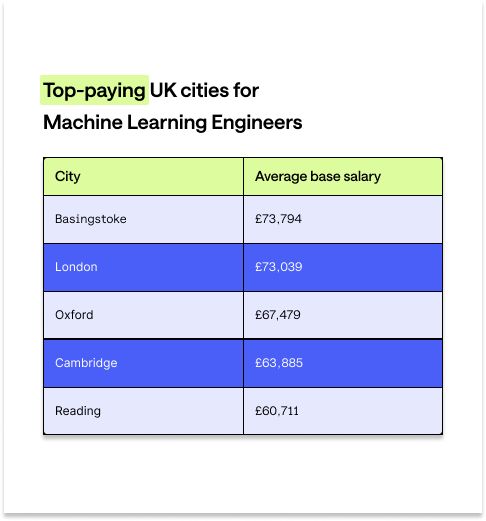
According to Indeed, the five highest-paying cities for Machine Learning Engineers in the UK are:
- Basingstoke
- London
- Oxford
- Cambridge
- Reading
Here’s a breakdown of the UK's top-paying cities for Machine Learning Engineers.
Machine Learning Engineer Job Requirements
Depending on the role, Machine Learning Engineers might need specific qualifications — a degree (or equivalent) qualification in computer science or statistics, for example. Still, many positions offer on-the-job training and development so that you can work towards a relevant qualification in the role.

A typical Machine Learning Engineer may have a background in programming, computer science, data science or another related field. Without this work experience, entry-level professionals should demonstrate a commitment to learning relevant skills.
To become a Machine Learning Engineer, you should have or be willing to develop the following skills:
- Mathematical understanding: Statistics, linear algebra and probability are critical in machine learning.
- Programming languages: You can use programming languages like Python, SQL (Structured Query Language) and Java for statistical analysis.
- Machine learning fundamentals: You can train accurate models using machine learning approaches and algorithms.
- Data analysis basics: You understand how to gather, clean, and organise raw data. You also have data visualisation skills.
- Business acumen: You know and use the entire machine learning process to meet business needs. You also use AI to drive business value and enhance your daily workflows.
Developing machine learning and AI skills in 2024
University can help you develop machine learning and AI skills. If you follow this path, you must choose a relevant degree or postgraduate qualification. Something like data science, computer science, or engineering would work. But this route is expensive — tuition fees alone cost up to £9,250 yearly.
Online learning through platforms like Coursera is another way to learn ML skills. This avenue offers flexibility around your existing commitments. But you may have to complete the work in your spare time. Plus, many online learning platforms don't provide accredited and industry-recognised qualifications. As such, you might stand out less in a competitive job market.
A professional apprenticeship with Multiverse, on the other hand, offers you the best of both worlds. You'll achieve an industry-recognised qualification. Then, depending on the programme, you can earn a degree equivalent. You'll also experience flexibility: learning in-demand skills through on-the-job training that fits around your work schedule.
These programmes can help you achieve your upskilling career goals, too. If you're already in a relevant role — say working as a Data Analyst — you can hone the skills needed to advance into machine learning. To top it off, apprenticeships are tuition-free. Not only will you save money, you'll make money by earning a salary as you learn.
Get paid to future-proof your career with Multiverse
Experts predict the market volume of the machine learning industry will grow from £126.30bn to £371.50bn by 2030. Those numbers suggest you could access more career opportunities — if you have the skills to meet future industry demand.
That said, specialists with machine learning skills are already in demand and well-compensated compared to most other professions. Long story short? There's never been a better time to future-proof your career by honing machine learning and AI skills.
A Multiverse apprenticeship programme is a tuition-free way for you to get started. As a Multiverse apprentice, you'll automatically gain access to the AI Jumpstart module — regardless of your programme.
The module caters to everyone. So, no matter where you are in your career, you'll learn foundational and future skills to stay ahead of the ever-changing digital landscape. And what's more, you'll get paid to do so.
Start or advance your machine learning career by completing our fast and simple application.